• 文献检索
  • 文档翻译
  • 深度研究
  • 学术资讯
  • Suppr Zotero 插件Zotero 插件
  • 邀请有礼
  • 套餐&价格
  • 历史记录
应用&插件
Suppr Zotero 插件Zotero 插件浏览器插件Mac 客户端Windows 客户端微信小程序
定价
高级版会员购买积分包购买API积分包
服务
文献检索文档翻译深度研究API 文档MCP 服务
关于我们
关于 Suppr公司介绍联系我们用户协议隐私条款
关注我们

Suppr 超能文献

核心技术专利:CN118964589B侵权必究
粤ICP备2023148730 号-1Suppr @ 2026

文献检索

告别复杂PubMed语法,用中文像聊天一样搜索,搜遍4000万医学文献。AI智能推荐,让科研检索更轻松。

立即免费搜索

文件翻译

保留排版,准确专业,支持PDF/Word/PPT等文件格式,支持 12+语言互译。

免费翻译文档

深度研究

AI帮你快速写综述,25分钟生成高质量综述,智能提取关键信息,辅助科研写作。

立即免费体验

关于美国男同性恋者、双性恋者及其他与男性发生性行为的男性中艾滋病毒流行病学、传播动态及其与预防和风险行为的关联的详细知识。

Detailed Knowledge About HIV Epidemiology and Transmission Dynamics and Their Associations With Preventive and Risk Behaviors Among Gay, Bisexual, and Other Men Who Have Sex With Men in the United States.

作者信息

Sharma Akshay, Sullivan Stephen P, Stephenson Rob B

机构信息

Center for Sexuality and Health Disparities, Department of Health Behavior and Biological Sciences, University of Michigan School of Nursing, Ann Arbor, MI, United States.

出版信息

JMIR Public Health Surveill. 2017 Mar 6;3(1):e11. doi: 10.2196/publichealth.7255.

DOI:10.2196/publichealth.7255
PMID:28264795
原文链接:https://pmc.ncbi.nlm.nih.gov/articles/PMC5359415/
Abstract

BACKGROUND

Gay, bisexual, and other men who have sex with men (GBMSM) in the United States remain disproportionately affected by human immunodeficiency virus (HIV). Yet their testing frequency is suboptimal and condomless anal sex (CAS) is increasing. Behavioral theories posit that information about HIV is a pivotal construct in individual risk reduction. However, measurements of knowledge have traditionally focused on ever hearing about HIV and being aware of the most common routes of spread.

OBJECTIVE

Using a national Web-based sample of sexually active GBMSM, we sought to (1) quantify levels of detailed knowledge about HIV epidemiology and transmission dynamics, (2) describe variations in detailed knowledge levels across demographic strata, and (3) evaluate potential associations of increasing levels of detailed knowledge with HIV testing in the past year and engaging in CAS with a male partner in the past 3 months.

METHODS

GBMSM were recruited through a social networking website (Facebook) from August to September 2015 and asked 17 knowledge-based questions pertaining to the following 2 domains using a Web-based survey: HIV epidemiology (9 questions including statistics on incidence, prevalence, and distribution) and HIV transmission dynamics (8 questions including modes of spread and per-act transmission probabilities). Ordinal domain-specific indices of detailed knowledge were created for each respondent by summing their number of correct responses. Separate cumulative logit models were used to identify factors independently associated with each index, and multivariable logistic regression models were used to characterize associations with HIV testing history and recently engaging in CAS.

RESULTS

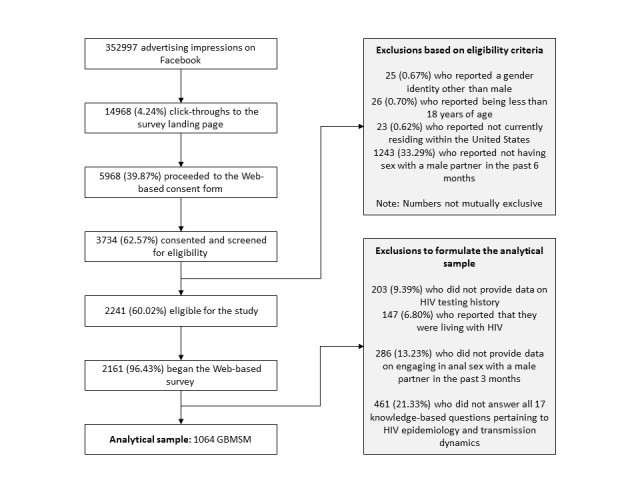
Of the 1064 participants in our study, only half (49.62%, 528/1064) had been tested for HIV in the past year, and almost half (47.84%, 509/1064) had engaged in CAS with a male partner in the past 3 months. Majority scored 3 of 9 epidemiology questions correct (26.88%, 286/1064) and 5 of 8 transmission dynamics questions correct (25.00%, 266/1064). Participants younger than 35 years, of non-Hispanic non-white or Hispanic race and ethnicity, with lower educational levels, and who reported a sexual orientation other than homosexual or gay were significantly less knowledgeable about HIV transmission dynamics. Increasing levels of knowledge about this domain were independently associated with testing in the past year (adjusted odds ratio for each additional correct response: 1.10, 95% CI 1.01-1.20) but not with recent CAS. Increasing knowledge about HIV epidemiology was not associated with either outcome.

CONCLUSIONS

Increasing detailed knowledge about HIV epidemiology might not be as important as educating sexually active GBMSM regarding transmission dynamics. Researchers and practitioners designing prevention messages targeting GBMSM should bear in mind that not all knowledge is equal and that some aspects might have a greater positive impact than others. Future research to identify influential content and contemporary modes of delivery is needed.

摘要

背景

美国男同性恋、双性恋及其他与男性发生性行为的男性(GBMSM)受人类免疫缺陷病毒(HIV)影响的比例仍然过高。然而,他们的检测频率并不理想,无保护肛交(CAS)的情况正在增加。行为理论认为,关于HIV的信息是个体降低风险的关键因素。然而,传统上对知识的衡量主要集中在是否听说过HIV以及是否了解最常见的传播途径。

目的

通过全国性的基于网络的性活跃GBMSM样本,我们试图(1)量化关于HIV流行病学和传播动态的详细知识水平,(2)描述不同人口统计学阶层详细知识水平的差异,以及(3)评估过去一年中详细知识水平的提高与HIV检测以及过去3个月与男性伴侣进行CAS之间的潜在关联。

方法

2015年8月至9月通过社交网站(Facebook)招募GBMSM,并使用基于网络的调查询问他们17个与以下两个领域相关的基于知识的问题:HIV流行病学(9个问题,包括发病率、患病率和分布的统计数据)和HIV传播动态(8个问题,包括传播方式和每次行为的传播概率)。通过将每个受访者的正确回答数量相加,为每个受访者创建特定领域的详细知识序数指数。使用单独的累积logit模型来识别与每个指数独立相关的因素,并使用多变量逻辑回归模型来描述与HIV检测历史和最近进行CAS之间的关联。

结果

在我们研究的1064名参与者中,只有一半(49.62%,528/1064)在过去一年中进行过HIV检测,近一半(47.84%,509/1064)在过去3个月中与男性伴侣进行过CAS。大多数人在9个流行病学问题中答对3个(26.88%,286/1064),在8个传播动态问题中答对5个(25.00%,266/1064)。年龄小于35岁、非西班牙裔非白人或西班牙裔种族和族裔、教育水平较低以及报告性取向不是同性恋或男同性恋的参与者对HIV传播动态的了解明显较少。关于该领域知识水平的提高与过去一年的检测独立相关(每增加一个正确回答的调整优势比:1.10,95%CI 1.01-1.20),但与最近的CAS无关。关于HIV流行病学知识的增加与这两个结果均无关。

结论

增加关于HIV流行病学的详细知识可能不如对性活跃的GBMSM进行关于传播动态的教育重要。设计针对GBMSM的预防信息的研究人员和从业者应牢记,并非所有知识都是平等的,某些方面可能比其他方面有更大的积极影响。需要未来的研究来确定有影响力的内容和当代的传播方式。
https://cdn.ncbi.nlm.nih.gov/pmc/blobs/e31f/5359415/117abf1181eb/publichealth_v3i1e11_fig1.jpg

相似文献

1
Detailed Knowledge About HIV Epidemiology and Transmission Dynamics and Their Associations With Preventive and Risk Behaviors Among Gay, Bisexual, and Other Men Who Have Sex With Men in the United States.关于美国男同性恋者、双性恋者及其他与男性发生性行为的男性中艾滋病毒流行病学、传播动态及其与预防和风险行为的关联的详细知识。
JMIR Public Health Surveill. 2017 Mar 6;3(1):e11. doi: 10.2196/publichealth.7255.
2
Birth Cohort Variations Across Functional Knowledge of HIV Prevention Strategies, Perceived Risk, and HIV-Associated Behaviors Among Gay, Bisexual, and Other Men Who Have Sex With Men in the United States.美国男同性恋、双性恋和其他与男性发生性关系的男性在艾滋病毒预防策略的功能知识、感知风险和与艾滋病毒相关行为方面的出生队列差异。
Am J Mens Health. 2018 Nov;12(6):1824-1834. doi: 10.1177/1557988318790875. Epub 2018 Jul 27.
3
Behavioral interventions to reduce risk for sexual transmission of HIV among men who have sex with men.降低男男性行为者中艾滋病毒性传播风险的行为干预措施。
Cochrane Database Syst Rev. 2008 Jul 16(3):CD001230. doi: 10.1002/14651858.CD001230.pub2.
4
Sexual behaviour, STI and HIV testing and testing need among gay, bisexual and other men who have sex with men recruited for online surveys pre/post-COVID-19 restrictions in the UK.在英国,对在线调查中招募的男同性恋、双性恋和其他与男性发生性关系的男性进行性行为、性传播感染和艾滋病毒检测以及检测需求的研究。
Sex Transm Infect. 2023 Nov;99(7):467-473. doi: 10.1136/sextrans-2022-055689. Epub 2023 Mar 1.
5
Developing a Video-Based eHealth Intervention for HIV-Positive Gay, Bisexual, and Other Men Who Have Sex with Men: Study Protocol for a Randomized Controlled Trial.为艾滋病毒呈阳性的男同性恋者、双性恋者及其他男男性行为者开发基于视频的电子健康干预措施:一项随机对照试验的研究方案
JMIR Res Protoc. 2016 Jun 17;5(2):e125. doi: 10.2196/resprot.5554.
6
HIV Testing Among Gay, Bisexual, and Other Men Who Have Sex with Men During the COVID-19 Pandemic in China: Implications for Promoting HIV Self-Testing Among Key Populations.中国 COVID-19 大流行期间男同性恋者、双性恋者和其他与男性发生性关系者中的 HIV 检测:对重点人群中推广 HIV 自我检测的启示。
AIDS Patient Care STDS. 2022 Dec;36(12):451-457. doi: 10.1089/apc.2022.0184. Epub 2022 Nov 17.
7
Correlates of Never Testing for HIV Among Sexually Active Internet-Recruited Gay, Bisexual, and Other Men Who Have Sex with Men in the United States.美国性活跃的互联网招募的男同性恋者、双性恋者和其他与男性发生性关系者中从未进行 HIV 检测的相关因素。
AIDS Patient Care STDS. 2018 Jan;32(1):9-15. doi: 10.1089/apc.2017.0244. Epub 2017 Dec 12.
8
Population Size Estimation of Gay and Bisexual Men and Other Men Who Have Sex With Men Using Social Media-Based Platforms.利用基于社交媒体的平台对男同性恋者、双性恋男性及其他与男性发生性行为的男性进行人口规模估计。
JMIR Public Health Surveill. 2018 Feb 8;4(1):e15. doi: 10.2196/publichealth.9321.
9
Factors associated with perceived accuracy of the Undetectable = Untransmittable slogan among men who have sex with men: Implications for messaging scale-up and implementation.与男男性行为者对“检测不到=无法传播”口号的感知准确性相关的因素:对信息传递扩大规模和实施的意义。
J Int AIDS Soc. 2018 Jan;21(1). doi: 10.1002/jia2.25055.
10
Extent and selectivity of sexual orientation disclosure and its association with HIV and other STI testing patterns among gay, bisexual and other men who have sex with men.男同性恋、双性恋和其他与男性发生性关系的男性的性取向披露的范围和选择性及其与 HIV 和其他性传播感染检测模式的关联。
Sex Transm Infect. 2019 Jun;95(4):273-278. doi: 10.1136/sextrans-2018-053866. Epub 2019 Mar 27.

引用本文的文献

1
After the program ends: HIV testing behavior among men who have sex when men after the conclusion of a program providing regular home delivery of HIV self-testing kits.项目结束后:在一个提供定期上门发放艾滋病毒自检试剂盒的项目结束后,男男性行为者中的艾滋病毒检测行为。
BMC Infect Dis. 2025 Apr 3;25(1):462. doi: 10.1186/s12879-025-10784-y.
2
Study Evaluating Self-Collected Specimen Return for HIV, Bacterial STI, and Potential Pre-Exposure Prophylaxis Adherence Testing Among Sexual Minority Men in the United States.研究评估在美国的性少数群体男性中进行自我采集标本返还用于 HIV、细菌性性传播感染和潜在的暴露前预防依从性检测。
Am J Mens Health. 2022 Jul-Aug;16(4):15579883221115591. doi: 10.1177/15579883221115591.
3

本文引用的文献

1
Impact of the Centers for Disease Control's HIV Preexposure Prophylaxis Guidelines for Men Who Have Sex With Men in the United States.美国疾病控制中心针对男男性行为者的HIV暴露前预防指南的影响
J Infect Dis. 2016 Dec 15;214(12):1800-1807. doi: 10.1093/infdis/jiw223. Epub 2016 Jul 14.
2
Trends in Racial and Ethnic Disparities in Antiretroviral Therapy Prescription and Viral Suppression in the United States, 2009-2013.2009 - 2013年美国抗逆转录病毒疗法处方及病毒抑制方面的种族和族裔差异趋势
J Acquir Immune Defic Syndr. 2016 Dec 1;73(4):446-453. doi: 10.1097/QAI.0000000000001125.
3
Rates of Prevalent HIV Infection, Prevalent Diagnoses, and New Diagnoses Among Men Who Have Sex With Men in US States, Metropolitan Statistical Areas, and Counties, 2012-2013.
Awareness, Utilization, and Preferences for Traditional and Contemporary HIV Prevention Strategies Among Facebook and Instagram-Using MSM in the United States.
美国使用 Facebook 和 Instagram 的男男性行为者对传统和当代 HIV 预防策略的认知、使用和偏好。
J Int Assoc Provid AIDS Care. 2021 Jan-Dec;20:23259582211024770. doi: 10.1177/23259582211024770.
4
Characteristics of gay and bisexual men who rarely use HIV risk reduction strategies during condomless anal intercourse: Results from the FLUX national online cohort study.在无保护肛交期间很少使用艾滋病毒减少风险策略的男同性恋和双性恋男性的特征:来自 FLUX 全国在线队列研究的结果。
PLoS One. 2020 Jun 1;15(6):e0233922. doi: 10.1371/journal.pone.0233922. eCollection 2020.
5
HIV Testing and Risks of Sexual Behavior among HIV-Negative Men Who Have Sex with Men in Ningbo, China.中国宁波 HIV 阴性男男性行为者的 HIV 检测与性行为风险。
Int J Environ Res Public Health. 2020 Feb 19;17(4):1322. doi: 10.3390/ijerph17041322.
6
Acceptability and Feasibility of Self-Collecting Biological Specimens for HIV, Sexually Transmitted Infection, and Adherence Testing Among High-Risk Populations (Project Caboodle!): Protocol for an Exploratory Mixed-Methods Study.高危人群中自我采集用于艾滋病毒、性传播感染及依从性检测的生物样本的可接受性与可行性(卡布oodle项目!):一项探索性混合方法研究的方案
JMIR Res Protoc. 2019 May 2;8(5):e13647. doi: 10.2196/13647.
7
Birth Cohort Variations Across Functional Knowledge of HIV Prevention Strategies, Perceived Risk, and HIV-Associated Behaviors Among Gay, Bisexual, and Other Men Who Have Sex With Men in the United States.美国男同性恋、双性恋和其他与男性发生性关系的男性在艾滋病毒预防策略的功能知识、感知风险和与艾滋病毒相关行为方面的出生队列差异。
Am J Mens Health. 2018 Nov;12(6):1824-1834. doi: 10.1177/1557988318790875. Epub 2018 Jul 27.
8
HIV Prioritization and Risk Perception Among an Online Sample of Men Who Have Sex With Men in the United States.美国男男性行为者在线样本中的HIV优先级与风险认知
Am J Mens Health. 2018 Jul;12(4):676-687. doi: 10.1177/1557988318776581. Epub 2018 May 21.
9
Knowledge, Normative Beliefs and Attitudes Related to Recent HIV Infection among People who Inject Drugs in Athens, Greece.希腊雅典注射吸毒者中与近期艾滋病毒感染相关的知识、规范信念和态度
Curr HIV Res. 2017;15(6):386-395. doi: 10.2174/1570162X15666171122165636.
2012-2013 年美国各州、都会统计区和各县男男性行为者中现患 HIV 感染率、现患诊断率和新诊断率。
JMIR Public Health Surveill. 2016 May 17;2(1):e22. doi: 10.2196/publichealth.5684.
4
Estimating per-act HIV transmission risk: a systematic review.估计单次行为的HIV传播风险:一项系统评价。
AIDS. 2014 Jun 19;28(10):1509-19. doi: 10.1097/QAD.0000000000000298.
5
Acceptability and intended usage preferences for six HIV testing options among internet-using men who have sex with men.在使用互联网的男男性行为者中,六种HIV检测方式的可接受性及预期使用偏好。
Springerplus. 2014 Feb 24;3:109. doi: 10.1186/2193-1801-3-109. eCollection 2014.
6
HIV testing and risk behaviors among gay, bisexual, and other men who have sex with men - United States.男同性恋者、双性恋者和其他与男性发生性关系的男性中的艾滋病毒检测和风险行为 - 美国。
MMWR Morb Mortal Wkly Rep. 2013 Nov 29;62(47):958-62.
7
Accessing sexual health information online: use, motivations and consequences for youth with different sexual orientations.在线获取性健康信息:不同性取向青少年的使用情况、动机及后果
Health Educ Res. 2014 Feb;29(1):147-57. doi: 10.1093/her/cyt071. Epub 2013 Jul 16.
8
HIV treatment as prevention and HPTN 052.HIV 治疗即预防和 HPTN 052。
Curr Opin HIV AIDS. 2012 Mar;7(2):99-105. doi: 10.1097/COH.0b013e32834f5cf2.
9
Prevention of HIV-1 infection with early antiretroviral therapy.早期抗逆转录病毒疗法预防 HIV-1 感染。
N Engl J Med. 2011 Aug 11;365(6):493-505. doi: 10.1056/NEJMoa1105243. Epub 2011 Jul 18.
10
Bias in online recruitment and retention of racial and ethnic minority men who have sex with men.在线招募和留住男男性行为的少数族裔男性过程中的偏差。
J Med Internet Res. 2011 May 13;13(2):e38. doi: 10.2196/jmir.1797.