Audiger Cindy, Rahman M Jubayer, Yun Tae Jin, Tarbell Kristin V, Lesage Sylvie
Department of Immunology-Oncology, Maisonneuve-Rosemont Hospital, Montreal, Quebec H1T 2M4, Canada.
Département de Microbiologie, Infectiologie et Immunologie, Université de Montréal, Montreal, Quebec H3C 3J7, Canada.
J Immunol. 2017 Mar 15;198(6):2223-2231. doi: 10.4049/jimmunol.1601629.
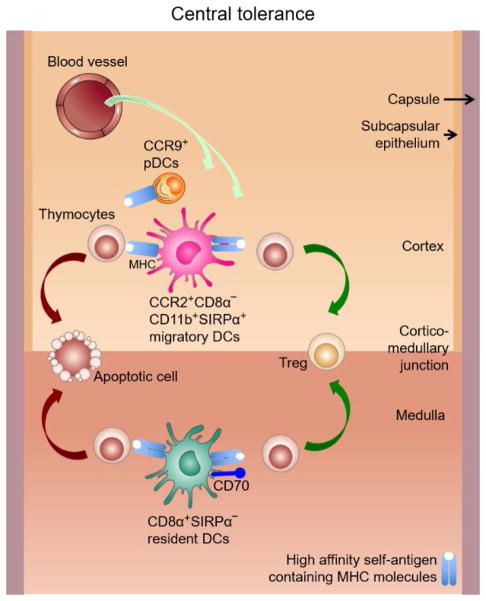
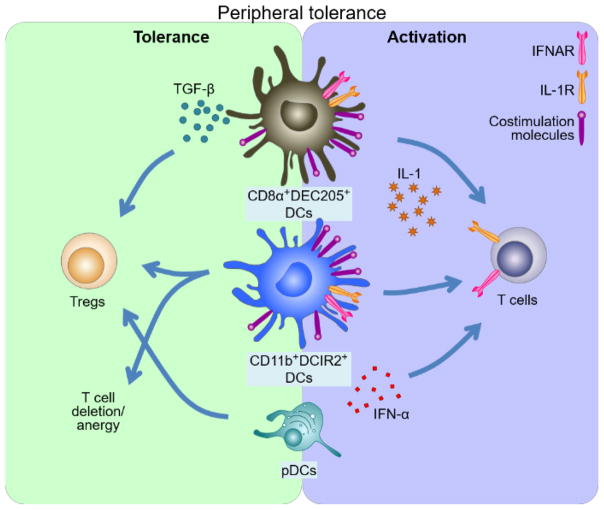
Immune tolerance is necessary to prevent the immune system from reacting against self, and thus to avoid the development of autoimmune diseases. In this review, we discuss key findings that position dendritic cells (DCs) as critical modulators of both thymic and peripheral immune tolerance. Although DCs are important for inducing both immunity and tolerance, increased autoimmunity associated with decreased DCs suggests their nonredundant role in tolerance induction. DC-mediated T cell immune tolerance is an active process that is influenced by genetic variants, environmental signals, as well as the nature of the specific DC subset presenting Ag to T cells. Answering the many open questions with regard to the role of DCs in immune tolerance could lead to the development of novel therapies for the prevention of autoimmune diseases.
免疫耐受对于防止免疫系统对自身产生反应从而避免自身免疫性疾病的发生是必要的。在这篇综述中,我们讨论了一些关键发现,这些发现将树突状细胞(DC)定位为胸腺和外周免疫耐受的关键调节因子。尽管DC对于诱导免疫和耐受都很重要,但与DC数量减少相关的自身免疫性增加表明它们在耐受诱导中具有不可替代的作用。DC介导的T细胞免疫耐受是一个活跃的过程,受到基因变异、环境信号以及向T细胞呈递抗原的特定DC亚群性质的影响。回答关于DC在免疫耐受中作用的诸多未决问题可能会推动预防自身免疫性疾病新疗法的开发。