Langguth Berthold, Landgrebe Michael, Schlee Winfried, Schecklmann Martin, Vielsmeier Veronika, Steffens Thomas, Staudinger Susanne, Frick Hannah, Frick Ulrich
Department of Psychiatry and Psychotherapy, University of Regensburg, Regensburg, Germany; Interdisciplinary Tinnitus Center of the University of Regensburg, Regensburg, Germany.
Department of Psychiatry and Psychotherapy, University of Regensburg, Regensburg, Germany; kbo Lech-Mangfall-Klinik Agatharied, Hausham, Germany.
Front Neurol. 2017 Feb 20;8:46. doi: 10.3389/fneur.2017.00046. eCollection 2017.
The heterogeneity of tinnitus is a major challenge for tinnitus research. Even if a complex interaction of many factors is involved in the etiology of tinnitus, hearing loss (HL) has been identified as the most relevant etiologic factor. Here, we used a data-driven approach to identify patterns of hearing function in a large sample of tinnitus patients presenting in a tinnitus clinic.
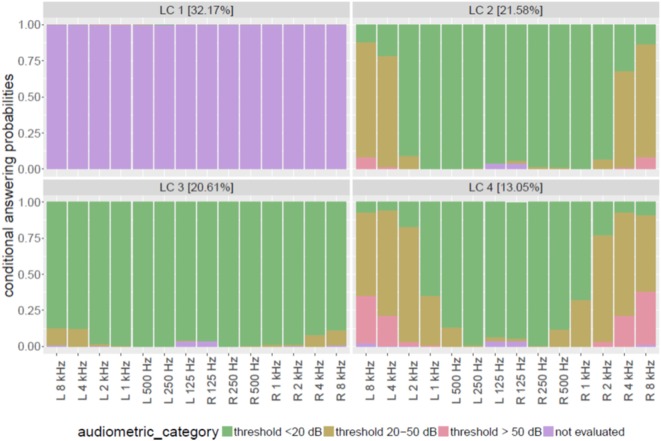
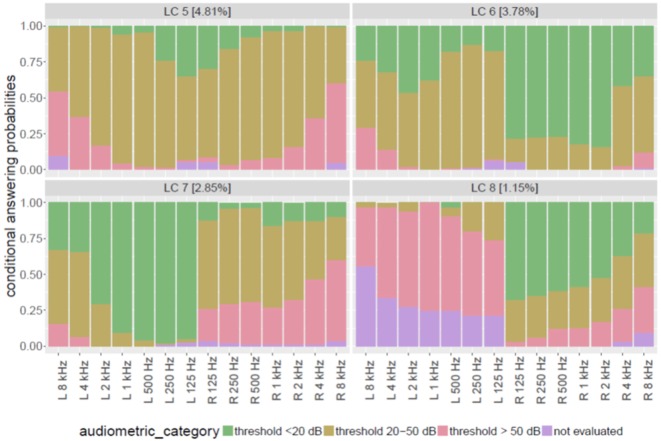
Data from 2,838 patients presenting at the Tinnitus Center of the University Regensburg between 2007 and 2014 have been analyzed. Standard audiometric data were frequency-wise categorized in four categories [a: normal hearing (0-20 dB HL); b: moderate HL (25-50 dB HL; representing outer hair cell loss); c: severe HL (>50 dB HL; representing outer and inner hair cell loss); d: no data available] and entered in a latent class analysis, a statistical method to find subtypes of cases in multivariate categorical data. To validate the clinical relevance of the identified latent classes, they were compared with respect to clinical and demographic characteristics of their members.
The classification algorithm identified eight distinct latent classes with an excellent separation. Patient classes differed with respect to demographic (e.g., age, gender) and clinical characteristics (e.g., tinnitus location, tinnitus severity, gradual, or abrupt onset, etc.).
Our results demonstrate that data-driven categorization of hearing function seems to be a promising approach for profiling tinnitus patients, as it revealed distinct subtypes that reflect prototypic forms of HL and that differ in several relevant clinical characteristics.
耳鸣的异质性是耳鸣研究的一项重大挑战。即便耳鸣病因涉及多种因素的复杂相互作用,但听力损失(HL)已被确定为最相关的病因。在此,我们采用数据驱动方法,在耳鸣诊所就诊的大量耳鸣患者样本中识别听力功能模式。
分析了2007年至2014年间在雷根斯堡大学耳鸣中心就诊的2838例患者的数据。标准听力测定数据按频率分为四类[a:听力正常(0 - 20 dB HL);b:中度HL(25 - 50 dB HL;代表外毛细胞损失);c:重度HL(>50 dB HL;代表外毛细胞和内毛细胞损失);d:无可用数据],并进行潜在类别分析,这是一种在多变量分类数据中寻找病例亚型的统计方法。为验证所识别潜在类别的临床相关性,就其成员的临床和人口统计学特征对它们进行了比较。
分类算法识别出八个明显不同的潜在类别,区分度极佳。患者类别在人口统计学(如年龄、性别)和临床特征(如耳鸣位置、耳鸣严重程度、渐进性或突发性发作等)方面存在差异。
我们的结果表明,数据驱动的听力功能分类似乎是一种对耳鸣患者进行特征分析的有前景的方法,因为它揭示了不同的亚型,这些亚型反映了HL的典型形式,且在几个相关临床特征方面存在差异。