Babaei Azadeh, Ranglová Karolína, Malapascua Jose R, Masojídek Jiří
Laboratory of Algal Biotechnology, Centre ALGATECH, Institute of Microbiology, CZ-37981, Třeboň, Czech Republic.
Faculty of Science, University of South Bohemia, CZ-37005, České Budějovice, Czech Republic.
AMB Express. 2017 Dec;7(1):56. doi: 10.1186/s13568-017-0348-7. Epub 2017 Mar 7.
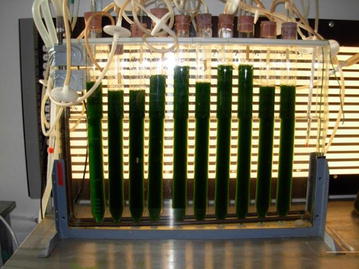
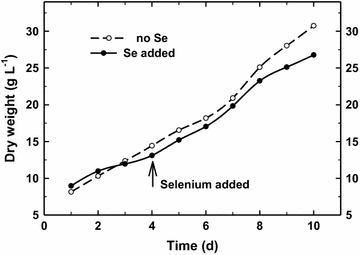
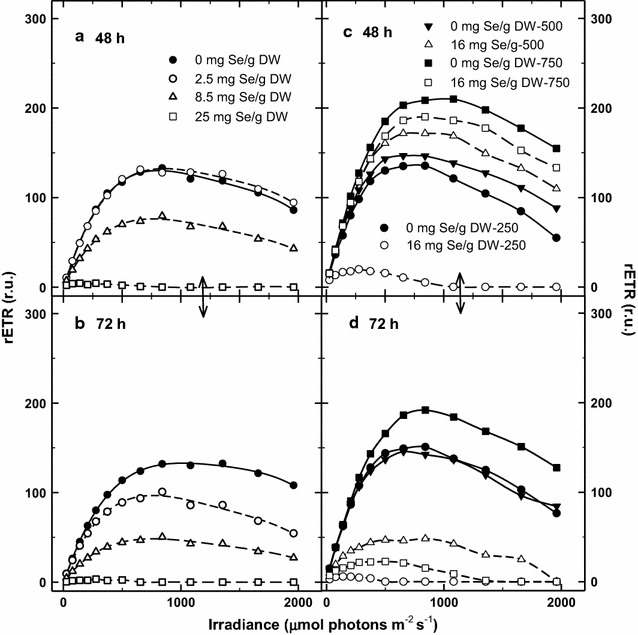
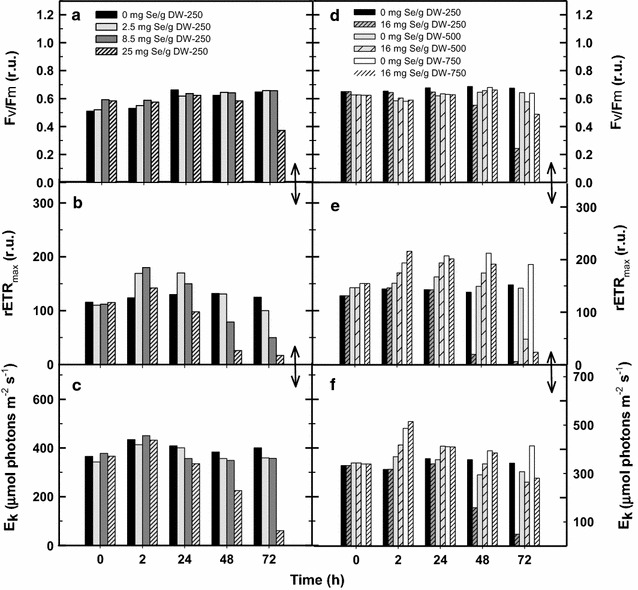
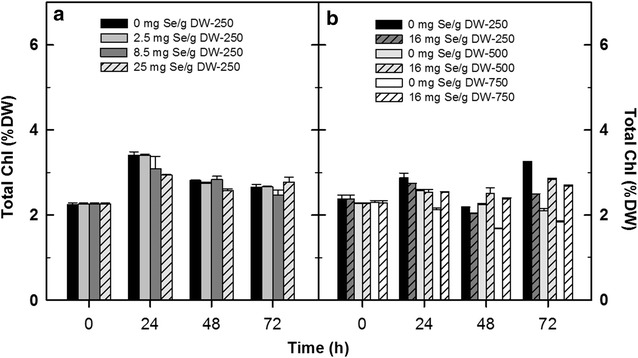
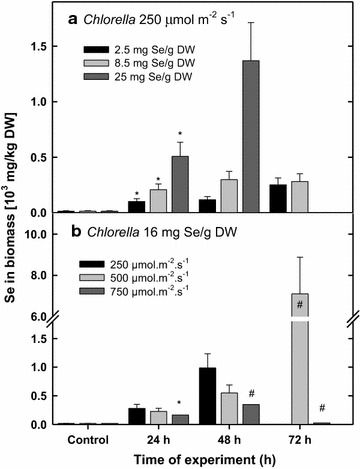
Microalgae are able to metabolize inorganic selenium (Se) to organic forms (e.g. Se-proteins); nevertheless at certain Se concentration culture growth is inhibited. The aim of this work was to confirm the hypothesis that the limit of Se tolerance in Chlorella cultures is related to photosynthetic performance, i.e. depends on light intensity. We studied the relation between the dose and irradiance to find the range of Se tolerance in laboratory and outdoor cultures. At low irradiance (250 µmol photons m s), the daily dose of Se below 8.5 mg per g of biomass (<20 µM) partially stimulated the photosynthetic activity (relative electron transport rate) and growth of Chlorella cultures (biomass density of 1.5 g DW L) compared to the control (no Se added). It was accompanied by substantial Se incorporation to microalgae biomass (0.5 mg Se g DW). When the Se daily dose and level of irradiance were doubled (16 mg Se g DW; 500 µmol photons m s), the photosynthetic activity and growth were stimulated for several days and ample incorporation of Se to biomass (7.1 mg g DW) was observed. Yet, the same Se daily dose under increased irradiance (750 µmol photons m s) caused the synergistic effect manifested by significant inhibition of photosynthesis, growth and lowered Se incorporation to biomass. In the present experiments Chl fluorescence techniques were used to monitor photosynthetic activity for determination of optimal Se doses in order to achieve efficient incorporation without substantial inhibition of microalgae growth when producing Se-enriched biomass.
微藻能够将无机硒(Se)代谢为有机形式(如硒蛋白);然而,在一定的硒浓度下,培养生长会受到抑制。这项工作的目的是证实以下假设:小球藻培养物中硒耐受极限与光合性能有关,即取决于光照强度。我们研究了剂量与辐照度之间的关系,以确定实验室和室外培养物中硒的耐受范围。在低辐照度(250 μmol光子·m⁻²·s⁻¹)下,与对照(不添加硒)相比,每天每克生物量低于8.5毫克(<20 μM)的硒剂量部分刺激了小球藻培养物的光合活性(相对电子传递速率)和生长(生物量密度约为1.5克干重·升⁻¹)。这伴随着大量的硒掺入微藻生物量中(约0.5毫克硒·克干重)。当硒的每日剂量和辐照度水平加倍时(16毫克硒·克干重;500 μmol光子·m⁻²·s⁻¹),光合活性和生长在几天内受到刺激,并且观察到大量的硒掺入生物量中(7.1毫克·克干重)。然而,在增加的辐照度(750 μmol光子·m⁻²·s⁻¹)下相同的硒每日剂量导致了协同效应,表现为光合作用、生长的显著抑制以及生物量中硒掺入量的降低。在本实验中,使用叶绿素荧光技术监测光合活性以确定最佳硒剂量,以便在生产富硒生物量时实现有效掺入而不会对微藻生长产生实质性抑制。