PHENOMIN, Institut Clinique de la Souris (ICS), CNRS, INSERM, University of Strasbourg, 1 rue Laurent Fries, F-67404 Illkirch-Graffenstaden, France.
Institut de Génétique et de Biologie Moléculaire et Cellulaire, Illkirch, France.
Sci Rep. 2017 Mar 7;7:43331. doi: 10.1038/srep43331.
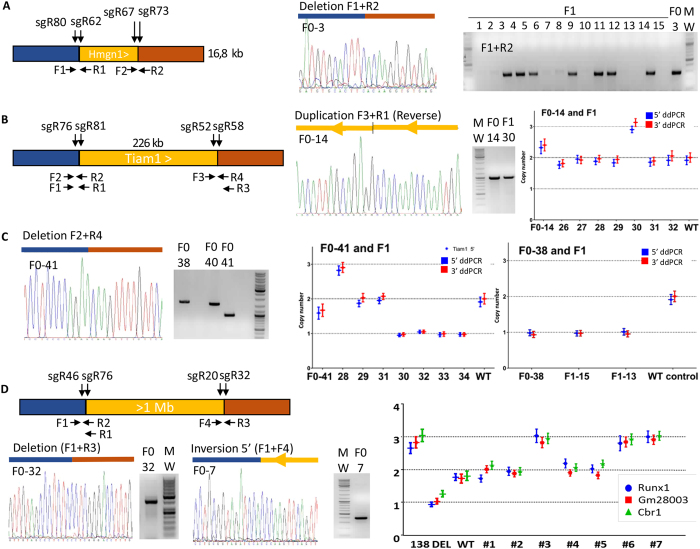
Modelling Down syndrome (DS) in mouse has been crucial for the understanding of the disease and the evaluation of therapeutic targets. Nevertheless, the modelling so far has been limited to the mouse and, even in this model, generating duplication of genomic regions has been labour intensive and time consuming. We developed the CRISpr MEdiated REarrangement (CRISMERE) strategy, which takes advantage of the CRISPR/Cas9 system, to generate most of the desired rearrangements from a single experiment at much lower expenses and in less than 9 months. Deletions, duplications, and inversions of genomic regions as large as 24.4 Mb in rat and mouse founders were observed and germ line transmission was confirmed for fragment as large as 3.6 Mb. Interestingly we have been able to recover duplicated regions from founders in which we only detected deletions. CRISMERE is even more powerful than anticipated it allows the scientific community to manipulate the rodent and probably other genomes in a fast and efficient manner which was not possible before.
在小鼠中建立唐氏综合征(DS)模型对于理解该疾病和评估治疗靶点至关重要。然而,迄今为止的建模仅限于小鼠,即使在这种模型中,基因组区域的重复也非常繁琐且耗时。我们开发了 CRISPr 介导的重排(CRISMERE)策略,该策略利用了 CRISPR/Cas9 系统,可以从单个实验中产生大部分所需的重排,费用更低,耗时不到 9 个月。在大鼠和小鼠的起始细胞中观察到了长达 24.4Mb 的基因组区域的缺失、重复和倒位,并且证实了长达 3.6Mb 的片段可以进行种系传递。有趣的是,我们已经能够从仅检测到缺失的起始细胞中回收重复区域。CRISMERE 比预期的更强大,它使科学界能够以前所未有的快速和高效的方式对啮齿动物甚至其他基因组进行操作。