Gallone Maria Serena, Gallone Maria Filomena, Larocca Angela Maria Vittoria, Germinario Cinzia, Tafuri Silvio
Department of Biomedical Science and Human Oncology, University of Bari Aldo Moro, Piazza Giulio Cesare 11, 70124, Bari, Italy.
Hygiene Unit, Bari Policlinico General Hospital, Bari, Italy.
BMC Infect Dis. 2017 Mar 7;17(1):199. doi: 10.1186/s12879-017-2295-y.
To support the evaluation of the 2010-15 National Plan for Measles and Congenital Rubella Elimination, the authors designed and performed a serosurveillance survey to verify the immunity/susceptibility rate against rubella among Apulian young adults.
The study was carried out from May 2011 to June 2012 in the Department of Transfusion Medicine/Blood Bank of Policlinico General Hospital in Bari. Subjects were enrolled by a convenience sampling. For each enrolled patient a 5 ml serum sample was collected and tested for anti-rubella IgG. The geometrical means (GMT) of anti-rubella IgG was calculated. T student test or ANOVA test, when appropriate, was used to compare the means of age per gender and GMT of anti-rubella IgG titres per age classes. Chi-square test was used to compare the proportion of anti-rubella IgG positive subjects per gender and per age classes. For all tests, a p value <0.05 was considered as significant.
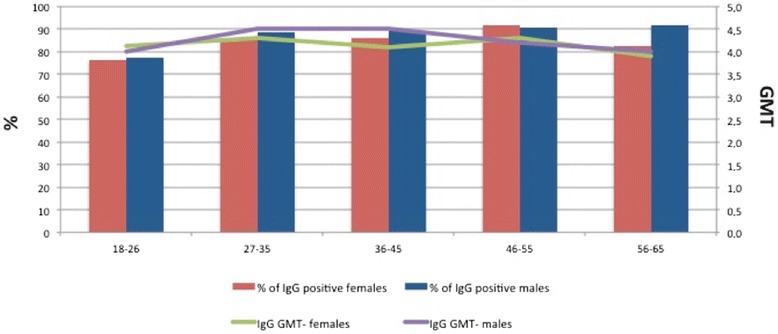
At the end of the study 1764 subjects were enrolled, 1362 (77.2%) of which were male. The mean age was 38.4 ± 11.7 years (range: 17-65). 86.7% (95% CI = 85.0-88.2) had a positive titre of anti-rubella IgG. GMT of anti-rubella IgG titre was 4.3. The proportion of positive subjects was of 76.8% (n = 279/363; 95% CI = 72.2-81.1) in persons aged 18-26 years; 88.1% (n = 310/352; 95% CI = 84.2-91.3) in 27-35 year-old people; 88.5% (n = 464/524; 95% CI = 85.5-91.1) in 36-45 year-old people; 90.7% (n = 350/386; 95% CI = 87.3-93.4) among people aged 46-55 years and 90.6% (n = 126/139; 95% CI = 84.5-94.9) in 55-65 year-old people (Chi-square = 39.7; p < 0.0001). GMT of anti-rubella IgG titre was 4.3 (4.3 in male and 4.2 in female, t = 2.2; p = 0.03) and seems to differ dividing the enrolled subjects by age group (F = 14.3; p < 0.0001).
According to our data, too many women of child-bearing age are still unprotected from rubella in the elimination era and in this scenario the public health efforts should be oriented to catch-up activities.
为支持对《2010 - 2015年消除麻疹和先天性风疹国家计划》的评估,作者设计并开展了一项血清学监测调查,以核实普利亚地区年轻成年人对风疹的免疫/易感性率。
该研究于2011年5月至2012年6月在巴里综合医院输血医学/血库进行。通过便利抽样招募受试者。为每位入选患者采集5毫升血清样本,并检测抗风疹IgG。计算抗风疹IgG的几何均值(GMT)。适当情况下,使用t检验或方差分析来比较不同性别的年龄均值以及不同年龄组的抗风疹IgG滴度GMT。使用卡方检验来比较不同性别和不同年龄组中抗风疹IgG阳性受试者的比例。所有检验中,p值<0.05被视为具有显著性。
研究结束时共招募了1764名受试者,其中1362名(77.2%)为男性。平均年龄为38.4±11.7岁(范围:17 - 65岁)。86.7%(95%置信区间=85.0 - 88.2)的抗风疹IgG滴度呈阳性。抗风疹IgG滴度的GMT为4.3。18 - 26岁人群中阳性受试者比例为76.8%(n = 279/363;95%置信区间=72.2 - 81.1);27 - 35岁人群中为88.1%(n = 310/352;95%置信区间=84.2 - 91.3);36 - 45岁人群中为88.5%(n = 464/524;95%置信区间=85.5 - 91.1);46 - 55岁人群中为90.7%(n = 350/386;95%置信区间=87.3 - 93.4);55 - 65岁人群中为90.6%(n = 126/139;95%置信区间=84.5 - 94.9)(卡方=39.7;p < 0.0001)。抗风疹IgG滴度的GMT为4.3(男性为4.3,女性为4.2,t = 2.2;p = 0.03),按年龄组划分入选受试者时似乎有所不同(F = 14.3;p < 0.0001)。
根据我们的数据,在消除风疹的时代,仍有太多育龄妇女未受到风疹的保护,在这种情况下,公共卫生工作应侧重于开展补种活动。