Castillo-Solórzano Carlos, Andrus Jon Kim
Pan American Health Organization Washington, DC 20037, USA.
Emerg Infect Dis. 2004 Nov;10(11):2017-21. doi: 10.3201/eid1011.040428.
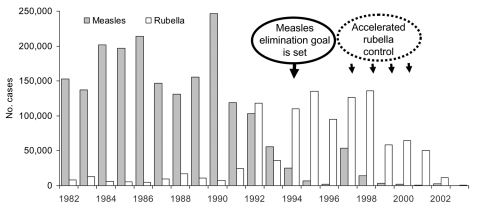
In the Americas, the Pan American Health Organization supports strategies for the appropriate control and elimination of vaccine-preventable diseases, especially if the strategies are designed to reduce health inequities, strengthen the political commitment for immunization services, and promote the culture of prevention. In September 2003, the 44th Directing Council of the Pan American Health Organization adopted a goal to eliminate rubella and congenital rubella syndrome by 2010. One of the main objectives of this initiative is improving women's health, consistent with achieving the Millennium Development Goals. An important component of rubella elimination is conducting vaccination campaigns for men and women of childbearing age to reduce rapidly the number of people susceptible to rubella infection. From 1998 to 2002, the English-speaking Caribbean, Chile, Costa Rica, Brazil, and Honduras conducted mass rubella vaccination campaigns aimed at adults. Vaccination coverage reached > 95% in each country with an exception of the Caribbean, where the coverage was 80%.
在美洲,泛美卫生组织支持采取战略,以适当控制和消除疫苗可预防疾病,特别是那些旨在减少健康不平等、加强免疫服务的政治承诺以及促进预防文化的战略。2003年9月,泛美卫生组织第44届指导委员会通过了到2010年消除风疹和先天性风疹综合征的目标。这一举措的主要目标之一是改善妇女健康,这与实现千年发展目标相一致。消除风疹的一个重要组成部分是为育龄男女开展疫苗接种运动,以迅速减少易感染风疹的人数。1998年至2002年期间,加勒比英语地区、智利、哥斯达黎加、巴西和洪都拉斯针对成年人开展了大规模风疹疫苗接种运动。除加勒比地区接种率为80%外,每个国家的疫苗接种覆盖率均达到95%以上。