Wang Wei Yan, Sun Yi, Zhao Wen Ting, Wu Tai, Wang Liang, Yuan Tian Ming, Yu Hui Min
Zhejiang University School of Medicine, Children's Hospital, Clinic of Neonates, Hangzhou, China.
J Clin Res Pediatr Endocrinol. 2017 Sep 1;9(3):194-201. doi: 10.4274/jcrpe.3934. Epub 2017 Mar 8.
Congenital hyperinsulinism (CHI) is a rare but severe cause of hypoglycemia. The present study investigates the clinical presentation, therapeutic outcomes and genetic mutations of CHI in Chinese individuals over the past 15 years.
The authors retrospectively reviewed one case in their department and 206 cases reported from January 2002 to October 2016 in China. PubMed, Ovid Medline, Springer and Wanfang Database, CBMD database, and CKNI database were the sources used to collect the data.
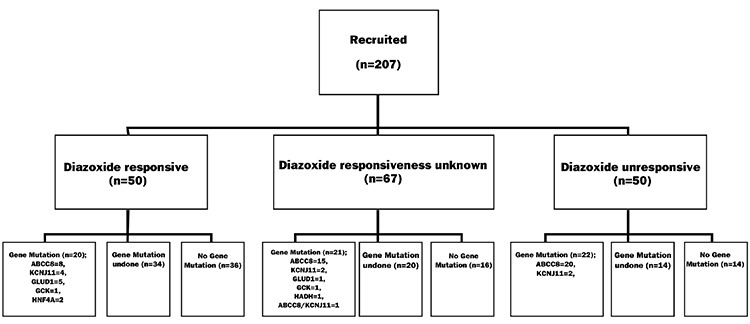
In total, 207 cases were recruited. Of these, the ages of 100 (48.3%) were within the 4th week after birth. Seventy-seven cases (37.2%) were born large for gestational age (LGA). Seizures occurred in 140 cases (67.6%). Among 140 cases (67.6%) who were administered diazoxide treatment, 90 (64.3%) were responsive. Seven cases (3.4%) received octreotide treatment and 19 cases (9.2%) underwent surgery. 63/129 cases (48.8%) were detected to have gene mutations, including ABCC8 (69.8%), KCNJ11 (12.7%), GLUD1, GCK, HADH, and HNF4A. Among the diazoxide-unresponsive cases, gene mutations were detected in 20/36 (55.6%) cases with ABCC8 and in 2 (5.6%) cases with KCNJ11. Among the diazoxide-responsive cases, gene mutations were detected in 8 patients with ABCC8, 4 with KCNJ11, 5 with GLUD1, and 1 with GCK.
The present study indicates that most CHI cases occurred in neonates and that 1/3 of the cases were born LGA. ABCC8 and KCNJ11 are the most common gene mutations. More than half of the diazoxide-unresponsive CHI detected mutations are in ABCC8 and KCNJ11 genes. The GLUD1 gene mutations cause diazoxide-responsive CHI. Identifying the gene mutations can assist in the diagnosis and treatment of CHI.
先天性高胰岛素血症(CHI)是一种罕见但严重的低血糖病因。本研究调查了过去15年中国人群中CHI的临床表现、治疗结果及基因突变情况。
作者回顾性分析了本部门的1例病例以及2002年1月至2016年10月中国报道的206例病例。通过PubMed、Ovid Medline、Springer以及万方数据库、中国生物医学文献数据库(CBMD)和中国知网数据库(CKNI)收集数据。
共纳入207例病例。其中,100例(48.3%)年龄在出生后第4周内。77例(37.2%)为大于胎龄儿(LGA)。140例(67.6%)出现惊厥。在接受二氮嗪治疗的140例(67.6%)病例中,90例(64.3%)有反应。7例(3.4%)接受了奥曲肽治疗,19例(9.2%)接受了手术。129例中有63例(48.8%)检测到基因突变,包括ABCC8(69.8%)、KCNJ11(12.7%)、GLUD1、GCK、HADH和HNF4A。在二氮嗪无反应的病例中,36例中有20例(55.6%)检测到ABCC8基因突变,2例(5.6%)检测到KCNJ11基因突变。在二氮嗪有反应的病例中,8例ABCC8、4例KCNJ11、5例GLUD1和1例GCK检测到基因突变。
本研究表明,大多数CHI病例发生在新生儿期,且1/3的病例为大于胎龄儿出生。ABCC8和KCNJ11是最常见的基因突变。超过一半的二氮嗪无反应性CHI检测到的突变存在于ABCC8和KCNJ11基因中。GLUD1基因突变导致二氮嗪反应性CHI。识别基因突变有助于CHI的诊断和治疗。