Romero-Aroca Pedro, Navarro-Gil Raul, Valls-Mateu Aida, Sagarra-Alamo Ramon, Moreno-Ribas Antonio, Soler Nuria
Ophthalmology Service, University Hospital Sant Joan, Reus, Spain.
Institut de Investigacio Sanitaria Pere Virgili (IISPV), Universitat Rovira and Virgili, Reus, Spain.
Br J Ophthalmol. 2017 Oct;101(10):1346-1351. doi: 10.1136/bjophthalmol-2016-310063. Epub 2017 Mar 7.
BACKGROUND/AIMS: To determine the incidence of any diabetic retinopathy (any-DR), sight-threatening diabetic retinopathy (STDR) and diabetic macular oedema (DMO) and their risk factors in type 1 diabetes mellitus (T1DM) over a screening programme.
Nine-year follow-up, prospective population-based study of 366 patients with T1DM and 15 030 with T2DM. Epidemiological risk factors were as follows: current age, age at DM diagnosis, sex, type of DM, duration of DM, arterial hypertension, levels of glycosylated haemoglobin (HbA), triglycerides, cholesterol fractions, serum creatinine, estimated glomerular filtration rate (eGFR) and urine albumin to creatinine ratio (UACR).
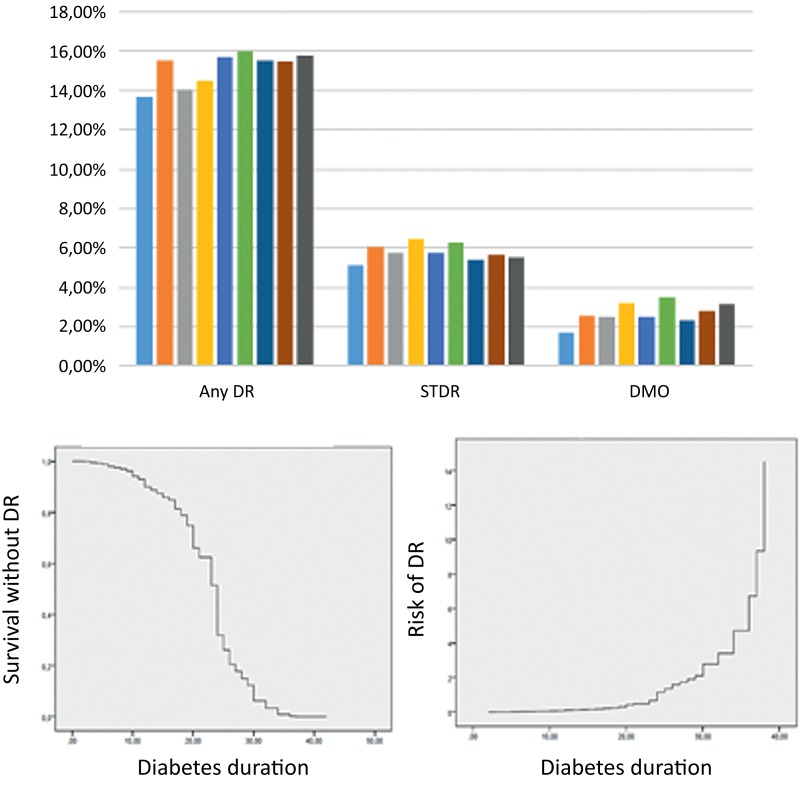
Sum incidence of any-DR was 47.26% with annual incidence 15.16±2.19% in T1DM, and 26.49% with annual incidence 8.13% in T2DM. Sum incidence of STDR was 18.03% with annual incidence 5.77±1.21% in T1DM, and 7.59% with annual incidence 2.64±0.15% in T2DM. Sum incidence of DMO was 8.46% with annual incidence 2.68±038% in patients with T1DM and 6.36% with annual incidence 2.19±0.18% in T2DM. Cox's survival analysis showed that current age and age at diagnosis were risk factors at p<0.001, as high HbA1c levels at p<0.001, LDL cholesterol was significant at p<0.001, eGFR was significant at p<0.001 and UACR at p=0.017.
The incidence of any-DR and STDR was higher in patients with T1DM than those with T2DM. Also, the 47.26% sum incidence of any-DR in patients with T1DM was higher than in a previous study (35.9%), which can be linked to poor metabolic control of DM. Our results suggest that physicians should be encouraged to pay greater attention to treatment protocols for T1DM in patients.
背景/目的:通过一项筛查计划,确定1型糖尿病(T1DM)患者中任何糖尿病视网膜病变(any-DR)、威胁视力的糖尿病视网膜病变(STDR)和糖尿病性黄斑水肿(DMO)的发生率及其危险因素。
对366例T1DM患者和15030例T2DM患者进行了为期9年的前瞻性人群研究。流行病学危险因素如下:当前年龄、糖尿病诊断时的年龄、性别、糖尿病类型、糖尿病病程、动脉高血压、糖化血红蛋白(HbA)水平、甘油三酯、胆固醇组分、血清肌酐、估计肾小球滤过率(eGFR)和尿白蛋白肌酐比值(UACR)。
T1DM患者中any-DR的总发生率为47.26%,年发生率为15.16±2.19%;T2DM患者中any-DR的总发生率为26.49%,年发生率为8.13%。T1DM患者中STDR的总发生率为18.03%,年发生率为5.77±1.21%;T2DM患者中STDR的总发生率为7.59%,年发生率为2.64±0.15%。T1DM患者中DMO的总发生率为8.46%,年发生率为2.68±0.38%;T2DM患者中DMO的总发生率为6.36%,年发生率为2.19±0.18%。Cox生存分析显示,当前年龄和诊断时的年龄是危险因素,p<0.001;高HbA1c水平是危险因素,p<0.001;低密度脂蛋白胆固醇是危险因素,p<0.001;eGFR是危险因素,p<0.001;UACR是危险因素,p=0.017。
T1DM患者中any-DR和STDR的发生率高于T2DM患者。此外,T1DM患者中any-DR的总发生率47.26%高于先前的研究(35.9%),这可能与糖尿病的代谢控制不佳有关。我们的结果表明,应鼓励医生更加关注T1DM患者的治疗方案。