Yakob Tagese, Abraham Awoke, Yakob Begidu, Menza Jaldo Mesfin
School of Public Health, College of Health Science and Medicine, Wolaita Sodo University, Sodo, Ethiopia
School of Public Health, College of Health Science and Medicine, Wolaita Sodo University, Sodo, Ethiopia.
BMJ Open. 2025 Jan 21;15(1):e090916. doi: 10.1136/bmjopen-2024-090916.
This study aimed to determine the incidence of diabetic retinopathy (DR) and predictors among adult patients with diabetes in central and southern Ethiopia.
A hospital-based retrospective cohort study was conducted.
The study was conducted in selected public hospitals in central and southern Ethiopia.
A total of 376 adult participants newly diagnosed with diabetes were enrolled from 2015 to 2023, and the follow-up date was from the date of enrolment to the development of events.
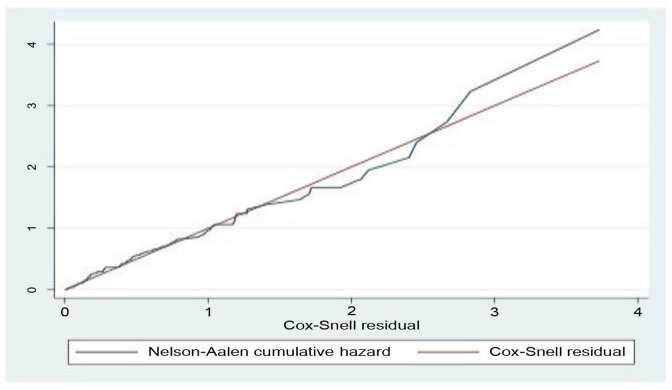
The data were collected by reviewing their records and entered in EpiData V.4.6.0.2 and exported to STATA V.14 for analysis. Descriptive statistics of the variables were obtained. The Cox proportional hazards assumption was checked. The Cox regression model was used to determine the median time to develop DR and identify predictors of DR. Bivariable and multivariable analyses were done; variables with a value of p<0.05 and a corresponding 95% CI in the final model were used. The model of adequacy was checked.
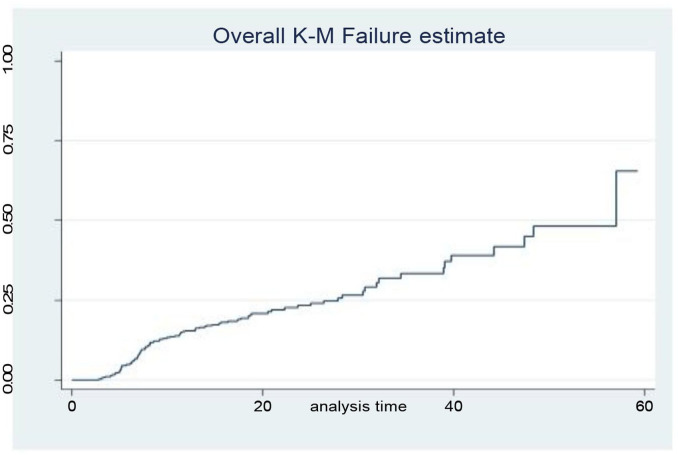
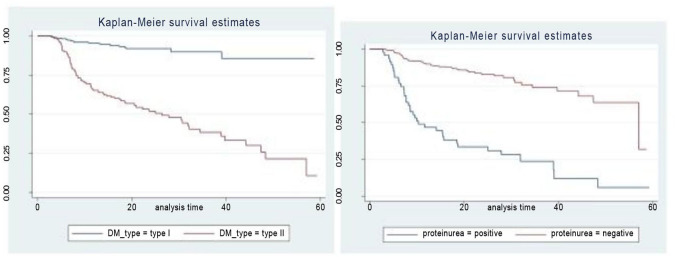
Records of a total of 376 adult patients with diabetes were reviewed with a mean baseline age (±SD) of 34.8±10 years. Of the total study participants, half (189, 50.3%) were female. A total of 376 adult patients with diabetes were followed for 45 752 person-months (PMs). Overall, the incidence rate was 11.7 per 1000 PMs of observation. Positive proteinuria (adjusted HR (AHR)=2.19; 95% CI 1.18 to 4.08), hypertension (HTN) (AHR=2.23; 95% CI 1.39 to 3.55) and type 2 diabetes mellitus (AHR=2.89; 95% CI 1.19 to 7.05) were independently significant predictors of DR.
The overall incidence rate of DR (type 1 and type 2) was high. Adult patients with diabetes with HTN, proteinuria and type of diabetes were independent predictors of DR. The best strategy to protect our eyesight from DR is to control high glucose level and giving due attention to high-risk individuals with diabetes. Thus, health professionals and concerned health authorities should target these factors in their efforts to prevent DR among diabetics.
本研究旨在确定埃塞俄比亚中南部成年糖尿病患者中糖尿病视网膜病变(DR)的发病率及其预测因素。
开展了一项基于医院的回顾性队列研究。
研究在埃塞俄比亚中南部的选定公立医院进行。
2015年至2023年共纳入376名新诊断的成年糖尿病患者,随访时间从入组日期至事件发生日期。
通过查阅病历收集数据,并录入EpiData V.4.6.0.2,然后导出至STATA V.14进行分析。获取变量的描述性统计数据。检验Cox比例风险假设。使用Cox回归模型确定发生DR的中位时间,并识别DR的预测因素。进行了单变量和多变量分析;使用最终模型中p值<0.05且对应95%置信区间的变量。检查模型的拟合优度。
共查阅了376名成年糖尿病患者的病历,平均基线年龄(±标准差)为34.8±10岁。在所有研究参与者中,一半(189名,50.3%)为女性。376名成年糖尿病患者共随访了45752人月(PMs)。总体而言,观察期内发病率为每1000人月11.7例。蛋白尿阳性(调整后风险比(AHR)=2.19;95%置信区间1.18至4.08)、高血压(HTN)(AHR=2.23;95%置信区间1.39至3.55)和2型糖尿病(AHR=2.89;95%置信区间1.19至7.05)是DR的独立显著预测因素。
DR(1型和2型)的总体发病率较高。患有高血压、蛋白尿和糖尿病类型的成年糖尿病患者是DR的独立预测因素。保护视力免受DR影响的最佳策略是控制高血糖水平,并对糖尿病高危个体给予适当关注。因此,卫生专业人员和相关卫生当局在预防糖尿病患者发生DR的努力中应针对这些因素。