Miroshnichenko Dmitry, Chaban Inna, Chernobrovkina Mariya, Dolgov Sergey
Institute of Basic Biological Problems RAS, Pushchino, Moscow Region, Russian Federation.
Branch of Shemyakin and Ovchinnikov Institute of Bioorganic Chemistry RAS, Pushchino, Moscow Region, Russian Federation.
PLoS One. 2017 Mar 8;12(3):e0173533. doi: 10.1371/journal.pone.0173533. eCollection 2017.
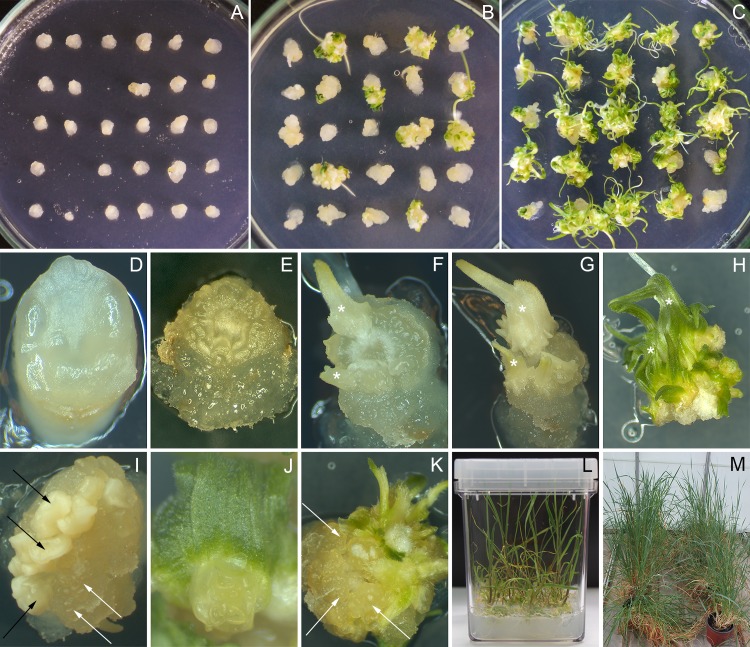
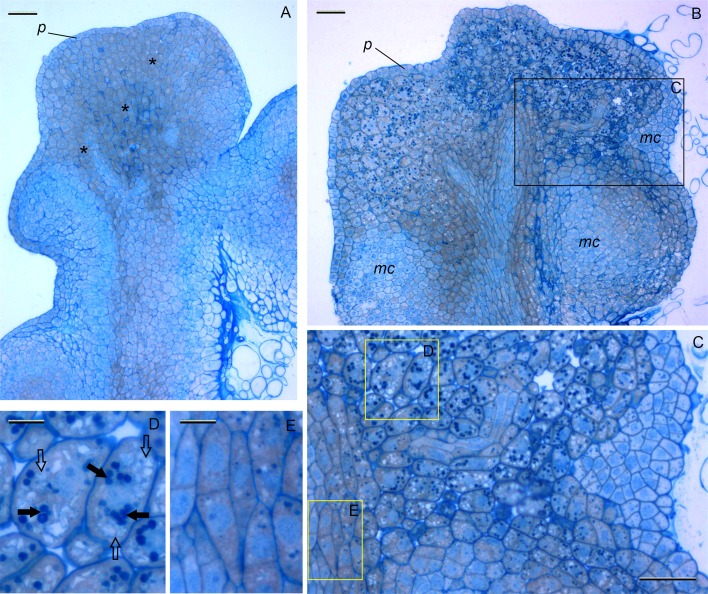
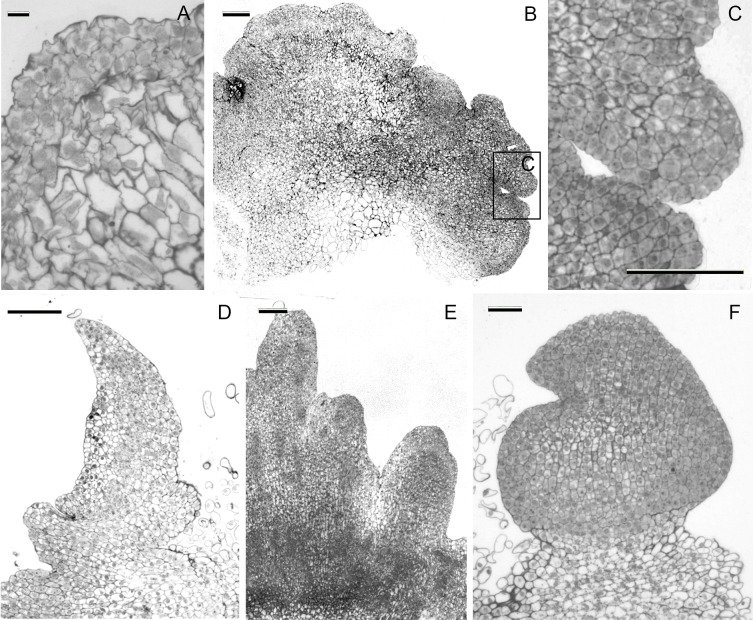
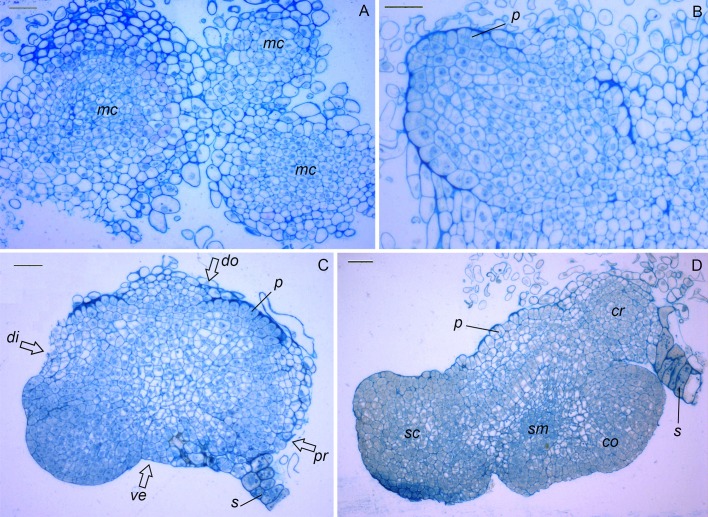
Einkorn (Triticum monococcum L.) is A-genome diploid wheat that has a potential to become a useful model for understanding the biology and genomics in Triticeae. Unfortunately, the application of modern technologies such as genetic engineering, RNAi-based gene silencing and genome editing is not available for einkorn as there is no efficient in vitro tissue culture and plant regeneration system. In the present study an efficient and simple protocol for plant regeneration via direct or indirect somatic embryogenesis and organogenesis has been developed. Various auxins used as sole inductors in einkorn displayed low effect for morphogenesis (0-8%) and plant regeneration (1-2 shoots per explant). The addition of Daminozide, the inhibitor of biosynthesis of gibberellins, together with auxin significantly improved the formation of morphogenic structures, especially when Dicamba (51.4%) and Picloram (56.6%) were used for combination; furthermore, the simultaneous addition of cytokinin into induction medium significantly promoted in vitro performance. Among the tested cytokinins, the urea-type substances, such as TDZ and CPPU were more effective than the adenine type ones, BA and Zeatin, for the regulation of morphogenesis; especially, TDZ was more effective than CPPU for shoot formation (11.73 vs. 7.04 per regenerating callus). The highest morphogenic response of 90.2% with the production of more than 10 shoots per initial explant was observed when 3.0 mg/L Dicamba, 50.0 mg/L Daminozide and 0.25 mg/L TDZ were combined together. Along with the identification of appropriate induction medium, the optimal developmental stage for einkorn was found as partially transparent immature embryo in size of around 1.0 mm. Although in the present study the critical balance between plant growth regulators was established for einkorn only, we assume that further the proposed strategy could be successfully applied to other recalcitrant cereal species and genotypes.
一粒小麦(Triticum monococcum L.)是具有A基因组的二倍体小麦,有潜力成为理解小麦族生物学和基因组学的有用模型。遗憾的是,由于缺乏高效的体外组织培养和植株再生系统,遗传工程、基于RNA干扰的基因沉默和基因组编辑等现代技术无法应用于一粒小麦。在本研究中,开发了一种通过直接或间接体细胞胚胎发生和器官发生进行植株再生的高效且简单的方案。在一粒小麦中用作唯一诱导剂的各种生长素对形态发生(0 - 8%)和植株再生(每个外植体1 - 2个芽)的效果较低。添加赤霉素生物合成抑制剂丁酰肼与生长素一起显著改善了形态发生结构的形成,特别是当使用麦草畏(51.4%)和毒莠定(56.6%)进行组合时;此外,在诱导培养基中同时添加细胞分裂素显著促进了体外表现。在测试的细胞分裂素中,脲类物质,如噻苯隆(TDZ)和氯吡脲(CPPU)在调节形态发生方面比腺嘌呤类物质,如苄氨基嘌呤(BA)和玉米素更有效;特别是,噻苯隆在芽形成方面比氯吡脲更有效(每个再生愈伤组织分别为11.73和7.04个芽)。当将3.0 mg/L麦草畏、50.0 mg/L丁酰肼和0.25 mg/L噻苯隆组合在一起时,观察到最高的形态发生响应为90.2%,每个初始外植体产生超过10个芽。随着合适诱导培养基的确定,发现一粒小麦的最佳发育阶段为大小约1.0 mm的部分透明未成熟胚。尽管在本研究中仅为一粒小麦建立了植物生长调节剂之间的关键平衡,但我们认为所提出的策略进一步可以成功应用于其他难培养的谷类物种和基因型。