Student at Biotechnology Undergraduate Course of Centro de Ciências Agrárias, Universidade Federal de São Carlos (CCA/UFSCar), Rodovia Anhanguera, km 174, Araras 13600-970, Brazil.
Centro Pluridisciplinar de Pesquisas Químicas, Biológicas e Agrícolas (CPQBA), Universidade Estadual de Campinas, Campinas 13083-970, Brazil.
Molecules. 2020 Dec 12;25(24):5895. doi: 10.3390/molecules25245895.
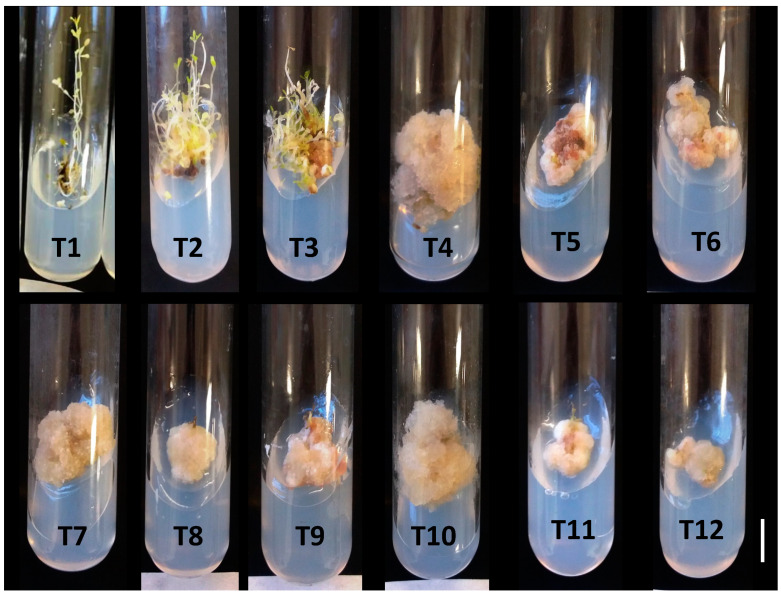
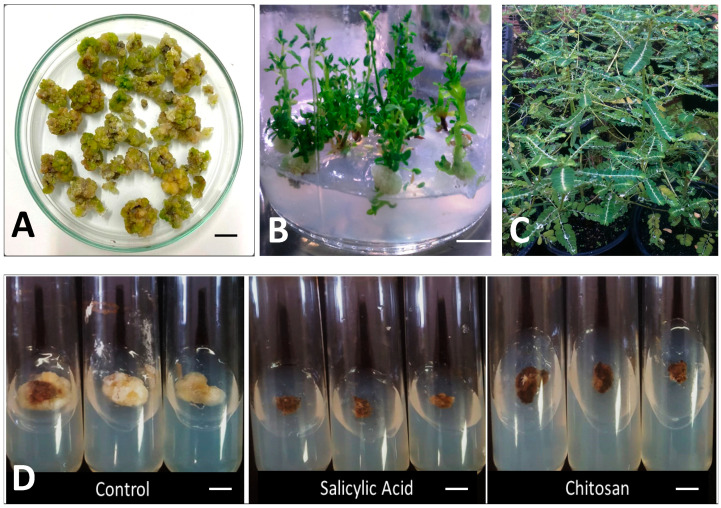
The efficient production of plant-derived medicinal compounds (PDMCs) from in vitro plants requires improvements in knowledge about control of plant or organ development and factors affecting the biosynthesis pathway of specific PDMCs under in vitro conditions, leading to a realistic large-scale tool for in vitro secondary metabolite production. Thus, this study aimed to develop an in vitro technique, through the induction and proliferation of calli, for production of plant fresh weight, and to compare the PDMC profile obtained from the plants versus in vitro calli of . It was successfully possible to obtain and proliferate two types of calli, one with a beige color and a friable appearance, obtained in the dark using Murashige and Skoog (MS) medium plus 2,4-dichlorophenoxyacetic acid (2,4-D), and a second type with a green color, rigid consistency, and nonfriable appearance obtained under light conditions and MS medium plus 6-benzyladenine (6-BA). In vitro micropropagated plants that gave rise to calli were also acclimatized in a greenhouse and cultivated until obtaining the mass for PDMC analysis and used as a control. While the micropropagated-derived plants concentrated the lignans niranthin, nirtetralin, and phyllanthin, the calli proliferated in vitro concentrated a completely different biochemical profile and synthesis of compounds, such as betulone, squalene, stigmasterol, and β-sitosterol, in addition to others not identified by GC-MS database. These results demonstrate the possibility of applying the calli in vitro from for production of important PDMCs unlike those obtained in cultures of differentiated tissues from field plants.
从体外植物高效生产植物源性药用化合物(PDMCs)需要提高对植物或器官发育控制的认识,以及了解在体外条件下影响特定 PDMC 生物合成途径的因素,从而为体外次生代谢产物生产提供现实的大规模工具。因此,本研究旨在开发一种通过诱导和增殖愈伤组织生产植物鲜重的体外技术,并比较从植物中获得的 PDMC 谱与 的体外愈伤组织。成功地获得并增殖了两种类型的愈伤组织,一种是米色、易碎的外观,在黑暗中使用 Murashige 和 Skoog(MS)培养基加 2,4-二氯苯氧乙酸(2,4-D)获得;另一种是绿色、坚硬、不易碎的外观,在光照条件下和 MS 培养基加 6-苄基腺嘌呤(6-BA)获得。在温室中适应和培养产生愈伤组织的体外微繁殖植物,直到获得 PDMC 分析的质量,并用作对照。虽然微繁殖植物集中了木脂素尼拉汀、尼特拉汀和叶素,但体外增殖的愈伤组织集中了完全不同的生化特征和化合物的合成,如桦木酮、角鲨烯、豆甾醇和 β-谷甾醇,以及其他通过 GC-MS 数据库未鉴定的化合物。这些结果表明,有可能应用 的体外愈伤组织生产不同于从田间植物分化组织培养中获得的重要 PDMCs。