Zhu Yi, Doornebal Ewald J, Pirtskhalava Tamar, Giorgadze Nino, Wentworth Mark, Fuhrmann-Stroissnigg Heike, Niedernhofer Laura J, Robbins Paul D, Tchkonia Tamara, Kirkland James L
Robert and Arlene Kogod Center on Aging, Mayo Clinic, Rochester, MN 55905, USA.
Faculty of Science and Engineering, University of Groningen, University Medical Center Groningen, Groningen, Netherlands.
Aging (Albany NY). 2017 Mar 8;9(3):955-963. doi: 10.18632/aging.101202.
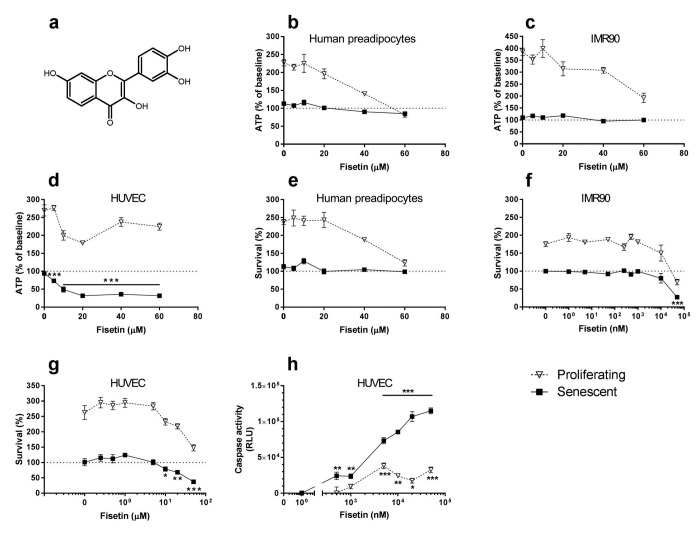
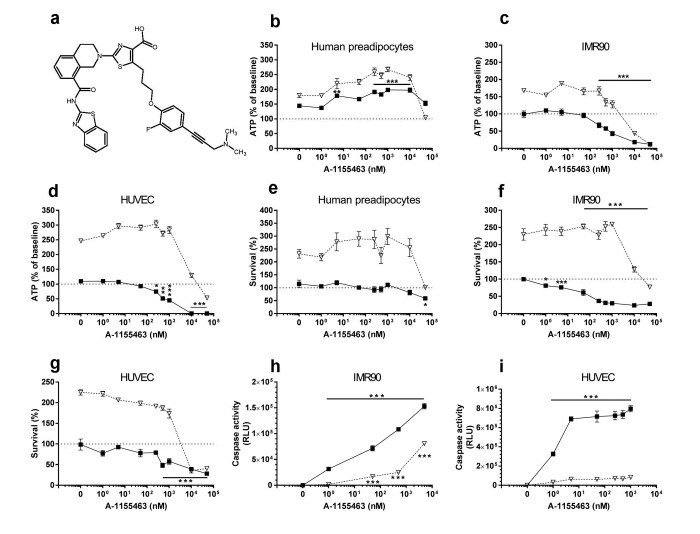
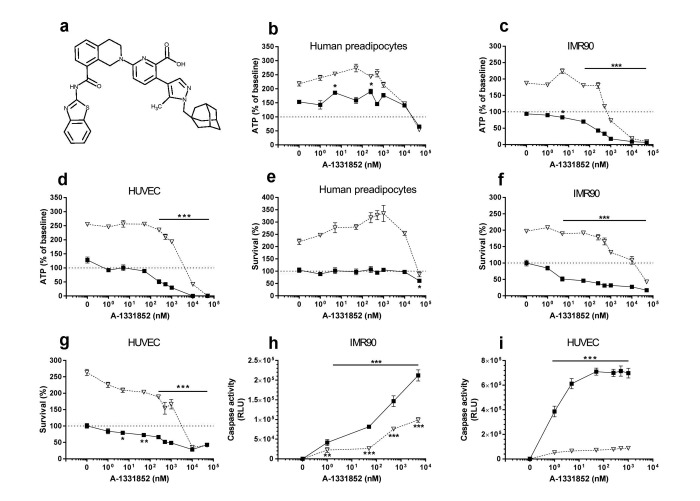
Senescent cells accumulate with aging and at sites of pathology in multiple chronic diseases. Senolytics are drugs that selectively promote apoptosis of senescent cells by temporarily disabling the pro-survival pathways that enable senescent cells to resist the pro-apoptotic, pro-inflammatory factors that they themselves secrete. Reducing senescent cell burden by genetic approaches or by administering senolytics delays or alleviates multiple age- and disease-related adverse phenotypes in preclinical models. Reported senolytics include dasatinib, quercetin, navitoclax (ABT263), and piperlongumine. Here we report that fisetin, a naturally-occurring flavone with low toxicity, and A1331852 and A1155463, selective BCL-X inhibitors that may have less hematological toxicity than the less specific BCL-2 family inhibitor navitoclax, are senolytic. Fisetin selectively induces apoptosis in senescent but not proliferating human umbilical vein endothelial cells (HUVECs). It is not senolytic in senescent IMR90 cells, a human lung fibroblast strain, or primary human preadipocytes. A1331852 and A1155463 are senolytic in HUVECs and IMR90 cells, but not preadipocytes. These agents may be better candidates for eventual translation into clinical interventions than some existing senolytics, such as navitoclax, which is associated with hematological toxicity.
衰老细胞随着衰老以及在多种慢性疾病的病理部位积累。衰老细胞溶解剂是一类药物,它们通过暂时阻断使衰老细胞能够抵抗其自身分泌的促凋亡、促炎因子的促生存途径,来选择性地促进衰老细胞凋亡。通过基因方法或使用衰老细胞溶解剂降低衰老细胞负担,可延缓或减轻临床前模型中多种与年龄和疾病相关的不良表型。已报道的衰老细胞溶解剂包括达沙替尼、槲皮素、纳维托克司(ABT263)和长胡椒碱。在此我们报告,具有低毒性的天然黄酮类化合物非瑟酮,以及选择性BCL-X抑制剂A1331852和A1155463是衰老细胞溶解剂,它们可能比特异性较低的BCL-2家族抑制剂纳维托克司具有更低的血液学毒性。非瑟酮选择性地诱导衰老的人脐静脉内皮细胞(HUVECs)凋亡,但不诱导增殖的HUVECs凋亡。它对衰老的人肺成纤维细胞系IMR90细胞或原代人前脂肪细胞没有衰老细胞溶解作用。A1331852和A1155463对HUVECs和IMR90细胞具有衰老细胞溶解作用,但对前脂肪细胞没有作用。与一些现有的衰老细胞溶解剂(如与血液学毒性相关的纳维托克司)相比,这些药物可能是最终转化为临床干预措施的更好候选药物。