Kim Eun-Hye, Jeon Byoung-Hak, Kim Jihyun, Kim Young-Min, Han Youngshin, Ahn Kangmo, Cheong Hae-Kwan
Department of Social and Preventive Medicine, Sungkyunkwan University School of Medicine, 2066 Seobu-ro, Jangan-gu, Suwon, Gyeonggi-do, 16419, Republic of Korea.
Samsung Biomedical Research Institute, Sungkyunkwan University School of Medicine, Seoul, 06351, Republic of Korea.
Environ Health. 2017 Mar 9;16(1):24. doi: 10.1186/s12940-017-0225-5.
Despite increasing evidence on the relationship between exposure to phthalates and bisphenol A with allergies and asthma, reports on atopic dermatitis (AD) with these chemicals are few. We assessed the association between AD symptoms and the exposure to phthalates and bisphenol A and in children.
We surveyed 18 boys with AD (age 3-7 years) in a day care center in Seoul between May 2009 and April 2010. AD symptoms were recorded by using a daily symptom diary. We collected 460 series of pooled urine twice a day, in the morning and afternoon, over 230 working days and measured the concentrations of mono-2-ethyl-5-oxohexyl phthalate (5-oxo-MEHP), mono-2-ethyl-5-hydroxyhexyl phthalate (5-OH-MEHP), mono-isobutyl phthalate (MnBP) and bisphenol A glucuronide (BPAG) in the pooled urine. Logistic regression was used for statistical analysis.
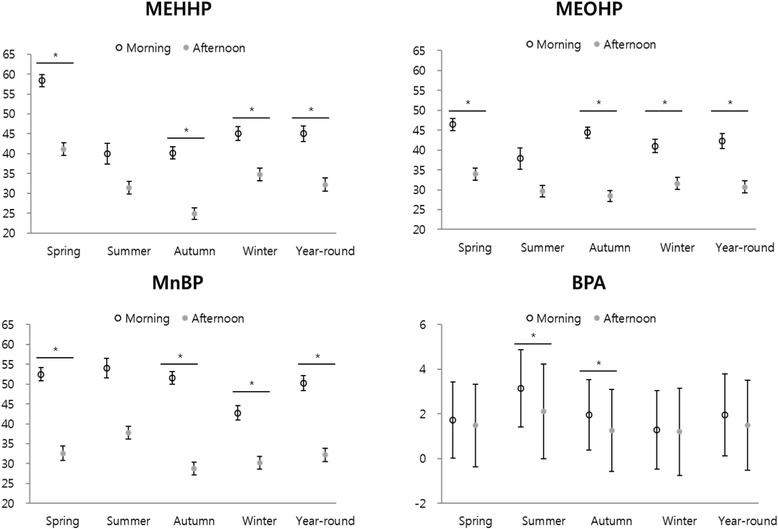
Most phthalate metabolite levels were higher in the morning than in the afternoon (p < 0.0001). There was seasonal variation in the levels of phthalates and bisphenol A metabolites. Levels of 5-OH-MEHP, MnBP, and BPAG were highest in summer (p < 0.0001). Manifestation of AD symptoms was associated with an increase in urinary levels of MnBP (adjusted odds ratio, aOR = 2.85, 95% CI: 1.12-7.26 per 1 μg/L of MnBP) and BPAG (aOR = 1.79, 95% CI: 0.91-3.52 per 1 μg/L BPAG) on the same day. The levels of MnBP and BPAG in the previous day increased AD symptoms (aOR = 2.74, 95% CI: 1.21-6.20, for 1 μg/L of MnBP and aOR = 2.01, 95% CI: 1.08-3.74 for 1 μg/L BPAG).
Our results suggest that exposure to phthalates and bisphenol A is associated with aggravation of AD symptoms in children.
尽管越来越多的证据表明邻苯二甲酸盐和双酚A的暴露与过敏及哮喘之间存在关联,但关于这些化学物质与特应性皮炎(AD)的报道却很少。我们评估了儿童AD症状与邻苯二甲酸盐和双酚A暴露之间的关联。
2009年5月至2010年4月期间,我们在首尔的一家日托中心对18名患有AD的男孩(年龄3 - 7岁)进行了调查。通过每日症状日记记录AD症状。在230个工作日里,我们每天上午和下午各收集一次共460份混合尿液样本,并测量混合尿液中邻苯二甲酸单-2-乙基-5-氧代己酯(5-氧代-MEHP)、邻苯二甲酸单-2-乙基-5-羟基己酯(5-OH-MEHP)、邻苯二甲酸单异丁酯(MnBP)和双酚A葡萄糖醛酸苷(BPAG)的浓度。采用逻辑回归进行统计分析。
大多数邻苯二甲酸酯代谢物水平上午高于下午(p < 0.0001)。邻苯二甲酸盐和双酚A代谢物水平存在季节性变化。5-OH-MEHP、MnBP和BPAG水平在夏季最高(p < 0.0001)。AD症状的表现与当日尿液中MnBP水平升高(调整后的优势比,aOR = 2.85,95%可信区间:每1μg/L MnBP为1.12 - 7.26)和BPAG水平升高(aOR = 1.79,95%可信区间:每1μg/L BPAG为0.91 - 3.52)相关。前一日的MnBP和BPAG水平升高会增加AD症状(每1μg/L MnBP的aOR = 2.74,95%可信区间:1.21 - 6.20;每1μg/L BPAG的aOR = 2.01,95%可信区间:1.08 - 3.74)。
我们的结果表明,邻苯二甲酸盐和双酚A的暴露与儿童AD症状的加重有关。