• 文献检索
  • 文档翻译
  • 深度研究
  • 学术资讯
  • Suppr Zotero 插件Zotero 插件
  • 邀请有礼
  • 套餐&价格
  • 历史记录
应用&插件
Suppr Zotero 插件Zotero 插件浏览器插件Mac 客户端Windows 客户端微信小程序
定价
高级版会员购买积分包购买API积分包
服务
文献检索文档翻译深度研究API 文档MCP 服务
关于我们
关于 Suppr公司介绍联系我们用户协议隐私条款
关注我们

Suppr 超能文献

核心技术专利:CN118964589B侵权必究
粤ICP备2023148730 号-1Suppr @ 2026

文献检索

告别复杂PubMed语法,用中文像聊天一样搜索,搜遍4000万医学文献。AI智能推荐,让科研检索更轻松。

立即免费搜索

文件翻译

保留排版,准确专业,支持PDF/Word/PPT等文件格式,支持 12+语言互译。

免费翻译文档

深度研究

AI帮你快速写综述,25分钟生成高质量综述,智能提取关键信息,辅助科研写作。

立即免费体验

独特的微生物群-神经免疫特征与自闭症谱系障碍儿童的功能性腹痛相关。

Distinct Microbiome-Neuroimmune Signatures Correlate With Functional Abdominal Pain in Children With Autism Spectrum Disorder.

作者信息

Luna Ruth Ann, Oezguen Numan, Balderas Miriam, Venkatachalam Alamelu, Runge Jessica K, Versalovic James, Veenstra-VanderWeele Jeremy, Anderson George M, Savidge Tor, Williams Kent C

机构信息

Texas Children's Microbiome Center, Department of Pathology, Texas Children's Hospital, Houston, Texas; Department of Pathology & Immunology, Baylor College of Medicine, Houston, Texas.

Department of Psychiatry, Columbia University, New York, New York.

出版信息

Cell Mol Gastroenterol Hepatol. 2016 Dec 11;3(2):218-230. doi: 10.1016/j.jcmgh.2016.11.008. eCollection 2017 Mar.

DOI:10.1016/j.jcmgh.2016.11.008
PMID:28275689
原文链接:https://pmc.ncbi.nlm.nih.gov/articles/PMC5331780/
Abstract

BACKGROUND & AIMS: Emerging data on the gut microbiome in autism spectrum disorder (ASD) suggest that altered host-microbe interactions may contribute to disease symptoms. Although gut microbial communities in children with ASD are reported to differ from individuals with neurotypical development, it is not known whether these bacteria induce pathogenic neuroimmune signals.

METHODS

Because commensal clostridia interactions with the intestinal mucosa can regulate disease-associated cytokine and serotonergic pathways in animal models, we evaluated whether microbiome-neuroimmune profiles (from rectal biopsy specimens and blood) differed in ASD children with functional gastrointestinal disorders (ASD-FGID, n = 14) compared with neurotypical (NT) children with FGID (NT-FGID, n = 15) and without abdominal pain (NT, n = 6). Microbial 16S ribosomal DNA community signatures, cytokines, and serotonergic metabolites were quantified and correlated with gastrointestinal symptoms.

RESULTS

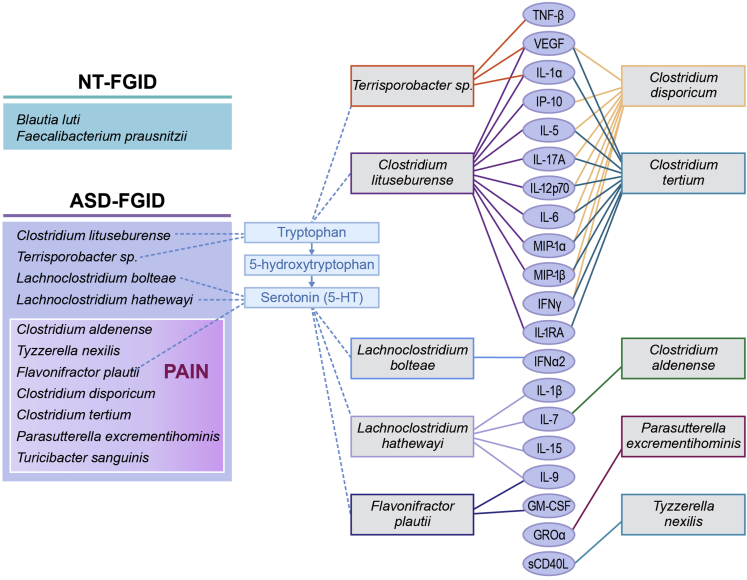
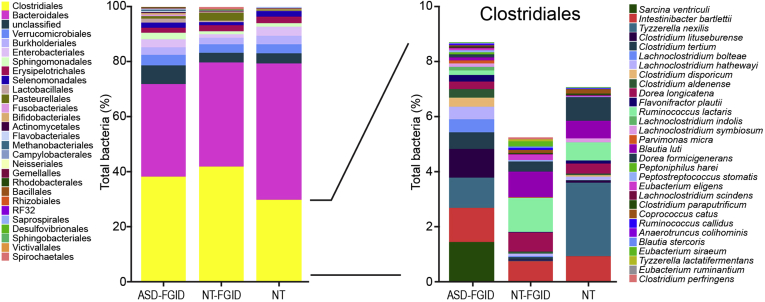
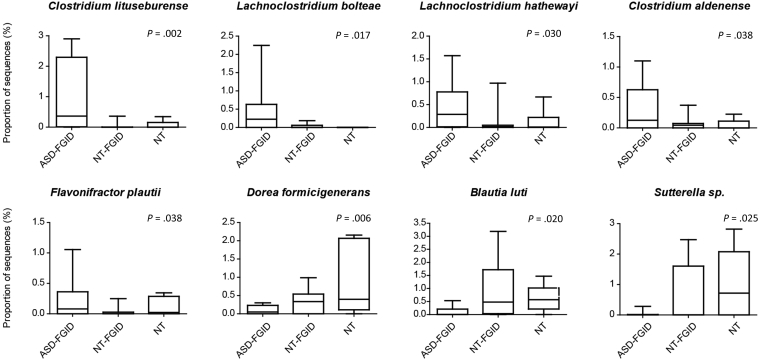
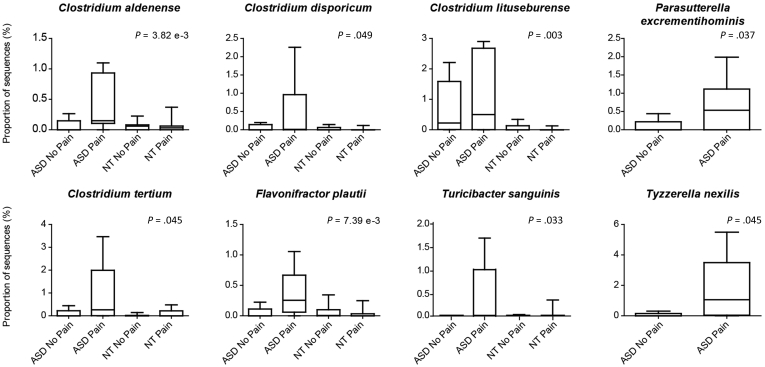
A significant increase in several mucosa-associated Clostridiales was observed in ASD-FGID, whereas marked decreases in and , as well as , were evident. Stratification by abdominal pain showed multiple organisms in ASD-FGID that correlated significantly with cytokines (interleukin [IL]6, IL1, IL17A, and interferon-γ). Group comparisons showed that IL6 and tryptophan release by mucosal biopsy specimens was highest in ASD children with abdominal pain, whereas serotonergic metabolites generally were increased in children with FGIDs. Furthermore, proinflammatory cytokines correlated significantly with several Clostridiales previously reported to associate with ASD, as did tryptophan and serotonin.

CONCLUSIONS

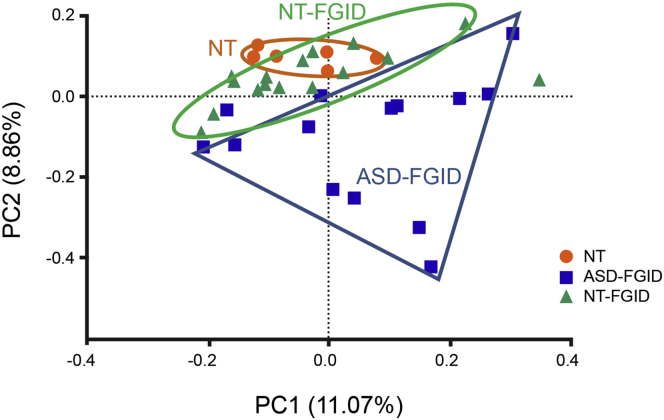
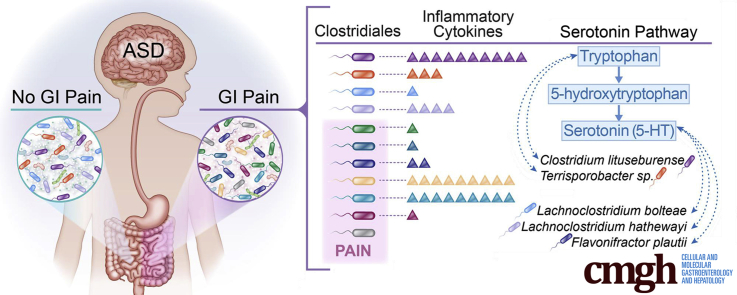
Our findings identify distinctive mucosal microbial signatures in ASD children with FGID that correlate with cytokine and tryptophan homeostasis. Future studies are needed to establish whether these disease-associated Clostridiales species confer early pathogenic signals in children with ASD and FGID.

摘要

背景与目的

关于自闭症谱系障碍(ASD)肠道微生物群的新数据表明,宿主与微生物相互作用的改变可能导致疾病症状。虽然据报道,患有ASD的儿童的肠道微生物群落与神经发育正常的个体不同,但尚不清楚这些细菌是否会诱导致病性神经免疫信号。

方法

由于共生梭菌与肠黏膜的相互作用可调节动物模型中与疾病相关的细胞因子和血清素能通路,我们评估了患有功能性胃肠疾病的ASD儿童(ASD-FGID,n = 14)与患有功能性胃肠疾病的神经发育正常儿童(NT-FGID,n = 15)以及无腹痛的神经发育正常儿童(NT,n = 6)相比,其微生物组-神经免疫特征(来自直肠活检标本和血液)是否存在差异。对微生物16S核糖体DNA群落特征、细胞因子和血清素能代谢产物进行了定量分析,并与胃肠道症状进行了关联。

结果

在ASD-FGID中观察到几种与黏膜相关的梭菌目显著增加,而在[具体菌名未给出]以及[另一种具体菌名未给出]中明显减少。按腹痛分层显示,ASD-FGID中有多种微生物与细胞因子(白细胞介素[IL]6、IL1、IL17A和干扰素-γ)显著相关。组间比较显示,有腹痛的ASD儿童黏膜活检标本中IL6和色氨酸释放最高,而功能性胃肠疾病儿童的血清素能代谢产物普遍增加。此外,促炎细胞因子与先前报道的几种与ASD相关的梭菌目显著相关,色氨酸和血清素也是如此。

结论

我们的研究结果确定了患有功能性胃肠疾病的ASD儿童独特的黏膜微生物特征,这些特征与细胞因子和色氨酸稳态相关。未来需要开展研究,以确定这些与疾病相关的梭菌目物种是否会在患有ASD和功能性胃肠疾病的儿童中产生早期致病信号。
https://cdn.ncbi.nlm.nih.gov/pmc/blobs/2471/5331780/eb7f55c088f8/gr5.jpg
https://cdn.ncbi.nlm.nih.gov/pmc/blobs/2471/5331780/a2e5d101c822/fx1.jpg
https://cdn.ncbi.nlm.nih.gov/pmc/blobs/2471/5331780/bb7e7f1873fc/gr1.jpg
https://cdn.ncbi.nlm.nih.gov/pmc/blobs/2471/5331780/c61a9b77de29/gr2.jpg
https://cdn.ncbi.nlm.nih.gov/pmc/blobs/2471/5331780/02efb56d48f1/gr3.jpg
https://cdn.ncbi.nlm.nih.gov/pmc/blobs/2471/5331780/cc75813740c6/gr4.jpg
https://cdn.ncbi.nlm.nih.gov/pmc/blobs/2471/5331780/eb7f55c088f8/gr5.jpg
https://cdn.ncbi.nlm.nih.gov/pmc/blobs/2471/5331780/a2e5d101c822/fx1.jpg
https://cdn.ncbi.nlm.nih.gov/pmc/blobs/2471/5331780/bb7e7f1873fc/gr1.jpg
https://cdn.ncbi.nlm.nih.gov/pmc/blobs/2471/5331780/c61a9b77de29/gr2.jpg
https://cdn.ncbi.nlm.nih.gov/pmc/blobs/2471/5331780/02efb56d48f1/gr3.jpg
https://cdn.ncbi.nlm.nih.gov/pmc/blobs/2471/5331780/cc75813740c6/gr4.jpg
https://cdn.ncbi.nlm.nih.gov/pmc/blobs/2471/5331780/eb7f55c088f8/gr5.jpg

相似文献

1
Distinct Microbiome-Neuroimmune Signatures Correlate With Functional Abdominal Pain in Children With Autism Spectrum Disorder.独特的微生物群-神经免疫特征与自闭症谱系障碍儿童的功能性腹痛相关。
Cell Mol Gastroenterol Hepatol. 2016 Dec 11;3(2):218-230. doi: 10.1016/j.jcmgh.2016.11.008. eCollection 2017 Mar.
2
Comparison of Fecal Microbiota in Children with Autism Spectrum Disorders and Neurotypical Siblings in the Simons Simplex Collection.西蒙斯单基因自闭症研究中自闭症谱系障碍儿童与其神经典型同胞的粪便微生物群比较。
PLoS One. 2015 Oct 1;10(10):e0137725. doi: 10.1371/journal.pone.0137725. eCollection 2015.
3
Disentangling the relationship of gut microbiota, functional gastrointestinal disorders and autism: a case-control study on prepubertal Chinese boys.解析肠道微生物群、功能性胃肠疾病和自闭症之间的关系:一项针对青春期前中国男孩的病例对照研究。
Sci Rep. 2022 Jun 23;12(1):10659. doi: 10.1038/s41598-022-14785-8.
4
Microbiota and gut-brain axis dysfunction in autism spectrum disorder: Evidence for functional gastrointestinal disorders.自闭症谱系障碍中的微生物群和肠道-大脑轴功能障碍:功能性胃肠疾病的证据。
Asian J Psychiatr. 2020 Jan;47:101874. doi: 10.1016/j.ajp.2019.101874. Epub 2019 Nov 12.
5
Differential immune responses and microbiota profiles in children with autism spectrum disorders and co-morbid gastrointestinal symptoms.自闭症谱系障碍伴胃肠道症状儿童的免疫反应和微生物群特征差异。
Brain Behav Immun. 2018 May;70:354-368. doi: 10.1016/j.bbi.2018.03.025. Epub 2018 Mar 20.
6
New and Preliminary Evidence on Altered Oral and Gut Microbiota in Individuals with Autism Spectrum Disorder (ASD): Implications for ASD Diagnosis and Subtyping Based on Microbial Biomarkers.自闭症谱系障碍(ASD)个体口腔和肠道微生物组改变的新证据和初步证据:基于微生物生物标志物的 ASD 诊断和亚型的意义。
Nutrients. 2019 Sep 6;11(9):2128. doi: 10.3390/nu11092128.
7
Fecal Microbiome Transplantation from Children with Autism Spectrum Disorder Modulates Tryptophan and Serotonergic Synapse Metabolism and Induces Altered Behaviors in Germ-Free Mice.来自自闭症谱系障碍儿童的粪便微生物群移植可调节色氨酸和血清素能突触代谢,并在无菌小鼠中诱导行为改变。
mSystems. 2021 Apr 6;6(2):e01343-20. doi: 10.1128/mSystems.01343-20.
8
Fecal microbiota transplantation relieves abdominal bloating in children with functional gastrointestinal disorders via modulating the gut microbiome and metabolome.粪便微生物群移植通过调节肠道微生物组和代谢组来缓解功能性胃肠疾病儿童的腹胀。
J Dig Dis. 2022 Aug;23(8-9):482-492. doi: 10.1111/1751-2980.13135. Epub 2022 Nov 28.
9
Comprehensive Analysis of Gut Microbiota Composition and Functional Metabolism in Children with Autism Spectrum Disorder and Neurotypical Children: Implications for Sex-Based Differences and Metabolic Dysregulation.自闭症谱系障碍儿童与神经典型儿童肠道微生物组成和功能代谢的综合分析:性别差异和代谢失调的影响。
Int J Mol Sci. 2024 Jun 18;25(12):6701. doi: 10.3390/ijms25126701.
10
Abdominal Pain-Predominant Functional Gastrointestinal Disorders in Jordanian School Children.约旦学龄儿童中以腹痛为主的功能性胃肠疾病
Gastroenterology Res. 2014 Dec;7(5-6):137-142. doi: 10.14740/gr627w. Epub 2014 Dec 27.

引用本文的文献

1
Sex-Specific effects of vitamin D on autistic behavior and gastrointestinal symptoms in rats via the regulation of serotonin metabolism.维生素D通过调节血清素代谢对大鼠自闭症行为和胃肠道症状的性别特异性影响。
Sci Rep. 2025 Jul 1;15(1):21769. doi: 10.1038/s41598-025-05845-w.
2
Polystyrene nanoplastics disrupt the intestinal microenvironment by altering bacteria-host interactions through extracellular vesicle-delivered microRNAs.聚苯乙烯纳米塑料通过细胞外囊泡传递的微小RNA改变细菌与宿主的相互作用,从而破坏肠道微环境。
Nat Commun. 2025 Jun 10;16(1):5026. doi: 10.1038/s41467-025-59884-y.
3
Interventions targeting the gut microbiota and their possible effect on gastrointestinal and neurobehavioral symptoms in autism spectrum disorder.

本文引用的文献

1
LotuS: an efficient and user-friendly OTU processing pipeline.LotuS:一个高效且用户友好的 OTU 处理流程。
Microbiome. 2014 Sep 30;2(1):30. doi: 10.1186/2049-2618-2-30.
2
Serotonin transporter variant drives preventable gastrointestinal abnormalities in development and function.血清素转运体变异体导致发育和功能中可预防的胃肠道异常。
J Clin Invest. 2016 Jun 1;126(6):2221-35. doi: 10.1172/JCI84877. Epub 2016 Apr 25.
3
The maternal interleukin-17a pathway in mice promotes autism-like phenotypes in offspring.小鼠母体白细胞介素-17a通路促进后代出现自闭症样表型。
针对肠道微生物群的干预措施及其对自闭症谱系障碍中胃肠道和神经行为症状的可能影响。
Gut Microbes. 2025 Dec;17(1):2499580. doi: 10.1080/19490976.2025.2499580. Epub 2025 May 16.
4
Mice expressing the autism-associated neuroligin-3 R451C variant exhibit increased mucus density and altered distributions of intestinal microbiota.表达与自闭症相关的神经连接蛋白3 R451C变体的小鼠表现出黏液密度增加和肠道微生物群分布改变。
ISME J. 2025 Jan 2;19(1). doi: 10.1093/ismejo/wraf037.
5
Microbiota-Gut-Brain Axis: Mass-Spectrometry-Based Metabolomics in the Study of Microbiome Mediators-Stress Relationship.微生物群-肠道-脑轴:基于质谱的代谢组学在微生物组介导因子与应激关系研究中的应用
Biomolecules. 2025 Feb 7;15(2):243. doi: 10.3390/biom15020243.
6
Unraveling the Connections: Eating Issues, Microbiome, and Gastrointestinal Symptoms in Autism Spectrum Disorder.揭示关联:自闭症谱系障碍中的饮食问题、微生物群和胃肠道症状
Nutrients. 2025 Jan 29;17(3):486. doi: 10.3390/nu17030486.
7
Influential articles in autism and gut microbiota: bibliometric profile and research trends.自闭症与肠道微生物群领域的影响力文章:文献计量分析及研究趋势
Front Microbiol. 2025 Jan 9;15:1401597. doi: 10.3389/fmicb.2024.1401597. eCollection 2024.
8
Stratification of Gut Microbiota Profiling Based on Autism Neuropsychological Assessments.基于自闭症神经心理学评估的肠道微生物群分析分层
Microorganisms. 2024 Oct 9;12(10):2041. doi: 10.3390/microorganisms12102041.
9
Turicibacter and Catenibacterium as potential biomarkers in autism spectrum disorders.厚壁菌门和拟杆菌门作为自闭症谱系障碍的潜在生物标志物。
Sci Rep. 2024 Oct 5;14(1):23184. doi: 10.1038/s41598-024-73700-5.
10
Analysis of Gut Bacterial and Fungal Microbiota in Children with Autism Spectrum Disorder and Their Non-Autistic Siblings.自闭症谱系障碍儿童及其非自闭症兄弟姐妹肠道细菌和真菌微生物群分析。
Nutrients. 2024 Sep 5;16(17):3004. doi: 10.3390/nu16173004.
Science. 2016 Feb 26;351(6276):933-9. doi: 10.1126/science.aad0314. Epub 2016 Jan 28.
4
Gastrointestinal symptoms and behavioral problems in preschoolers with Autism Spectrum Disorder.自闭症谱系障碍学龄前儿童的胃肠道症状与行为问题
Dig Liver Dis. 2016 Mar;48(3):248-54. doi: 10.1016/j.dld.2015.11.026. Epub 2015 Dec 11.
5
Improved taxonomic assignment of human intestinal 16S rRNA sequences by a dedicated reference database.通过专用参考数据库改进人类肠道16S rRNA序列的分类学归属
BMC Genomics. 2015 Dec 12;16:1056. doi: 10.1186/s12864-015-2265-y.
6
The serotonin system in autism spectrum disorder: From biomarker to animal models.自闭症谱系障碍中的血清素系统:从生物标志物到动物模型。
Neuroscience. 2016 May 3;321:24-41. doi: 10.1016/j.neuroscience.2015.11.010. Epub 2015 Nov 11.
7
Brief Report: Whole Blood Serotonin Levels and Gastrointestinal Symptoms in Autism Spectrum Disorder.简短报告:自闭症谱系障碍中的全血血清素水平与胃肠道症状
J Autism Dev Disord. 2016 Mar;46(3):1124-30. doi: 10.1007/s10803-015-2646-8.
8
Comparison of Fecal Microbiota in Children with Autism Spectrum Disorders and Neurotypical Siblings in the Simons Simplex Collection.西蒙斯单基因自闭症研究中自闭症谱系障碍儿童与其神经典型同胞的粪便微生物群比较。
PLoS One. 2015 Oct 1;10(10):e0137725. doi: 10.1371/journal.pone.0137725. eCollection 2015.
9
Th17 Cell Induction by Adhesion of Microbes to Intestinal Epithelial Cells.微生物与肠上皮细胞黏附诱导Th17细胞
Cell. 2015 Oct 8;163(2):367-80. doi: 10.1016/j.cell.2015.08.058. Epub 2015 Sep 24.
10
The initial state of the human gut microbiome determines its reshaping by antibiotics.人类肠道微生物群的初始状态决定了其受抗生素影响后的重塑情况。
ISME J. 2016 Mar;10(3):707-20. doi: 10.1038/ismej.2015.148. Epub 2015 Sep 11.