Department of Systems, Populations and Leadership, University of Michigan School of Nursing, 400 N. Ingalls Street, Room 4352, Ann Arbor, MI 48109, United States.
Division of General Internal Medicine and Health Services Research, UCLA David Geffen School of Medicine, Department of Health Policy and Management, UCLA Fielding School of Public Health, United States.
Soc Sci Med. 2017 Apr;178:206-213. doi: 10.1016/j.socscimed.2017.02.020. Epub 2017 Mar 7.
Falls are common among older adults and may be related to depressive symptoms (DS). With advancing age, there is an onset of chronic conditions, sensory impairments, and activity limitations that are associated with falls and with depressive disorders. Prior cross-sectional studies have observed significant associations between DS and subsequent falls as well as between fractures and subsequent clinical depression and DS.
The directionality of these observed relationship between falls and DS is in need of elaboration given that cross-sectional study designs can yield biased estimates of the DS-falls relationship.
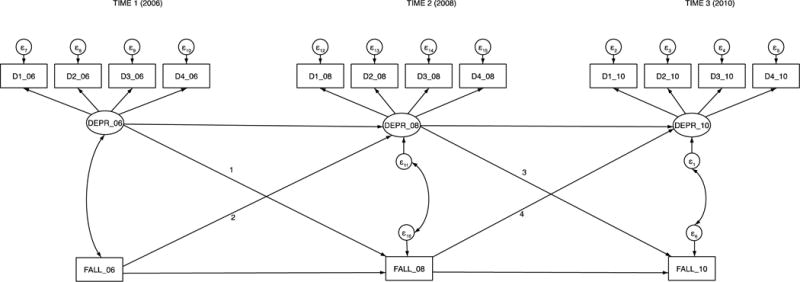
Using 2006-2010 Health and Retirement Study data, cross-lagged panel structural equation models were used to evaluate associations between falls and DS among 7233 community-dwelling adults ages ≥65. Structural coefficients between falls and DS (in 2006→2008, 2008→2010) were estimated.
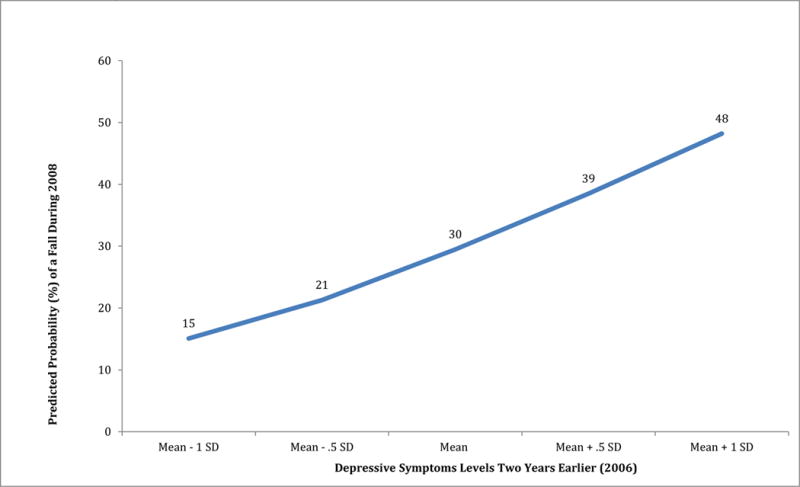
A good-fitting model was found: Controlling for baseline (2006) physical functioning, vision, chronic conditions, and social support and neighborhood social cohesion, falls were not associated with subsequent DS, but a 0.5 standard deviation increase in 2006 DS was associated with a 30% increase in fall risk two years later. This DS-falls relationship was no longer significant when use of psychiatric medications, which was positively associated with falls, was included in the model.
Using sophisticated methods and a large U.S. sample, we found larger magnitudes of effect in the DS-falls relationship than in prior studies-highlighting the risk of falls for older adults with DS. Medical providers might assess older individuals for DS as well as use of psychotropic medications as part of a broadened falls prevention approach. National guidelines for fall risk assessments as well as quality indicators for fall prevention should include assessment for clinical depression.
老年人常发生跌倒,且跌倒可能与抑郁症状(DS)有关。随着年龄的增长,慢性疾病、感觉障碍和活动受限的发生频率增加,这些因素与跌倒和抑郁障碍均相关。先前的横断面研究已经观察到 DS 与随后的跌倒以及骨折与随后的临床抑郁和 DS 之间存在显著关联。
鉴于横断面研究设计可能会对 DS-跌倒关系的估计产生偏差,因此需要详细阐述这些观察到的跌倒和 DS 之间关系的方向性。
使用 2006-2010 年健康与退休研究的数据,通过交叉滞后面板结构方程模型评估了 7233 名年龄≥65 岁的社区居住成年人中跌倒和 DS 之间的关系。估计了 2006 年→2008 年和 2008 年→2010 年期间跌倒和 DS 之间的结构系数。
发现一个拟合良好的模型:在控制基线(2006 年)身体功能、视力、慢性疾病以及社会支持和邻里社会凝聚力的情况下,跌倒与随后的 DS 无关,但 2006 年 DS 增加 0.5 个标准差与两年后跌倒风险增加 30%相关。当模型中包含与跌倒呈正相关的精神科药物使用情况时,DS-跌倒关系不再显著。
使用复杂的方法和美国大型样本,我们发现 DS-跌倒关系的影响幅度大于先前的研究,突出了 DS 对老年跌倒者的风险。医疗服务提供者可能会评估老年人的 DS 以及精神药物的使用情况,作为更广泛的跌倒预防方法的一部分。国家跌倒风险评估指南以及跌倒预防质量指标应包括对临床抑郁的评估。