Diehl Leandro Arthur, Souza Rodrigo Martins, Gordan Pedro Alejandro, Esteves Roberto Zonato, Coelho Izabel Cristina Meister
Internal Medicine Department, Health Sciences Center, Londrina State University (UEL), Londrina PR, Brazil.
Games Division, Oniria Software Industry, Londrina PR, Brazil.
J Med Internet Res. 2017 Mar 9;19(3):e72. doi: 10.2196/jmir.6944.
Most patients with diabetes mellitus (DM) are followed by primary care physicians, who often lack knowledge or confidence to prescribe insulin properly. This contributes to clinical inertia and poor glycemic control. Effectiveness of traditional continuing medical education (CME) to solve that is limited, so new approaches are required. Electronic games are a good option, as they can be very effective and easily disseminated.
The objective of our study was to assess applicability, user acceptance, and educational effectiveness of InsuOnline, an electronic serious game for medical education on insulin therapy for DM, compared with a traditional CME activity.
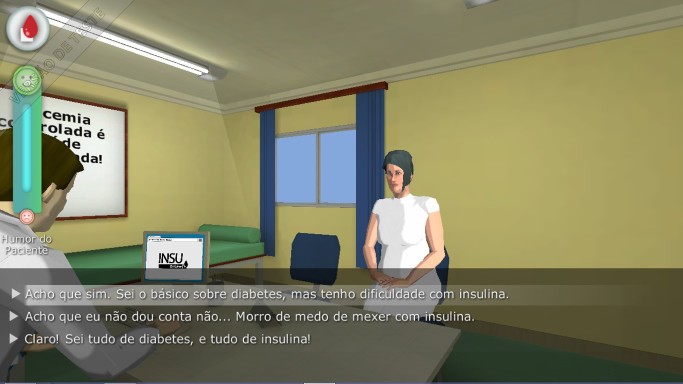
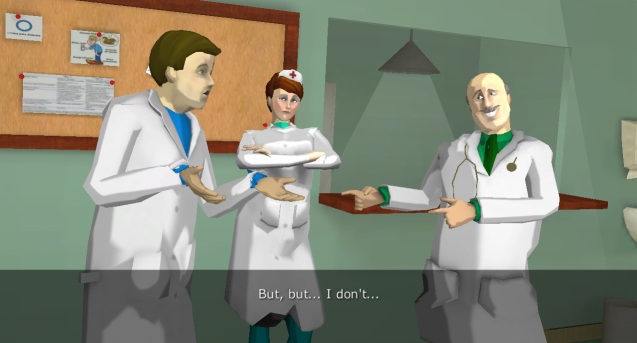
Primary care physicians (PCPs) from South of Brazil were invited by phone or email to participate in an unblinded randomized controlled trial and randomly allocated to play the game InsuOnline, installed as an app in their own computers, at the time of their choice, with minimal or no external guidance, or to participate in a traditional CME session, composed by onsite lectures and cases discussion. Both interventions had the same content and duration (~4 h). Applicability was assessed by the number of subjects who completed the assigned intervention in each group. Insulin-prescribing competence (factual knowledge, problem-solving skills, and attitudes) was self-assessed through a questionnaire applied before, immediately after, and 3 months after the interventions. Acceptance of the intervention (satisfaction and perceived importance for clinical practice) was also assessed immediately after and 3 months after the interventions, respectively.
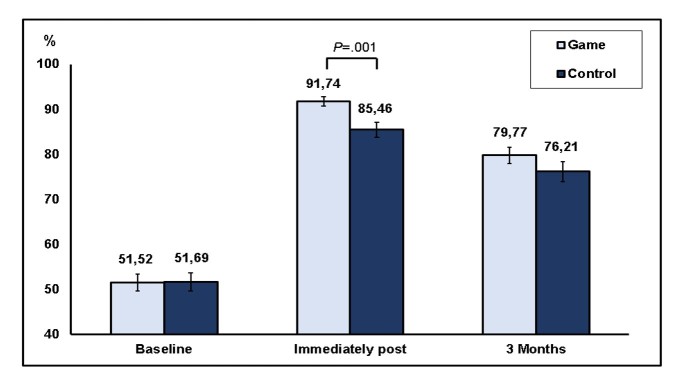
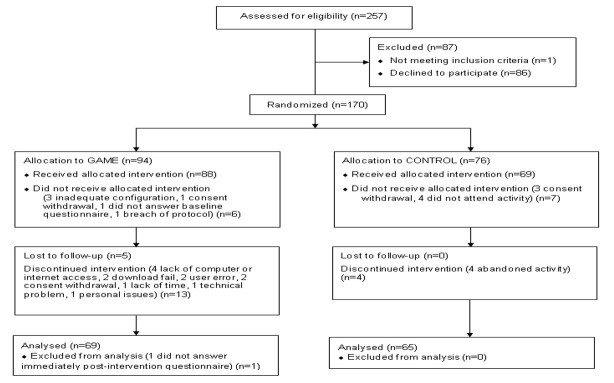
Subjects' characteristics were similar between groups (mean age 38, 51.4% [69/134] male). In the game group, 69 of 88 (78%) completed the intervention, compared with 65 of 73 (89%) in the control group, with no difference in applicability. Percentage of right answers in the competence subscale, which was 52% at the baseline in both groups, significantly improved immediately after both interventions to 92% in the game group and to 85% in control (P<.001). After 3 months, it remained significantly higher than that at the baseline in both groups (80% in game, and 76% in control; P<.001). Absolute increase in competence score was better with the game (40%) than with traditional CME (34%; P=.01). Insulin-related attitudes were improved both after the game (significant improvement in 4 of 9 items) and after control activity (3 of 9). Both interventions were very well accepted, with most subjects rating them as "fun or pleasant," "useful," and "practice-changing."
The game InsuOnline was applicable, very well accepted, and highly effective for medical education on insulin therapy. In view of its flexibility and easy dissemination, it is a valid option for large-scale CME, potentially helping to reduce clinical inertia and to improve quality of care for DM patients.
Clinicaltrials.gov NCT001759953; https://clinicaltrials.gov/ct2/show/NCT01759953 (Archived by WebCite at http://www.webcitation.org/6oeHoTrBf).
大多数糖尿病患者由初级保健医生随访,而这些医生往往缺乏正确开具胰岛素处方的知识或信心。这导致了临床惰性和血糖控制不佳。传统的继续医学教育(CME)解决这一问题的效果有限,因此需要新的方法。电子游戏是一个不错的选择,因为它们非常有效且易于传播。
我们研究的目的是评估一款用于糖尿病胰岛素治疗医学教育的电子严肃游戏InsuOnline与传统CME活动相比的适用性、用户接受度和教育效果。
通过电话或电子邮件邀请巴西南部的初级保健医生(PCP)参加一项非盲随机对照试验,并随机分配他们在自己选择的时间、在极少或没有外部指导的情况下,玩安装在自己电脑上的InsuOnline游戏应用程序,或者参加由现场讲座和病例讨论组成的传统CME课程。两种干预措施的内容和时长相同(约4小时)。通过每组完成指定干预的受试者数量来评估适用性。通过在干预前、干预后立即以及干预后3个月应用的问卷对胰岛素处方能力(事实知识、解决问题的技能和态度)进行自我评估。还分别在干预后立即和干预后3个月评估对干预措施的接受度(满意度以及对临床实践的重要性感知)。
两组受试者的特征相似(平均年龄38岁,51.4%[69/134]为男性)。游戏组88名受试者中有69名(78%)完成了干预,而对照组73名受试者中有65名(89%)完成了干预,适用性方面无差异。能力子量表中正确答案的百分比,两组在基线时均为52%,在两种干预后立即均显著提高,游戏组提高到92%,对照组提高到85%(P<0.001)。3个月后,两组该百分比仍显著高于基线水平(游戏组为80%,对照组为76%;P<0.001)。游戏组能力得分的绝对增幅(40%)优于传统CME(34%;P=0.01)。游戏后胰岛素相关态度得到改善(9项中有4项显著改善),对照活动后也得到改善(9项中有3项)。两种干预措施都非常受欢迎,大多数受试者将其评为“有趣或愉快”“有用”和“改变实践”。
InsuOnline游戏适用于胰岛素治疗的医学教育,非常受欢迎且高效。鉴于其灵活性和易于传播,它是大规模CME的有效选择,可能有助于减少临床惰性并提高糖尿病患者的护理质量。
Clinicaltrials.gov NCT001759953;https://clinicaltrials.gov/ct2/show/NCT01759953(由WebCite存档于http://www.webcitation.org/6oeHoTrBf)