Jankowska-Polańska Beata, Chudiak Anna, Uchmanowicz Izabella, Dudek Krzysztof, Mazur Grzegorz
Department of Clinical Nursing, Wroclaw Medical University.
Department of Logistics and Transport Systems, Faculty of Mechanical Engineering, Wrocław University of Technology.
Patient Prefer Adherence. 2017 Mar 1;11:363-371. doi: 10.2147/PPA.S127407. eCollection 2017.
Low adherence to hypertension (HT) management is one of the major contributors to poor blood pressure (BP) control. Approximately 40%-60% of patients with HT do not follow the prescribed treatment. The aim of the study was to analyze the relationship between selected variables and adherence to hypotensive pharmacological treatment. Besides socioclinical variables, the study focused on the role of illness acceptance.
The study included 602 patients with HT. Adherence and acceptance of illness were assessed using the following validated instruments: the Acceptance of Illness Scale (AIS) and the Morisky Medication Adherence Scale (MMAS).
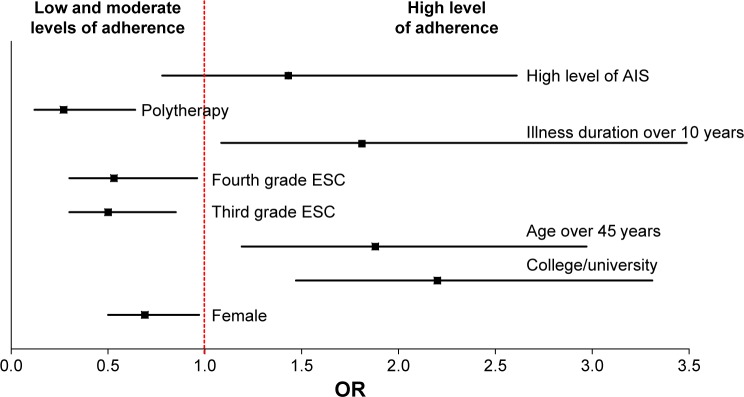
The high-adherence group comprised a significantly higher percentage of patients with high illness acceptance scale scores than that of patients with low-to-moderate scores (42.4 vs 31.8%; =0.008<0.01). The odds ratio (OR) showed that high adherence to pharmacological treatment was >1.5 times as likely to occur in the high acceptance group as in the low-to-moderate acceptance group (OR =1.58, 95% CI 1.14-2.19). Spearman's rank correlation coefficients showed statistically significant correlations between adherence and sex (men =-0.101; =0.012), age >45-66 years (=0.098; =0.015), higher education level (=0.132; =0.001), grade ESC of HT (=-0.037; =0.057), receiving one-tablet polytherapy (=0.131; =0.015), and illness acceptance (=0.090; =0.024).
Acceptance of illness is correlated with adherence to pharmacological treatment, and consideration should be given to more widespread assessment of illness acceptance in daily practice. Male sex, age >45-66 years, duration of illness grade ESC of HT, and receiving one-tablet polytherapy are significant determinants of adherence to pharmacological treatment in HT.
高血压(HT)管理依从性低是血压(BP)控制不佳的主要原因之一。约40%-60%的高血压患者不遵循规定的治疗方案。本研究的目的是分析选定变量与降压药物治疗依从性之间的关系。除社会临床变量外,该研究还关注疾病接纳的作用。
该研究纳入了602例高血压患者。使用以下经过验证的工具评估疾病的依从性和接纳度:疾病接纳量表(AIS)和莫氏 Medication 依从性量表(MMAS)。
高依从性组中疾病接纳量表得分高的患者百分比显著高于中低得分患者(42.4%对31.8%;P=0.008<0.01)。优势比(OR)表明,高接纳组中药物治疗高依从性发生的可能性是中低接纳组的1.5倍以上(OR=1.58,95%CI 1.14-2.19)。Spearman等级相关系数显示,依从性与性别(男性r=-0.101;P=0.012)、年龄>45-66岁(r=0.098;P=0.015)、高等教育水平(r=0.132;P=0.001)、高血压欧洲心脏病学会(ESC)分级(r=-0.037;P=0.057)、接受单片复方治疗(r=0.131;P=0.015)以及疾病接纳度(r=0.090;P=0.024)之间存在统计学显著相关性。
疾病接纳度与药物治疗依从性相关,在日常实践中应考虑更广泛地评估疾病接纳度。男性、年龄>45-66岁、高血压ESC分级病程以及接受单片复方治疗是高血压药物治疗依从性的重要决定因素。