Uchmanowicz Bartosz, Jankowska Ewa A, Uchmanowicz Izabella, Morisky Donald E
Department of Clinical Nursing, Faculty of Health Sciences, Wroclaw Medical University, Wroclaw, Poland.
Cardiology Department, Centre for Heart Diseases, Military Hospital, Wroclaw, Poland.
Front Pharmacol. 2019 Mar 1;10:168. doi: 10.3389/fphar.2019.00168. eCollection 2019.
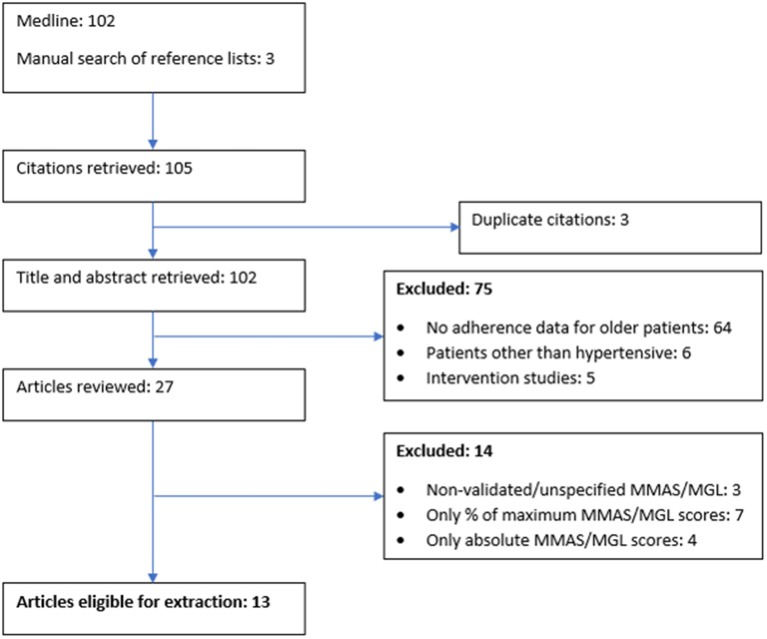
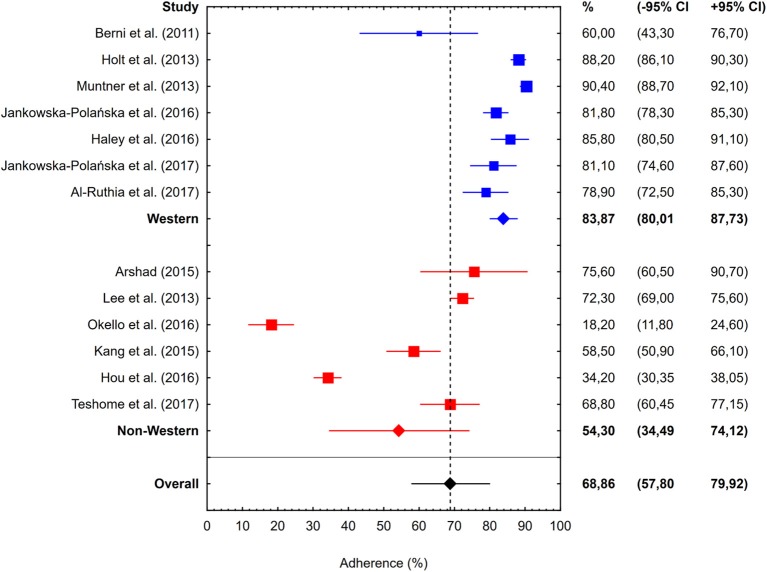
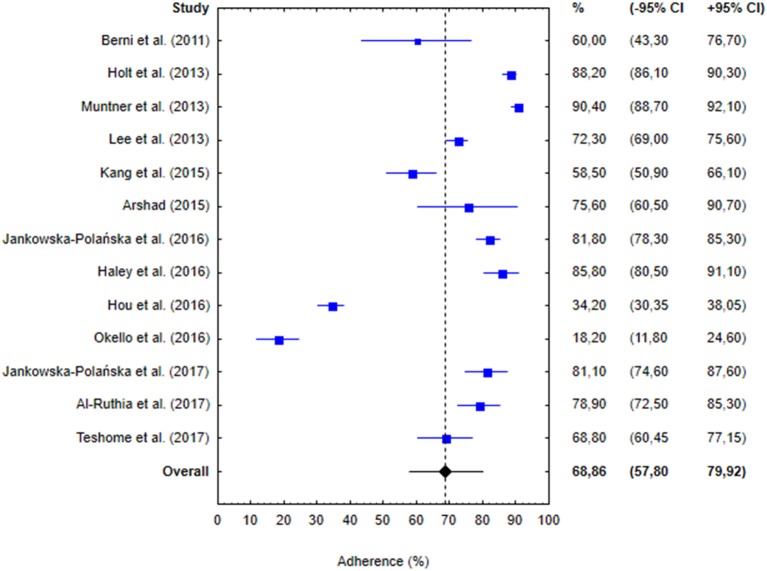
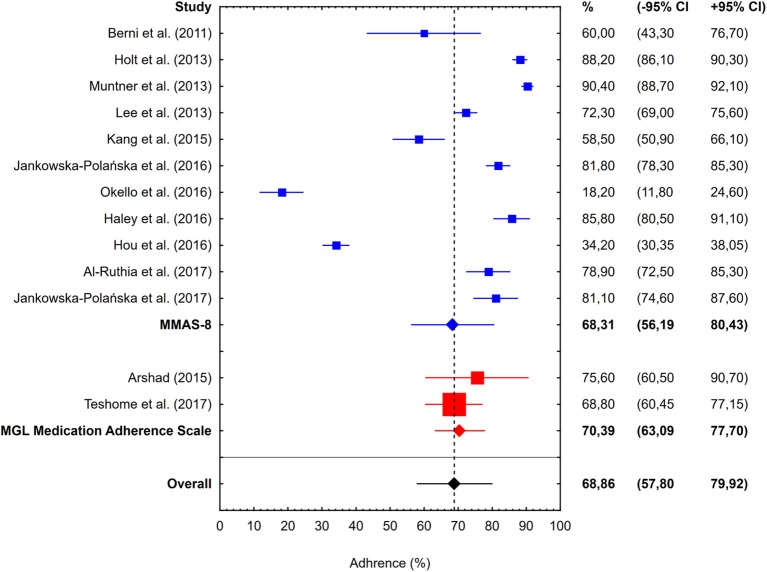
The aim of this systematic review and meta-analysis was to estimate medication adherence in hypertensive patients aged ≥60 years and to explore potential determinants of adherence with antihypertensive treatment in this age group. A systematic search of the PubMed, Scopus, and Google Scholar using the Cochrane guidelines was performed. The analysis included articles published between 1 January 2000 and 30 June 2018. The patients were considered adherent if they scored ≥6 pts. on the Morisky Medication Adherence Scale (MMAS-8) or ≥3 pts. on the Morisky Green Levine Medication Adherence Scale (MGL). If available, also odds ratios (OR) with 95% confidence intervals (95% CI) for determinants of medication adherence were recorded. Thirteen studies including a total of 5,247 patients were available for the meta-analysis. The pooled percentage of adherence was 68.86% (95% CI: 57.80-79.92%). Subgroup analysis did not demonstrate a significant difference in the adherence measured with the MMAS-8 and the MGL (68.31 vs. 70.39%, = 0.773). The adherence of patients from Western countries (Europe, United States) turned out to be significantly higher than in other patients (83.87 vs. 54.30%, = 0.004). The significant determinants of better adherence identified in more than one study were older age, retirement/unemployment, duration of hypertension >10 years, and a lower number of prescribed drugs. Medication adherence in the oldest old hypertensive patients seems to be higher than in younger persons. Adherence in older persons was associated with age, socioeconomic status, and therapy-related factors.
本系统评价和荟萃分析的目的是评估60岁及以上高血压患者的药物依从性,并探讨该年龄组抗高血压治疗依从性的潜在决定因素。按照Cochrane指南对PubMed、Scopus和谷歌学术进行了系统检索。分析纳入了2000年1月1日至2018年6月30日发表的文章。如果患者在Morisky药物依从性量表(MMAS-8)上得分≥6分或在Morisky Green Levine药物依从性量表(MGL)上得分≥3分,则被视为依从。如有可用数据,还记录了药物依从性决定因素的比值比(OR)及95%置信区间(95%CI)。共有13项研究、总计5247例患者可纳入荟萃分析。合并的依从率为68.86%(95%CI:57.80 - 79.92%)。亚组分析未显示MMAS-8和MGL测量的依从性有显著差异(68.31%对70.39%,P = 0.773)。西方国家(欧洲、美国)患者的依从性显著高于其他患者(83.87%对54.30%,P = 0.004)。在不止一项研究中确定的依从性较好的显著决定因素为年龄较大、退休/失业、高血压病程>10年以及处方药数量较少。年龄最大的老年高血压患者的药物依从性似乎高于年轻人。老年人的依从性与年龄、社会经济状况及治疗相关因素有关。