Ayalew Mohammed Biset
Department of Clinical Pharmacy, School of Pharmacy, College of Medicine and Health Sciences, University of Gondar, Gondar, Ethiopia.
Patient Prefer Adherence. 2017 Mar 1;11:401-413. doi: 10.2147/PPA.S131496. eCollection 2017.
Self-medication patterns vary among different populations, and are influenced by many factors. No review has been done that comprehensively expresses self-medication practice in Ethiopia. The aim of this study was to provide an overview of the literature on self-medication practice in Ethiopia.
Databases (PubMed, Google Scholar, ResearchGate, and Hinari) were searched for published studies on the practice of self-medication in Ethiopia without restriction in the year of publication or methodology. Some studies were also identified through manual Google search. Primary search terms were "self medication", "Ethiopia", "self care", "non-prescription", "OTC drug use", "drug utilization", and "drug hoarding". Studies that measured knowledge only or attitude only or beliefs only and did not determine the practice of self-medication were excluded.
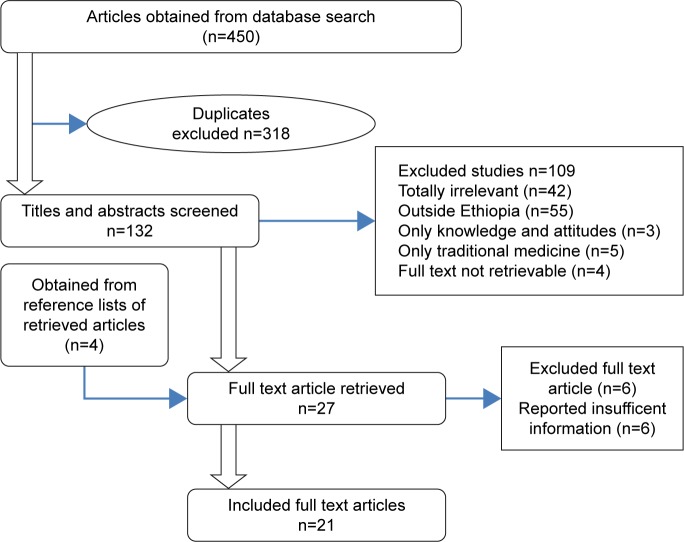
The database search produced a total of 450 papers. After adjustment for duplicates and inclusion and exclusion criteria, 21 articles were found suitable for the review. All studies were cross-sectional in nature. The prevalence of self-medication varied from 12.8% to 77.1%, with an average of 36.8%. Fever/headache, gastrointestinal tract diseases, and respiratory diseases were the commonest illnesses/symptoms for which self-medication was taken. The major reasons for practicing self-medication were previous experience of treating a similar illness and feeling that the illness was mild. Analgesics/antipyretics, antimicrobials, gastrointestinal drugs, and respiratory drugs were the common drug classes used in self-medication. Mainly, these drugs were obtained from drug-retail outlets. The use of self-medication was commonly suggested by pharmacy professionals and friends/relatives.
Self-medication practice is prevalent in Ethiopia and varies in different populations and regions of the country. Some of the self-medication practices are harmful and need prompt action. Special attention should be given to educating the public and health care providers on the types of illnesses that can be self-diagnosed and self-treated and the types of drugs to be used for self-medication.
自我药疗模式在不同人群中存在差异,并受多种因素影响。目前尚未有综述全面阐述埃塞俄比亚的自我药疗情况。本研究旨在概述埃塞俄比亚自我药疗的相关文献。
检索数据库(PubMed、谷歌学术、ResearchGate和Hinari)中关于埃塞俄比亚自我药疗实践的已发表研究,对发表年份或研究方法不设限制。部分研究也通过谷歌手动搜索确定。主要检索词为“自我药疗”“埃塞俄比亚”“自我护理”“非处方药”“非处方药物使用”“药物利用”和“囤药”。仅测量知识、态度或信念而未确定自我药疗实践的研究被排除。
数据库搜索共产生450篇论文。经重复文献调整及纳入和排除标准筛选后,发现21篇文章适合纳入综述。所有研究均为横断面研究。自我药疗的患病率从12.8%至77.1%不等,平均为36.8%。发热/头痛、胃肠道疾病和呼吸道疾病是自我药疗最常见的疾病/症状。自我药疗的主要原因是既往有治疗类似疾病的经验以及认为病情较轻。镇痛药/退热药、抗菌药物、胃肠道药物和呼吸道药物是自我药疗中常用的药物类别。这些药物主要从药店获取。自我药疗的做法通常由药剂师和朋友/亲属建议。
自我药疗在埃塞俄比亚普遍存在,且在该国不同人群和地区存在差异。一些自我药疗做法有害,需要迅速采取行动。应特别重视对公众和医疗保健提供者进行教育,使其了解哪些疾病可以自我诊断和自我治疗,以及自我药疗应使用哪些药物。