Sisay Mekonnen, Mengistu Getnet, Edessa Dumessa
Department of Pharmacology and Toxicology, School of Pharmacy, College of Health and Medical Sciences, Haramaya University, P.O. Box 235, Harar, Ethiopia.
Pharmacology Unit, Department of Pharmacy, College of Medicine and Health Sciences, Wollo University, P.O. Box 1145, Dessie, Ethiopia.
BMC Pharmacol Toxicol. 2018 Sep 10;19(1):56. doi: 10.1186/s40360-018-0248-8.
Self-medication is the use of drugs to treat self-diagnosed disorders and/or symptoms, or the intermittent or continued use of a prescribed drug for recurrent disease or symptoms. This phenomenon is alarmingly increasing over time despite the occurrence of health-related hazards. This study is, therefore, aimed to quantitatively estimate self-medication practice and possible reasons for it in Ethiopia.
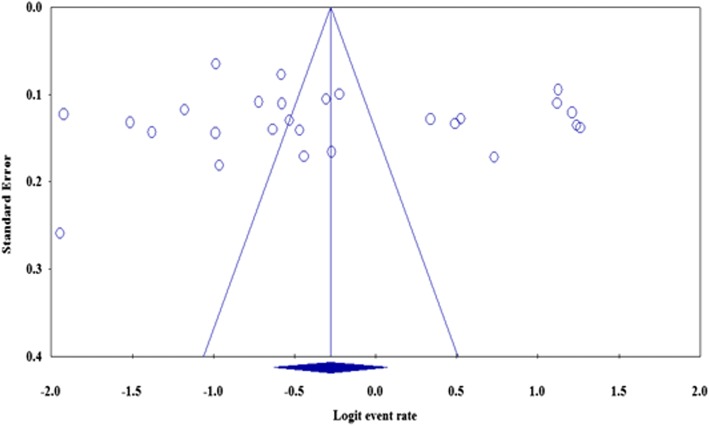
Data were identified from major databases and indexing services including EMBASE (Ovid), PubMed, MEDLINE (Ovid), and Google Scholar. Both published and unpublished records addressing self medication practice in Ethiopia without time limit were included for the study. Data were extracted with structured format prepared in Microsoft Excel and exported to OpenMeta[analyst] version 3.3 software for analyses. Pooled estimation of outcomes was performed with DerSimonian-Laird random-effects model at 95% confidence level. Sensitivity and subgroup analyses were also considered. Degree of heterogeneity of studies was presented with I statistics. Publication bias was also performed with the help of Comprehensive Meta-Analysis version-3 software and presented with funnel plots of standard error supplemented by Begg's and Egger's tests. The study protocol is registered on PROSPERO with reference number ID: CRD42018093790.
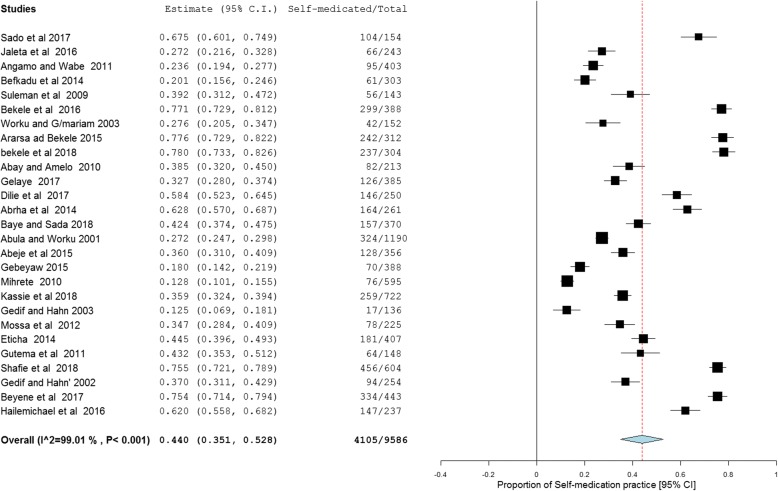
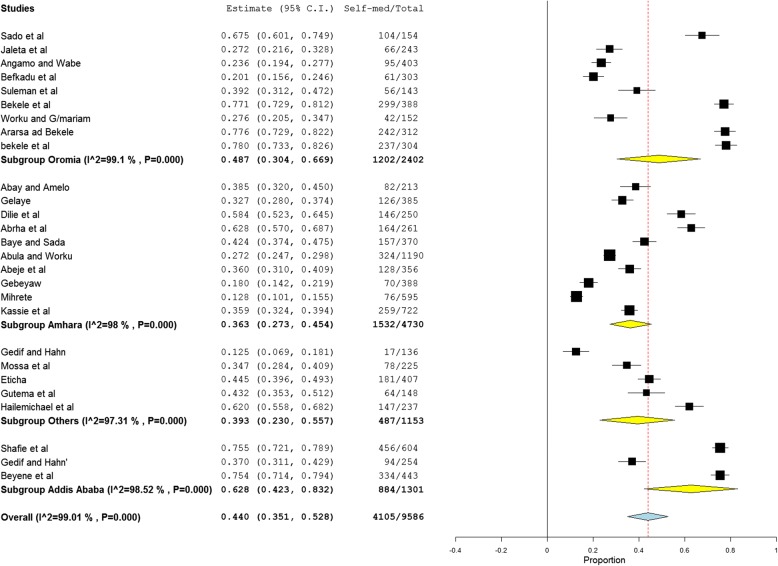
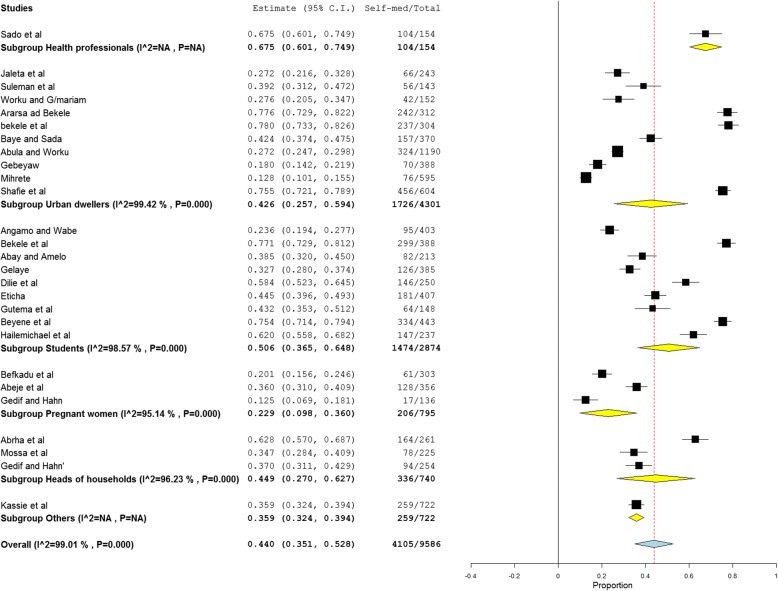
A total of 27 studies with 9586 participants were included for the study. The pooled prevalence of self-medication in Ethiopia was found to be 44.0% (95% confidence interval [CI]: 35.1, 52.8). Geographical-based subgroup analysis revealed that the highest prevalence was observed at the capital of Ethiopia, Addis Ababa, 62.8% (95% CI: 42.3, 83.2). Population based analysis indicated that healthcare professionals and students were the main practitioners of self-medication. Besides, the prevalence of self-medication practice in pregnant women is approximately 22.9% (95% CI: 9.8, 36). The most common reasons to practice self-medication were previous experience of clients and/or familiarity of treatments, 31.3% (95% CI: 21.5, 41.1) and perceived mildness of the illness, 31.1% (95% CI: 26.0, 36.2). The pooled prevalence of analgesics, antimicrobial agents and gastrointestinal drugs were 46.1% (95% CI: 36.2, 56.1), 28.2% (95% CI: 19.6, 36.8), and 14.9% (95% CI: 7.8, 21.9), respectively.
Self-medication practice becomes a common phenomenon in Ethiopia. The use of prescription-only medications including antimicrobial agents without medical consult has become alarmingly high. This practice will come with potential health related hazards including emergence of antimicrobial resistance. Therefore, there must be a multitude of strategies for reversing the current worrying trends of self-medication.
自我药疗是指使用药物来治疗自我诊断的疾病和/或症状,或对复发性疾病或症状间歇性或持续使用处方药。尽管存在与健康相关的危害,但随着时间的推移,这种现象正惊人地增加。因此,本研究旨在定量评估埃塞俄比亚的自我药疗行为及其可能的原因。
从主要数据库和索引服务中获取数据,包括EMBASE(Ovid)、PubMed、MEDLINE(Ovid)和谷歌学术。纳入了所有不限时间、涉及埃塞俄比亚自我药疗行为的已发表和未发表记录进行研究。数据采用在Microsoft Excel中准备的结构化格式提取,并导出到OpenMeta[analyst] 3.3版软件进行分析。采用DerSimonian-Laird随机效应模型在95%置信水平下对结果进行合并估计。还考虑了敏感性和亚组分析。研究的异质性程度用I统计量表示。借助Comprehensive Meta-Analysis 3版软件进行发表偏倚分析,并通过标准误差漏斗图以及Begg检验和Egger检验呈现。该研究方案已在PROSPERO注册,注册号为:CRD42018093790。
本研究共纳入27项研究,涉及9586名参与者。埃塞俄比亚自我药疗的合并患病率为44.0%(95%置信区间[CI]:35.1,52.8)。基于地理的亚组分析显示,埃塞俄比亚首都亚的斯亚贝巴的患病率最高,为62.8%(95% CI:42.3,83.2)。基于人群的分析表明,医疗保健专业人员和学生是自我药疗的主要践行者。此外,孕妇自我药疗行为的患病率约为22.9%(95% CI:9.8,36)。自我药疗最常见的原因是患者以前的经验和/或对治疗的熟悉程度,为31.3%(95% CI:21.5,41.1),以及认为疾病轻微,为31.1%(95% CI:26.0,36.2)。镇痛药、抗菌药物和胃肠道药物的合并患病率分别为46.1%(95% CI:36.2,56.1)、28.2%(95% CI:19.6,36.8)和14.9%(95% CI:7.8,21.9)。
自我药疗行为在埃塞俄比亚已成为一种普遍现象。在没有医疗咨询的情况下使用包括抗菌药物在内的仅凭处方使用的药物的情况已高得惊人。这种行为将带来包括抗菌药物耐药性出现在内的潜在健康相关危害。因此,必须采取多种策略来扭转当前令人担忧的自我药疗趋势。