Lizán Luis, Comellas Marta, Paz Silvia, Poveda José Luis, Meletiche Dennis M, Polanco Carlos
Outcomes'10, Castellón, Spain.
Hospital Universitario La Fe, Valencia, Spain.
Patient Prefer Adherence. 2014 Dec 4;8:1653-64. doi: 10.2147/PPA.S67253. eCollection 2014.
Treatment adherence is one of the key factors for achieving optimal clinical outcomes. In order to assess costs related to adherence to, and persistence and compliance with, disease-modifying therapies (DMTs) in patients with multiple sclerosis (MS), a narrative review of the literature was performed. Satisfaction with and preference for DMTs and their delivery devices were also assessed, as both can have an influence on patients' adherence and persistence.
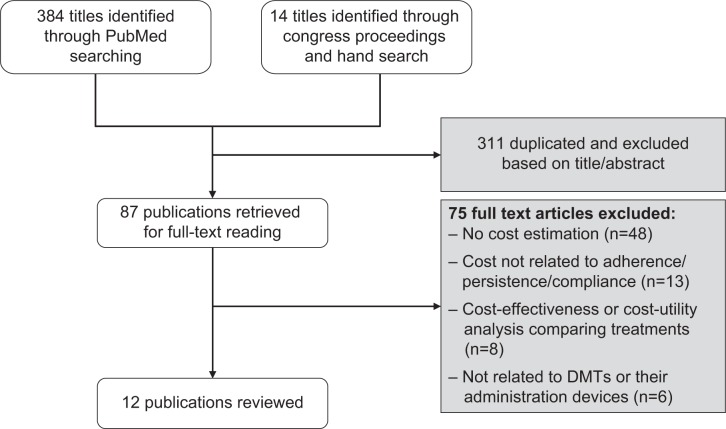
Electronic databases (MEDLINE, PubMed, Google Scholar, congress proceedings) were searched to identify publications analyzing MS costs related to adherence, persistence, satisfaction, and preferences for MS treatments. Bibliographic references were hand searched. English or Spanish studies published between January 2007 and January 2013 were selected.
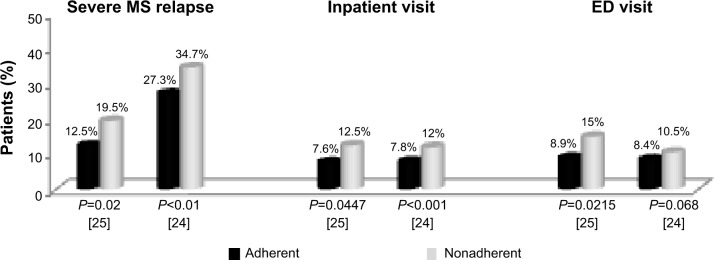
A total of 398 titles were identified, of which 12 met the inclusion criteria. Six studies evaluated the impact of adherence, persistence, and compliance on treatment costs; four publications analyzed satisfaction with DMTs; and two assessed treatment preferences based on attributes of the delivery device. Increased adherence and persistence were associated with better clinical outcomes, leading to lower relapse risk (odds ratio [OR]: 0.71; 95% confidence interval [CI]: 0.59-0.85) and a decrease in health care resource use, such as MS-related hospitalizations (OR: 0.63; 95% CI: 0.47-0.83) and emergency department visits (OR: 0.80; 95% CI: 0.60-1.07). This reduction in resource use led to a patient/year total cost reduction (excluding DMT costs) of up to 22%.
This review highlights the importance of ensuring adequate adherence in MS patients through treatments and devices better tailored to patients' needs that could enhance clinical outcomes and reduce MS costs. Understanding the factors underlying satisfaction and compliance with treatment and patients' preference for certain therapies could help in the development of strategies that can improve adherence.
治疗依从性是实现最佳临床疗效的关键因素之一。为了评估与多发性硬化症(MS)患者对疾病修饰疗法(DMT)的依从性、持续性和顺应性相关的成本,我们对文献进行了叙述性综述。同时还评估了患者对DMT及其给药装置的满意度和偏好,因为这两者都会影响患者的依从性和持续性。
检索电子数据库(MEDLINE、PubMed、谷歌学术、会议论文集),以识别分析与MS治疗的依从性、持续性、满意度和偏好相关成本的出版物。对手工检索的参考文献进行了检查。选取了2007年1月至2013年1月期间发表的英文或西班牙文研究。
共识别出398个标题,其中12个符合纳入标准。六项研究评估了依从性、持续性和顺应性对治疗成本的影响;四项出版物分析了对DMT的满意度;两项基于给药装置的属性评估了治疗偏好。依从性和持续性的提高与更好的临床疗效相关,导致复发风险降低(优势比[OR]:0.71;95%置信区间[CI]:0.59 - 0.85),以及医疗资源使用的减少,如与MS相关的住院(OR:0.63;95% CI:0.47 - 0.83)和急诊就诊(OR:0.80;95% CI:0.60 - 1.07)。这种资源使用的减少导致患者每年总成本(不包括DMT成本)降低高达22%。
本综述强调了通过更适合患者需求的治疗方法和装置来确保MS患者充分依从性的重要性,这可以提高临床疗效并降低MS成本。了解影响治疗满意度和顺应性的因素以及患者对某些疗法的偏好,有助于制定可提高依从性的策略。