
农用化学品协同作用对新热带地区蜜蜂造成的风险比对蜜蜂造成的风险更高。
Agrochemical synergism imposes higher risk to Neotropical bees than to honeybees.
作者信息
Tomé Hudson V V, Ramos Gabryele S, Araújo Micaele F, Santana Weyder C, Santos Gil R, Guedes Raul Narciso C, Maciel Carlos D, Newland Philip L, Oliveira Eugênio E
机构信息
Departamento de Entomologia, Universidade Federal de Viçosa, 36570-900 Viçosa-MG, Brazil; EAG Laboratories, 13709 Progress Boulevard no. 24, Suite S163, Alachua, FL, 32615USA.
Departamento de Entomologia , Universidade Federal de Viçosa , 36570-900 Viçosa-MG , Brazil.
出版信息
R Soc Open Sci. 2017 Jan 18;4(1):160866. doi: 10.1098/rsos.160866. eCollection 2017 Jan.
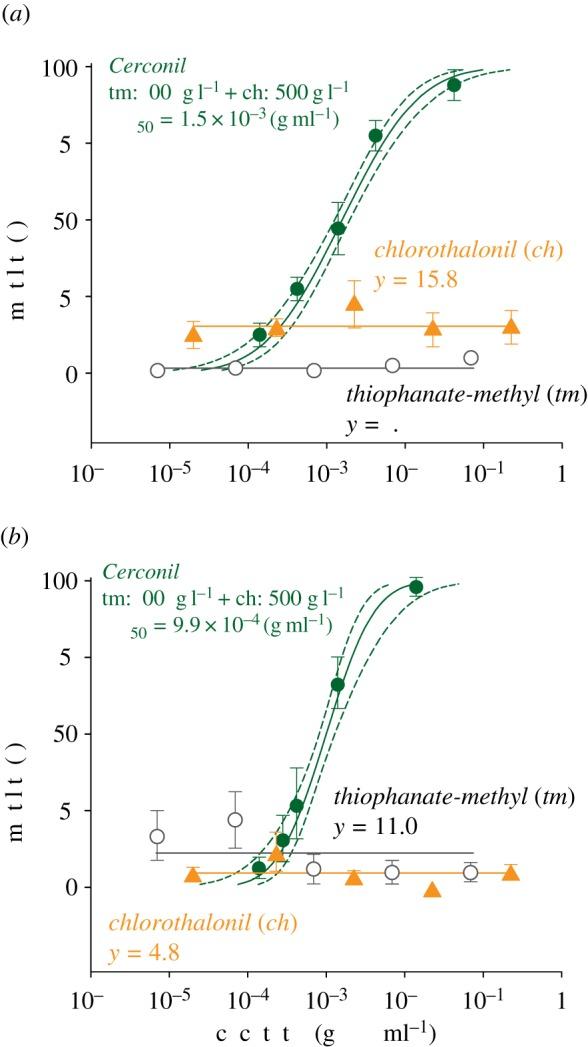
Bees are key pollinators whose population numbers are declining, in part, owing to the effects of different stressors such as insecticides and fungicides. We have analysed the susceptibility of the Africanized honeybee, , and the stingless bee, to commercial formulations of the insecticides deltamethrin and imidacloprid. The toxicity of fungicides based on thiophanate-methyl and chlorothalonil were investigated individually and in combination, and with the insecticides. Results showed that stingless bees were more susceptible to insecticides than honeybees. The commercial fungicides thiophanate-methyl or chlorothalonil caused low mortality, regardless of concentration; however, their combination was as toxic as imidacloprid to both species, and over 400-fold more toxic than deltamethrin for . There were highly synergistic effects on mortality caused by interactions in the mixture of imidacloprid and the fungicides thiophanate-methyl, chlorothalonil and the combined fungicide formulation in and also to a lesser extent in . By contrast, mixtures of the deltamethrin and the combined fungicide formulation induced high synergy in , but had little effect on the mortality of . Differences in physiology and modes of action of agrochemicals are discussed as key factors underlying the differences in susceptibility to agrochemicals.
蜜蜂是关键的传粉者,但其数量正在下降,部分原因是杀虫剂和杀菌剂等不同压力源的影响。我们分析了非洲化蜜蜂和无刺蜂对杀虫剂溴氰菊酯和吡虫啉商业制剂的敏感性。单独和联合研究了基于甲基托布津和百菌清的杀菌剂的毒性,以及与杀虫剂的联合毒性。结果表明,无刺蜂比蜜蜂对杀虫剂更敏感。商业杀菌剂甲基托布津或百菌清无论浓度如何,死亡率都很低;然而,它们的组合对两种蜜蜂的毒性与吡虫啉相当,对无刺蜂的毒性比对溴氰菊酯高400多倍。吡虫啉与杀菌剂甲基托布津、百菌清以及复合杀菌剂制剂的混合物对无刺蜂和蜜蜂的死亡率有高度协同作用,在无刺蜂中的协同作用程度较低。相比之下,溴氰菊酯与复合杀菌剂制剂的混合物在无刺蜂中诱导出高协同作用,但对蜜蜂的死亡率影响很小。讨论了农药生理和作用方式的差异是导致对农药敏感性差异的关键因素。




 Zotero 插件