Coenen Volker Arnd, Varkuti Balint, Parpaley Yaroslav, Skodda Sabine, Prokop Thomas, Urbach Horst, Li Meng, Reinacher Peter Christoph
Department of Stereotactic and Functional Neurosurgery, Medical Faculty, Freiburg University Medical Center, Freiburg (i.Br.), Germany.
Brainlab AG, Feldkirchen, Germany.
Acta Neurochir (Wien). 2017 May;159(5):779-787. doi: 10.1007/s00701-017-3134-z. Epub 2017 Mar 10.
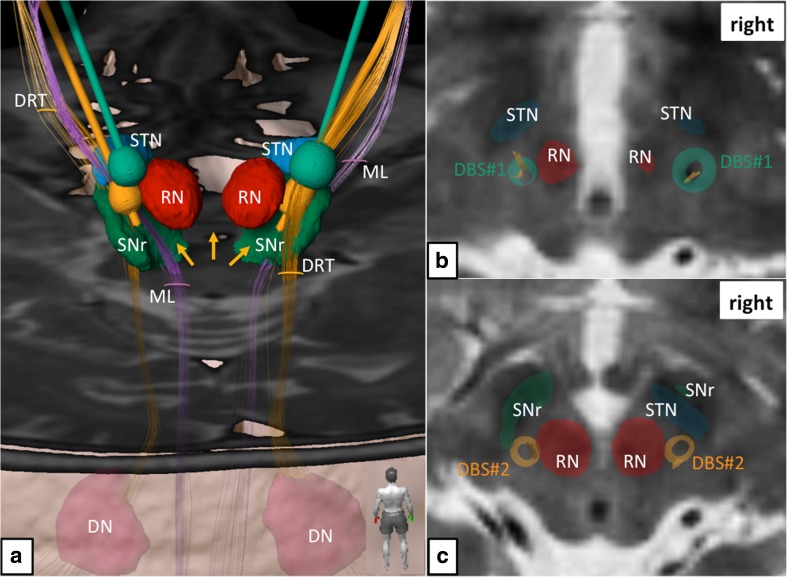
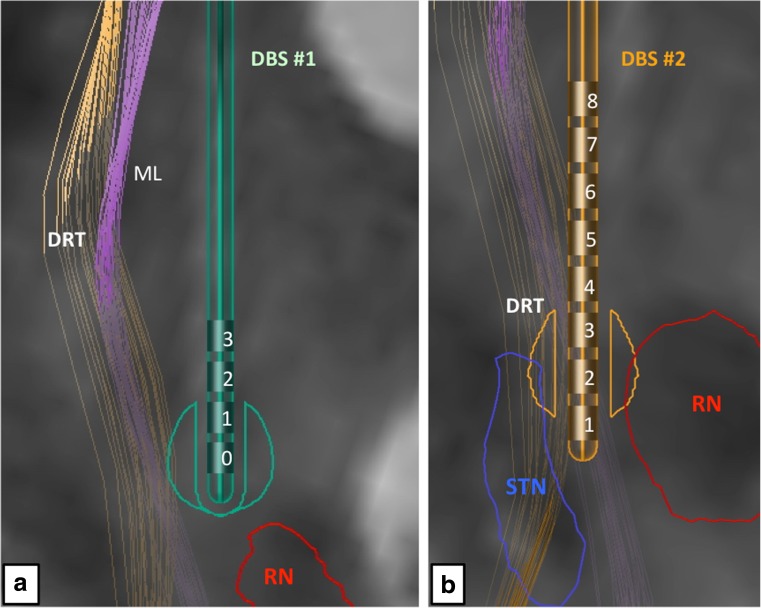
We report a patient who received conventional bilateral deep brain stimulation of the ventral intermediate nucleus of thalamus (Vim) for the treatment of medication refractory essential tremor (ET). After initial beneficial effects, therapeutic efficacy was lost due to a loss of control of his proximal trunkal and extremity tremor. The patient received successful diffusion tensor magnetic resonance imaging fiber tractographic (DTI FT)-assisted DBS revision surgery targeting the dentato-rubro-thalamic tract (DRT) in the subthalamic region (STR).
To report the concept of DTI FT-assisted DRT DBS revision surgery for ET and to show sophisticated postoperative neuroimaging analysis explaining improved symptom control.
Analysis was based on preoperative DTI sequences and postoperative helical computed tomography (hCT). Leads, stimulation fields, and fibers were reconstructed using commercial software systems (Elements, Brainlab AG, Feldkirchen, Germany; GUIDE XT, Boston Scientific Corp., Boston, MA, USA).
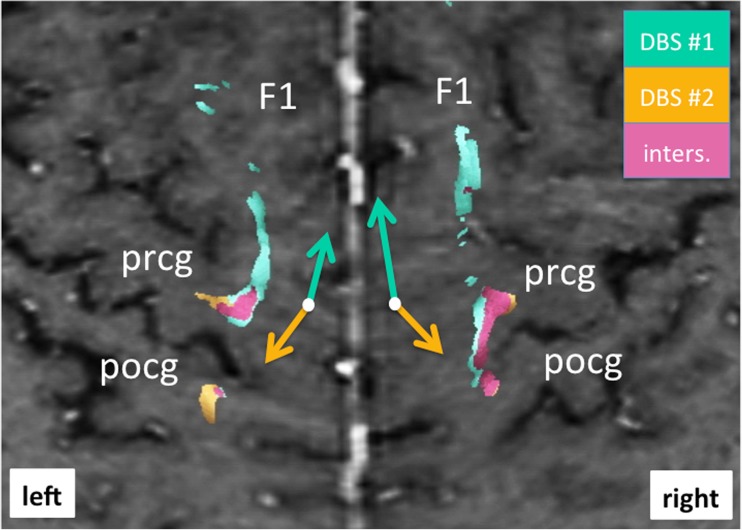
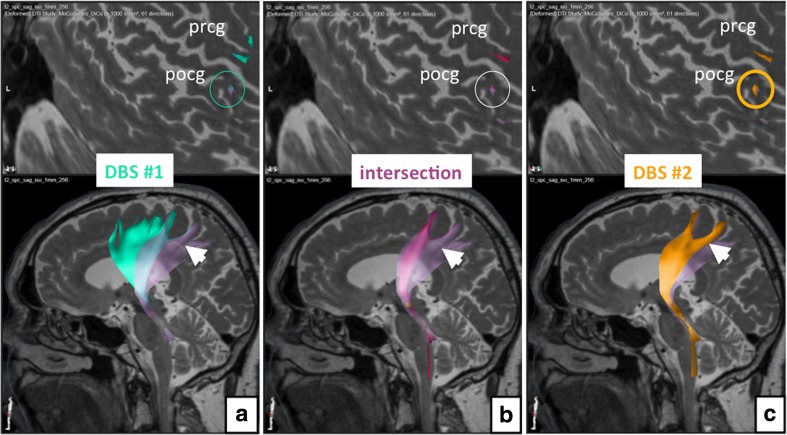
The patient showed immediate and sustained tremor improvement after DTI FT-assisted revision surgery. Analysis of the two implantations (electrode positions in both instances) revealed a lateral and posterior shift in the pattern of modulation of the cortical fiber pathway projection after revision surgery as compared to initial implantation, explaining a more efficacious stimulation.
Our work underpins a possible superiority of direct targeting approaches using advanced neuroimaging technologies to perform personalized DBS surgery. The evaluation of DBS electrode positions with the herein-described neuroimaging simulation technologies will likely improve targeting and revision strategies. Direct targeting with DTI FT-assisted approaches in a variety of indications is the focus of our ongoing research.
我们报告了一名接受传统双侧丘脑腹中间核(Vim)深部脑刺激治疗药物难治性特发性震颤(ET)的患者。在最初取得有益效果后,由于对其近端躯干和肢体震颤失去控制,治疗效果丧失。该患者接受了成功的弥散张量磁共振成像纤维束成像(DTI FT)辅助的脑深部电刺激(DBS)翻修手术,靶点为丘脑底区域(STR)的齿状红核丘脑束(DRT)。
报告DTI FT辅助DRT DBS翻修手术治疗ET的概念,并展示复杂的术后神经影像学分析,解释症状控制改善的原因。
分析基于术前DTI序列和术后螺旋计算机断层扫描(hCT)。使用商业软件系统(Elements,Brainlab AG,德国费尔德kirchen;GUIDE XT,美国波士顿科学公司,马萨诸塞州波士顿)重建电极、刺激区域和纤维束。
患者在DTI FT辅助翻修手术后立即且持续出现震颤改善。对两次植入(两次的电极位置)的分析显示,与初次植入相比,翻修手术后皮质纤维束投射的调制模式出现了外侧和后方移位,这解释了刺激效果更佳的原因。
我们的工作支持了使用先进神经影像学技术进行个性化DBS手术的直接靶向方法可能具有的优势。使用本文所述神经影像学模拟技术评估DBS电极位置可能会改善靶向和翻修策略。在各种适应症中采用DTI FT辅助方法进行直接靶向是我们正在进行的研究重点。