Strappini Francesca, Pelli Denis G, Di Pace Enrico, Martelli Marialuisa
Department of Psychology, University of Rome La Sapienza, Rome, Italy; Neuropsychology Research Centre, IRCCS Foundation Hospital Santa Lucia, Rome, Italy; Neurobiology Department, Weizmann Institute of Science, Rehovot, Israel.
Department of Psychology and Center for Neural Science, New York University, New York, NY, USA.
Cortex. 2017 Apr;89:135-155. doi: 10.1016/j.cortex.2017.01.012. Epub 2017 Feb 1.
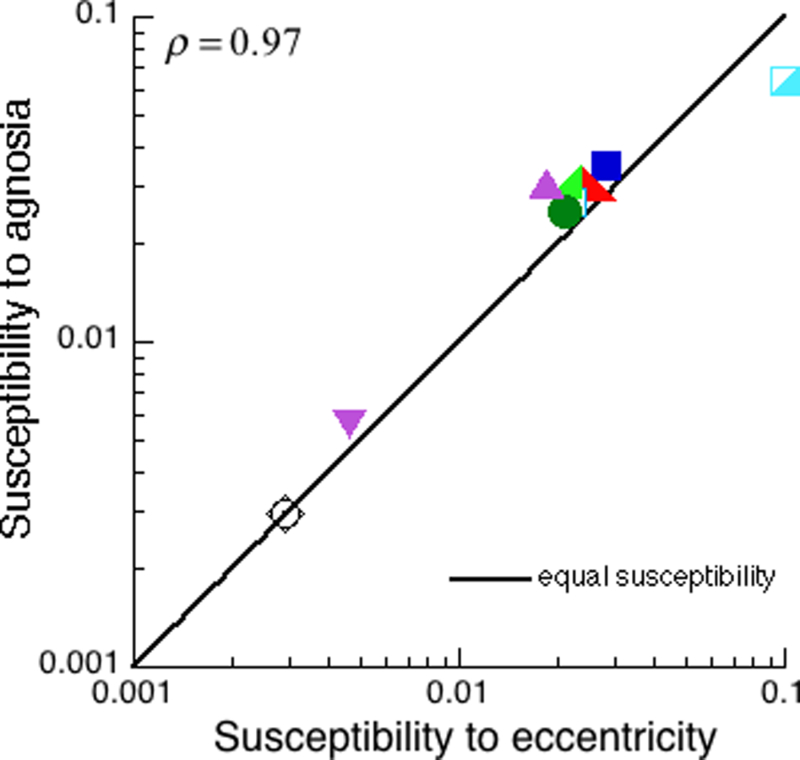
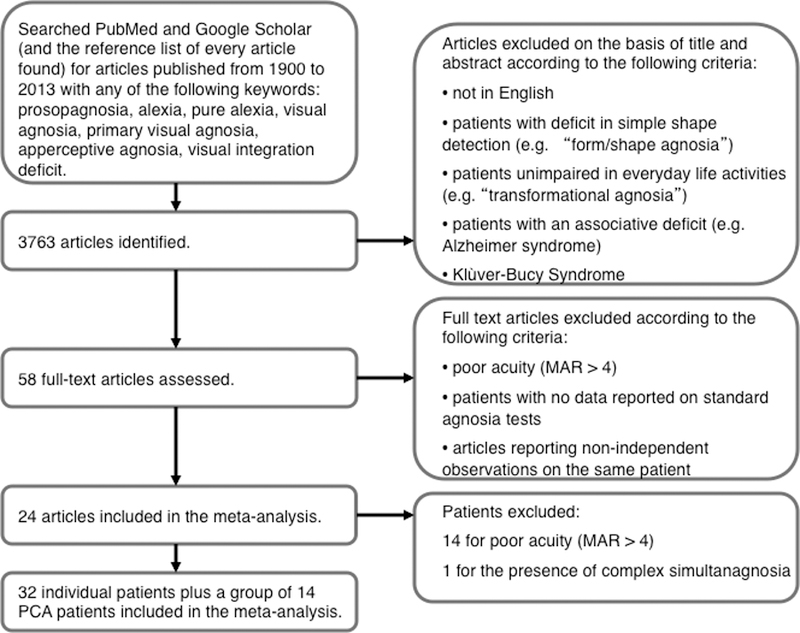
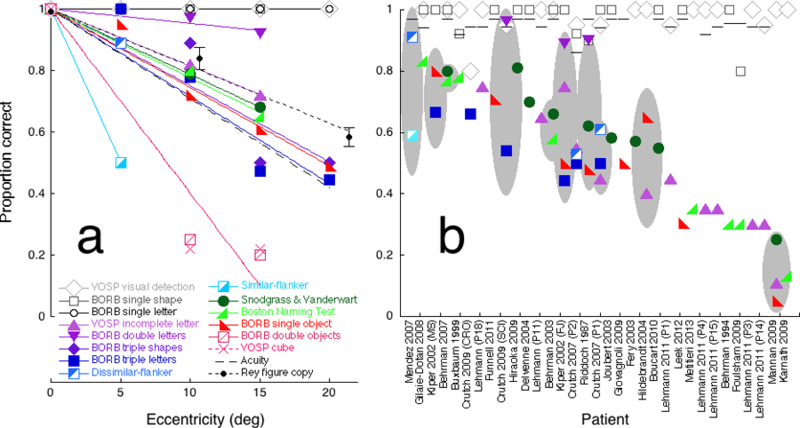
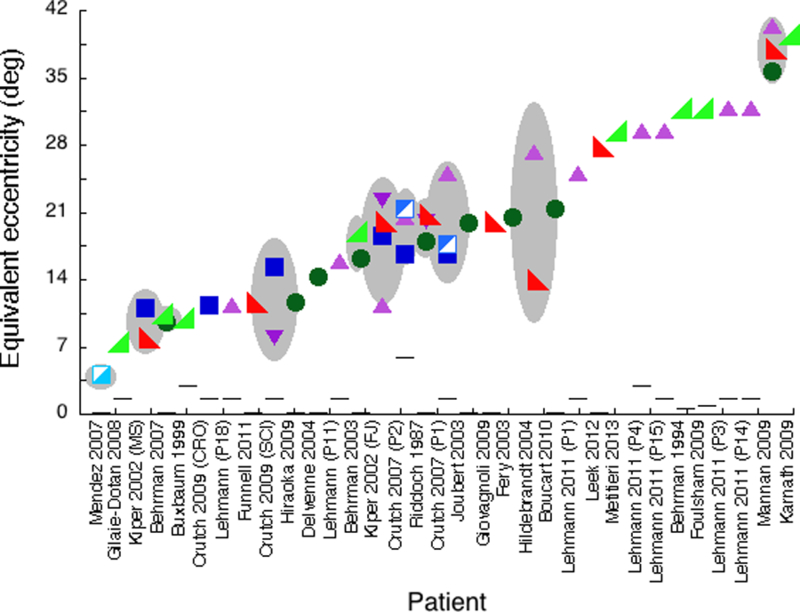
Visual agnosia is a neuropsychological impairment of visual object recognition despite near-normal acuity and visual fields. A century of research has provided only a rudimentary account of the functional damage underlying this deficit. We find that the object-recognition ability of agnosic patients viewing an object directly is like that of normally-sighted observers viewing it indirectly, with peripheral vision. Thus, agnosic vision is like peripheral vision. We obtained 14 visual-object-recognition tests that are commonly used for diagnosis of visual agnosia. Our "standard" normal observer took these tests at various eccentricities in his periphery. Analyzing the published data of 32 apperceptive agnosia patients and a group of 14 posterior cortical atrophy (PCA) patients on these tests, we find that each patient's pattern of object recognition deficits is well characterized by one number, the equivalent eccentricity at which our standard observer's peripheral vision is like the central vision of the agnosic patient. In other words, each agnosic patient's equivalent eccentricity is conserved across tests. Across patients, equivalent eccentricity ranges from 4 to 40 deg, which rates severity of the visual deficit. In normal peripheral vision, the required size to perceive a simple image (e.g., an isolated letter) is limited by acuity, and that for a complex image (e.g., a face or a word) is limited by crowding. In crowding, adjacent simple objects appear unrecognizably jumbled unless their spacing exceeds the crowding distance, which grows linearly with eccentricity. Besides conservation of equivalent eccentricity across object-recognition tests, we also find conservation, from eccentricity to agnosia, of the relative susceptibility of recognition of ten visual tests. These findings show that agnosic vision is like eccentric vision. Whence crowding? Peripheral vision, strabismic amblyopia, and possibly apperceptive agnosia are all limited by crowding, making it urgent to know what drives crowding. Acuity does not (Song et al., 2014), but neural density might: neurons per deg in the crowding-relevant cortical area.
视觉失认症是一种神经心理学上的视觉物体识别障碍,尽管视力和视野接近正常。一个世纪的研究仅对这种缺陷背后的功能损伤给出了初步解释。我们发现,失认症患者直接观看物体时的物体识别能力,类似于视力正常的观察者通过周边视觉间接观看该物体时的能力。因此,失认症视觉类似于周边视觉。我们获得了14项常用于诊断视觉失认症的视觉物体识别测试。我们的“标准”正常观察者在其周边的不同偏心度下进行了这些测试。分析32名apperceptive失认症患者和一组14名后皮质萎缩(PCA)患者在这些测试中的已发表数据,我们发现每个患者的物体识别缺陷模式都可以用一个数字很好地描述,即我们的标准观察者的周边视觉类似于失认症患者中心视觉的等效偏心度。换句话说,每个失认症患者的等效偏心度在各项测试中是守恒的。在不同患者中,等效偏心度范围为4至40度,这衡量了视觉缺陷的严重程度。在正常周边视觉中,感知简单图像(例如单个字母)所需的大小受视力限制,而对于复杂图像(例如面部或单词)则受拥挤效应限制。在拥挤效应中,相邻的简单物体除非其间距超过拥挤距离,否则会显得杂乱无章而无法辨认,拥挤距离随偏心度线性增加。除了在物体识别测试中等效偏心度的守恒外,我们还发现从偏心度到失认症,十种视觉测试识别的相对易感性也存在守恒。这些发现表明失认症视觉类似于偏心视觉。那么拥挤效应是怎么回事呢?周边视觉、斜视性弱视以及可能的apperceptive失认症都受拥挤效应限制,因此迫切需要了解是什么驱动了拥挤效应。视力并非如此(Song等人,2014年),但神经密度可能是:拥挤相关皮质区域中每度的神经元数量。