Penzhorn Barend L, Vorster Ilse, Harrison-White Robert F, Oosthuizen Marinda C
Department of Veterinary Tropical Diseases, Faculty of Veterinary Science, University of Pretoria, Private Bag X04, Onderstepoort, 0110, South Africa.
Research Associate, National Zoological Gardens, Boom Street, Pretoria, South Africa.
Parasit Vectors. 2017 Mar 13;10(1):124. doi: 10.1186/s13071-017-2057-0.
Babesia rossi, which is transmitted by Haemaphysalis spp. and is highly virulent to domestic dogs, occurs only in sub-Saharan Africa. Since dogs are not native to the region, it has been postulated that the natural host of B. rossi is an indigenous African canid. Although various attempts at artificial infection indicated that black-backed jackals (Canis mesomelas) could become subclinically infected with B. rossi, data on occurrence of B. rossi in free-ranging jackals was lacking. A long-term behaviour study in which free-ranging black-backed jackals were radio-collared offered the opportunity of collecting blood specimens from a large number of free-ranging jackals.
Genomic DNA was extracted from the EDTA blood samples (n = 107). PCR products were subjected to Reverse Line Blot hybridization using Theileria and Babesia genera-specific as well as 28 species-specific oligonucleotide probes, including Babesia canis, Babesia rossi, Babesia vogeli and Babesia gibsoni. The near full-length parasite 18S rRNA gene was amplified from two selected samples (free-ranging jackals), cloned and a total of six recombinants were sequenced.
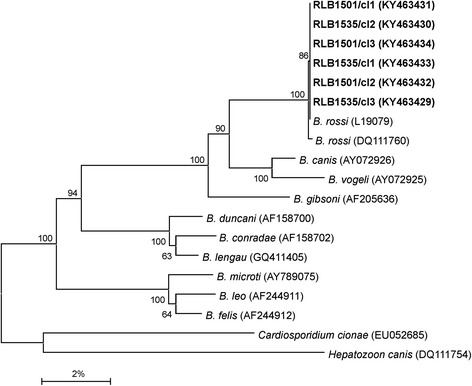
Of 91 free-ranging jackals, 77 (84.6%) reacted with the Babesia genus-specific probe; 27 (29.7%) also reacted with the B. rossi probe. Of 16 captive jackals, 6 (37.5%) reacted with the B. rossi probe, while one further sample reacted with the Babesia genus-specific probe only. After cloning, 6 recombinants yielded identical sequences identical to that of B. rossi (L19079) and differing by 2 base pairs from B. rossi (DQ111760) in GenBank. The observed sequence similarities were confirmed by phylogenetic analyses using neighbour joining and maximum parsimony.
Black-backed jackals are natural hosts of B. rossi.
罗西巴贝斯虫由血蜱属传播,对家犬具有高致病性,仅出现在撒哈拉以南非洲地区。由于狗并非该地区原生动物,因此推测罗西巴贝斯虫的天然宿主是非洲本土犬科动物。尽管多次人工感染尝试表明黑背胡狼(黑背豺)可被罗西巴贝斯虫亚临床感染,但关于野生黑背胡狼感染罗西巴贝斯虫的情况缺乏相关数据。一项对野生黑背胡狼佩戴无线电项圈的长期行为研究提供了从大量野生黑背胡狼采集血样的机会。
从乙二胺四乙酸(EDTA)血样(n = 107)中提取基因组DNA。使用泰勒虫属和巴贝斯虫属特异性以及28种特异性寡核苷酸探针,包括犬巴贝斯虫、罗西巴贝斯虫、沃氏巴贝斯虫和吉氏巴贝斯虫,对聚合酶链反应(PCR)产物进行反向线印迹杂交。从两个选定样本(野生黑背胡狼)中扩增出近乎全长的寄生虫18S核糖体RNA(rRNA)基因,进行克隆,并对总共六个重组体进行测序。
在91只野生黑背胡狼中,77只(84.6%)与巴贝斯虫属特异性探针发生反应;27只(29.7%)也与罗西巴贝斯虫探针发生反应。在16只圈养黑背胡狼中,6只(37.5%)与罗西巴贝斯虫探针发生反应,而另有一个样本仅与巴贝斯虫属特异性探针发生反应。克隆后,6个重组体产生的序列与罗西巴贝斯虫(L19079)相同,与GenBank中的罗西巴贝斯虫(DQ111760)相差2个碱基对。通过邻接法和最大简约法进行系统发育分析,证实了观察到的序列相似性。
黑背胡狼是罗西巴贝斯虫的天然宿主。