Wolgast Martin, Lundh Lars-Gunnar
Department of Psychology, Lund University, Box 213, 221 00 Lund, Sweden.
J Psychopathol Behav Assess. 2017;39(1):117-127. doi: 10.1007/s10862-016-9570-x. Epub 2016 Sep 7.
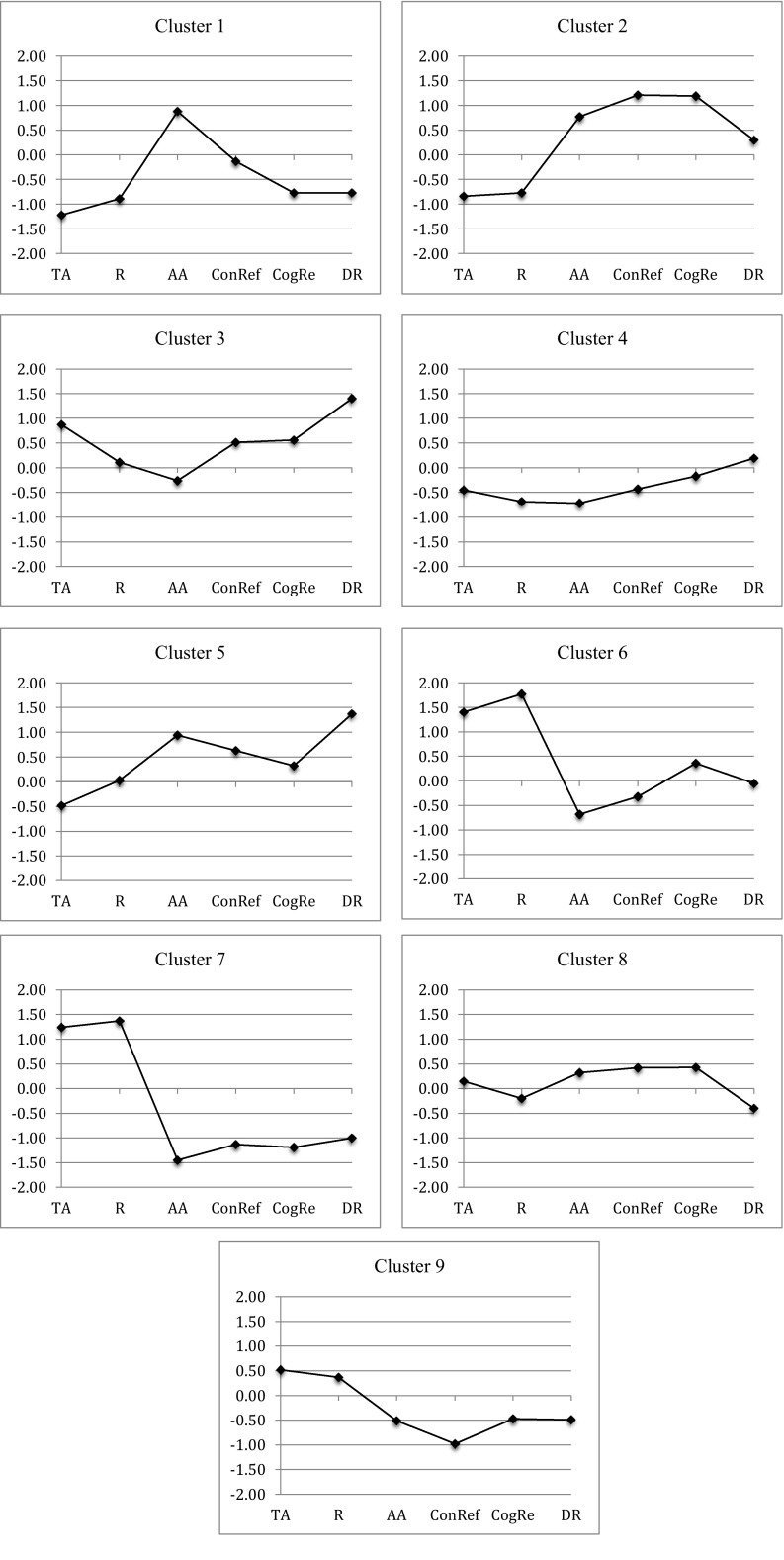
Distraction is an emotion regulation strategy that has an ambiguous status within cognitive-behavior therapy. According to some treatment protocols it is counterproductive, whereas according to other protocols it is seen as a quite useful strategy. The main purpose of the present study was to test the hypothesis that distraction is adaptive when combined with active acceptance, but maladaptive when combined with avoidant strategies. A non-clinical community sample of adults ( = 638) and a clinical sample ( = 172) completed measures of emotion regulation and well-being. Hierarchical cluster analysis was used to identify subgroups with different profiles on six emotion regulation variables, and these subgroups were then compared on well-being (positive and negative emotionality, and life quality) and on clinical status. A nine-cluster solution was chosen on the basis of explained variance and homogeneity coefficients. Two of these clusters had almost identical scores on distraction, but showed otherwise very different profiles (distraction combined with acceptance vs. distraction combined with avoidance). The distraction-acceptance cluster scored significantly higher than the distraction-avoidance cluster on all measures of well-being; it was also under-represented in the clinical sample, whereas the distraction-avoidance cluster was over-represented. Limitations include a cross-sectional design, and use of self-report measures. The findings suggest that distraction may be either adaptive or maladaptive, depending on whether it is combined with an attitude of acceptance or avoidance.
分心是一种情绪调节策略,在认知行为疗法中其地位尚不明确。根据一些治疗方案,它会适得其反,而根据其他方案,它被视为一种相当有用的策略。本研究的主要目的是检验以下假设:分心与积极接纳相结合时具有适应性,但与回避策略相结合时则具有 maladaptive。一个由成年人组成的非临床社区样本(n = 638)和一个临床样本(n = 172)完成了情绪调节和幸福感的测量。采用层次聚类分析来识别在六个情绪调节变量上具有不同特征的亚组,然后比较这些亚组在幸福感(积极和消极情绪以及生活质量)和临床状态方面的差异。基于解释方差和同质性系数选择了一个九聚类解决方案。其中两个聚类在分心方面得分几乎相同,但在其他方面表现出非常不同的特征(分心与接纳相结合 vs. 分心与回避相结合)。在所有幸福感测量指标上,分心 - 接纳聚类的得分显著高于分心 - 回避聚类;在临床样本中,它的代表性不足,而分心 - 回避聚类的代表性过高。局限性包括横断面设计和使用自我报告测量方法。研究结果表明,分心可能是适应性的,也可能是 maladaptive 的,这取决于它是与接纳态度还是回避态度相结合。