Herzig David, Eser Prisca, Radtke Thomas, Wenger Alina, Rusterholz Thomas, Wilhelm Matthias, Achermann Peter, Arhab Amar, Jenni Oskar G, Kakebeeke Tanja H, Leeger-Aschmann Claudia S, Messerli-Bürgy Nadine, Meyer Andrea H, Munsch Simone, Puder Jardena J, Schmutz Einat A, Stülb Kerstin, Zysset Annina E, Kriemler Susi
Preventive Cardiology and Sports Medicine, University Clinic for Cardiology, Inselspital, Bern University Hospital, University of Bern Bern, Switzerland.
Epidemiology, Biostatistics and Prevention Institute, University of Zurich Zurich, Switzerland.
Front Physiol. 2017 Feb 24;8:109. doi: 10.3389/fphys.2017.00109. eCollection 2017.
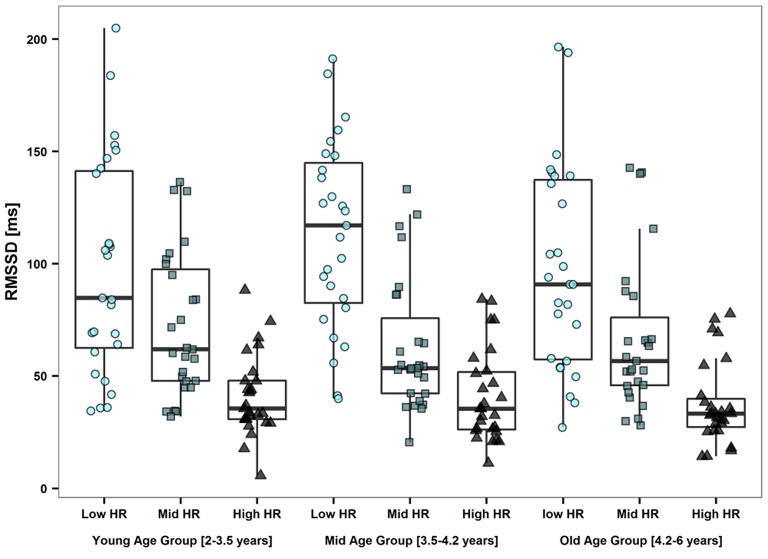
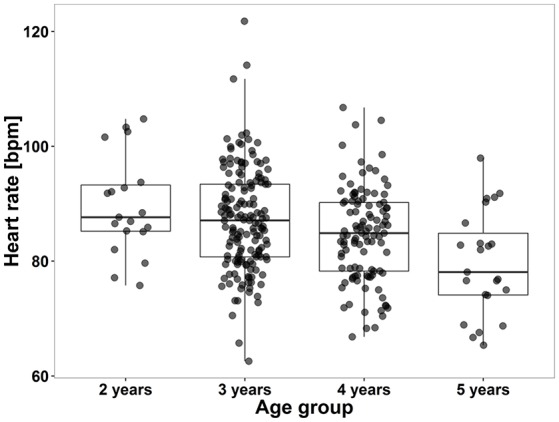
Recent studies have claimed a positive effect of physical activity and body composition on vagal tone. In pediatric populations, there is a pronounced decrease in heart rate with age. While this decrease is often interpreted as an age-related increase in vagal tone, there is some evidence that it may be related to a decrease in intrinsic heart rate. This factor has not been taken into account in most previous studies. The aim of the present study was to assess the association between physical activity and/or body composition and heart rate variability (HRV) independently of the decline in heart rate in young children. Anthropometric measurements were taken in 309 children aged 2-6 years. Ambulatory electrocardiograms were collected over 14-18 h comprising a full night and accelerometry over 7 days. HRV was determined of three different night segments: (1) over 5 min during deep sleep identified automatically based on HRV characteristics; (2) during a 20 min segment starting 15 min after sleep onset; (3) over a 4-h segment between midnight and 4 a.m. Linear models were computed for HRV parameters with anthropometric and physical activity variables adjusted for heart rate and other confounding variables (e.g., age for physical activity models). We found a decline in heart rate with increasing physical activity and decreasing skinfold thickness. HRV parameters decreased with increasing age, height, and weight in HR-adjusted regression models. These relationships were only found in segments of deep sleep detected automatically based on HRV or manually 15 min after sleep onset, but not in the 4-h segment with random sleep phases. Contrary to most previous studies, we found no increase of standard HRV parameters with age, however, when adjusted for heart rate, there was a significant decrease of HRV parameters with increasing age. Without knowing intrinsic heart rate correct interpretation of HRV in growing children is impossible.
最近的研究表明体育活动和身体成分对迷走神经张力有积极影响。在儿科人群中,心率会随着年龄的增长而显著下降。虽然这种下降通常被解释为与年龄相关的迷走神经张力增加,但有证据表明这可能与固有心率的下降有关。在大多数先前的研究中,这个因素没有被考虑在内。本研究的目的是在不考虑幼儿心率下降的情况下,评估体育活动和/或身体成分与心率变异性(HRV)之间的关联。对309名2至6岁的儿童进行了人体测量。收集了14至18小时的动态心电图,包括一整晚,以及7天的加速度测量。HRV是在三个不同的夜间时段测定的:(1)根据HRV特征自动识别的深度睡眠期间的5分钟;(2)睡眠开始后15分钟开始的20分钟时段;(3)午夜至凌晨4点之间的4小时时段。针对HRV参数计算了线性模型,对人体测量和体育活动变量进行了心率和其他混杂变量(如体育活动模型中的年龄)的调整。我们发现随着体育活动的增加和皮褶厚度的减少,心率下降。在心率调整后的回归模型中,HRV参数随着年龄、身高和体重的增加而下降。这些关系仅在基于HRV自动检测或睡眠开始后15分钟手动检测的深度睡眠时段中发现,而在具有随机睡眠阶段的4小时时段中未发现。与大多数先前的研究相反,我们发现标准HRV参数不会随着年龄的增长而增加,然而,在调整心率后,HRV参数会随着年龄的增加而显著下降。如果不知道固有心率,就无法对成长中儿童的HRV进行正确解释。