Reddehase M J, Jonjić S, Weiland F, Mutter W, Koszinowski U H
Federal Research Centre for Virus Diseases of Animals, Tübingen, Federal Republic of Germany.
J Virol. 1988 Mar;62(3):1061-5. doi: 10.1128/JVI.62.3.1061-1065.1988.
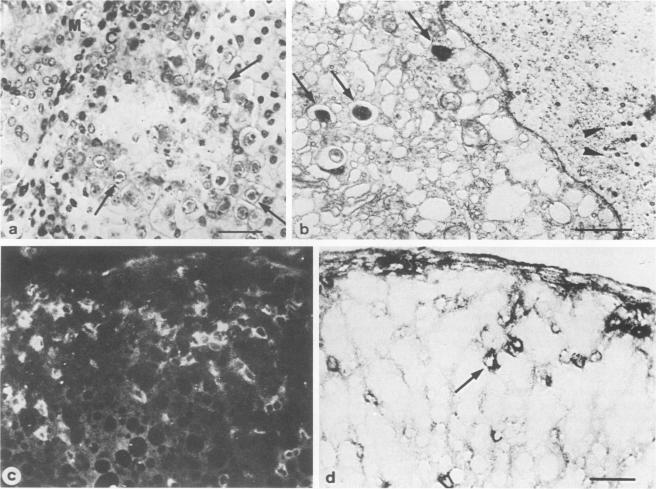
The ability of memory T lymphocytes derived from latently infected mice to control murine cytomegalovirus disease in the immunocompromised host was studied by adoptive transfer experiments. At a stage of pathogenesis when virus had already colonized target tissues, a therapeutic antiviral function could be ascribed to the CD8+ subset. This in vivo function was not restricted to sites in which intravenously infused lymphocytes usually are trapped or home in, such as the lungs or the spleen, respectively, but was also evident in the adrenal glands, a site to which antiviral effector cells have to specifically migrate. Specific infiltration of adrenal gland cortical tissue by donor-derived CD8+ memory T lymphocytes was demonstrated. CD4+ memory T lymphocytes had no antiviral effect by themselves and also were not required for the function of the CD8+ effector cells in this short-term immunotherapy model. These findings should help settle the debate about which subset of T lymphocytes comprises the effector cells that can directly control cytomegalovirus infection in the murine model system.
通过过继转移实验,研究了来自潜伏感染小鼠的记忆性T淋巴细胞在免疫受损宿主中控制鼠巨细胞病毒病的能力。在病毒已经定植于靶组织的发病阶段,CD8 +亚群具有治疗性抗病毒功能。这种体内功能并不局限于静脉内注入的淋巴细胞通常滞留或归巢的部位,如肺或脾,在肾上腺中也很明显,抗病毒效应细胞必须特异性迁移到该部位。证实了供体来源的CD8 +记忆性T淋巴细胞对肾上腺皮质组织的特异性浸润。在这个短期免疫治疗模型中,CD4 +记忆性T淋巴细胞本身没有抗病毒作用,也不是CD8 +效应细胞发挥功能所必需的。这些发现应有助于解决关于在鼠模型系统中,哪一亚群的T淋巴细胞构成可直接控制巨细胞病毒感染的效应细胞的争论。