Martin David, Grapin-Botton Anne
Service of Cardiology, Centre Hospitalier Universitaire Vaudois (CHUV) Lausanne, Switzerland.
Danish Stem Cell Center, University of Copenhagen Copenhagen, Denmark.
Front Cell Dev Biol. 2017 Feb 24;5:12. doi: 10.3389/fcell.2017.00012. eCollection 2017.
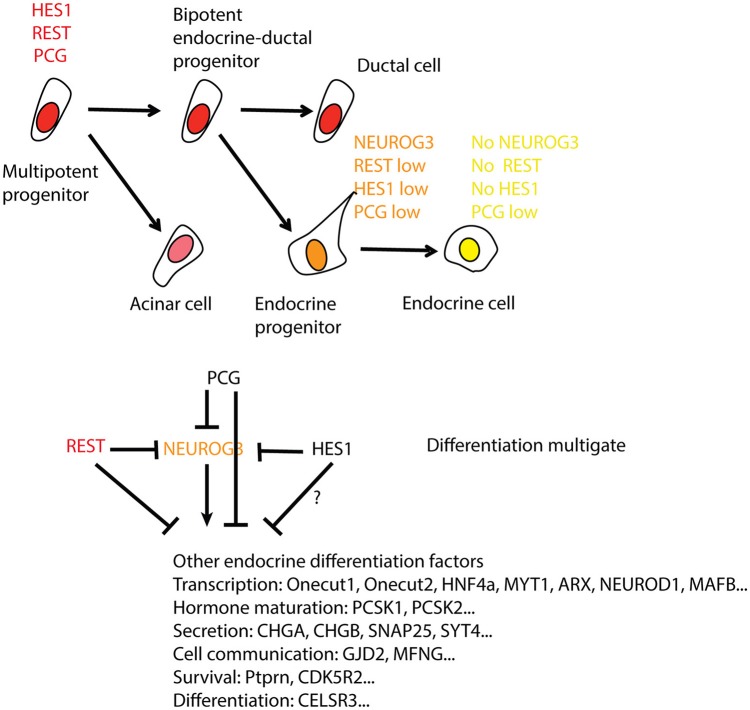
Beta cells are defined by the genes they express, many of which are specific to this cell type, and ensure a specific set of functions. Beta cells are also defined by a set of genes they should not express (in order to function properly), and these genes have been called forbidden genes. Among these, the transcriptional repressor RE-1 Silencing Transcription factor (REST) is expressed in most cells of the body, excluding most populations of neurons, as well as pancreatic beta and alpha cells. In the cell types where it is expressed, REST represses the expression of hundreds of genes that are crucial for both neuronal and pancreatic endocrine function, through the recruitment of multiple transcriptional and epigenetic co-regulators. REST targets include genes encoding transcription factors, proteins involved in exocytosis, synaptic transmission or ion channeling, and non-coding RNAs. REST is expressed in the progenitors of both neurons and beta cells during development, but it is down-regulated as the cells differentiate. Although REST mutations and deregulation have yet to be connected to diabetes in humans, REST activation during both development and in adult beta cells leads to diabetes in mice.
β细胞由它们所表达的基因所定义,其中许多基因是这种细胞类型所特有的,并确保了一组特定的功能。β细胞也由一组它们不应表达的基因(为了正常发挥功能)所定义,这些基因被称为禁忌基因。其中,转录抑制因子RE-1沉默转录因子(REST)在身体的大多数细胞中表达,但不包括大多数神经元群体以及胰腺β细胞和α细胞。在其表达的细胞类型中,REST通过招募多种转录和表观遗传共调节因子来抑制数百个对神经元和胰腺内分泌功能都至关重要的基因的表达。REST的靶标包括编码转录因子的基因、参与胞吐作用、突触传递或离子通道形成的蛋白质以及非编码RNA。在发育过程中,REST在神经元和β细胞的祖细胞中均有表达,但随着细胞分化其表达下调。虽然REST突变和失调尚未与人类糖尿病相关联,但在发育过程中和成年β细胞中激活REST会导致小鼠患糖尿病。