Roundy Christopher M, Azar Sasha R, Rossi Shannan L, Huang Jing H, Leal Grace, Yun Ruimei, Fernandez-Salas Ildefonso, Vitek Christopher J, Paploski Igor A D, Kitron Uriel, Ribeiro Guilherme S, Hanley Kathryn A, Weaver Scott C, Vasilakis Nikos
Emerg Infect Dis. 2017 Apr;23(4):625-632. doi: 10.3201/eid2304.161484. Epub 2017 Apr 15.
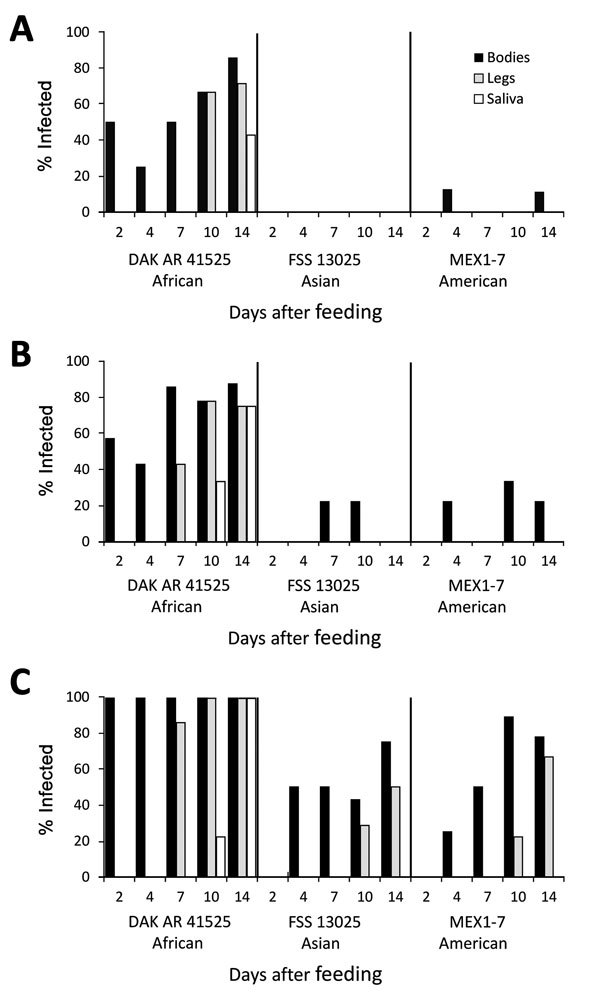
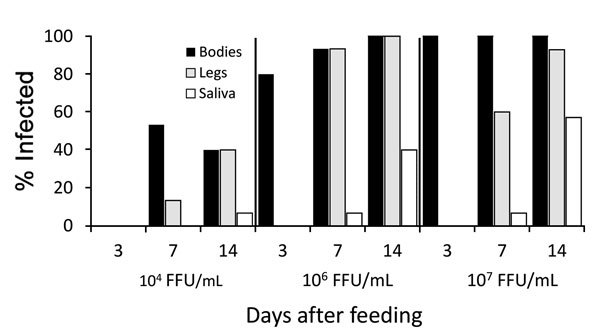
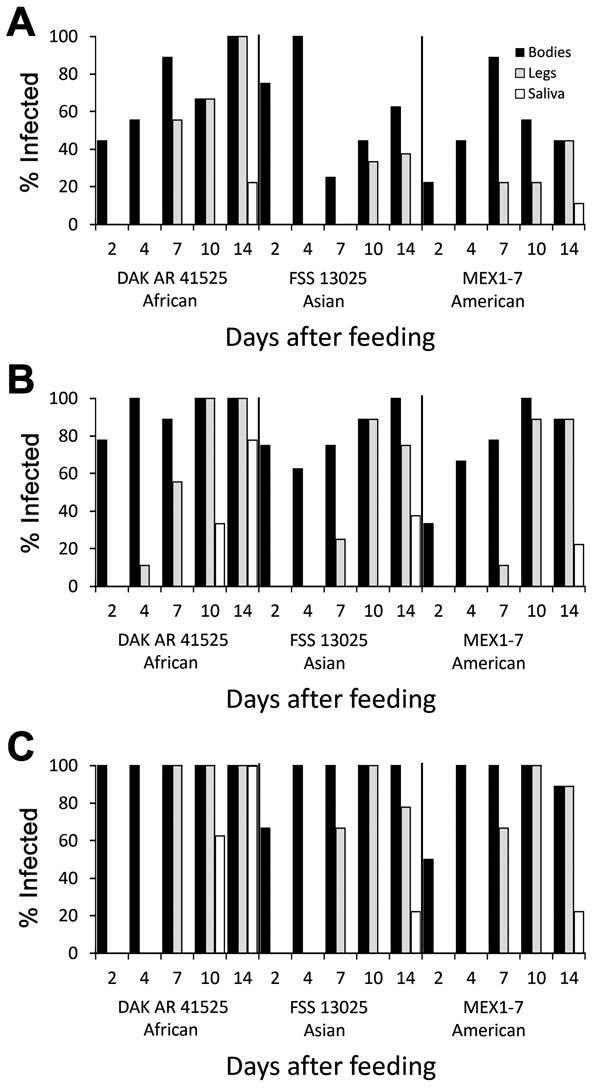
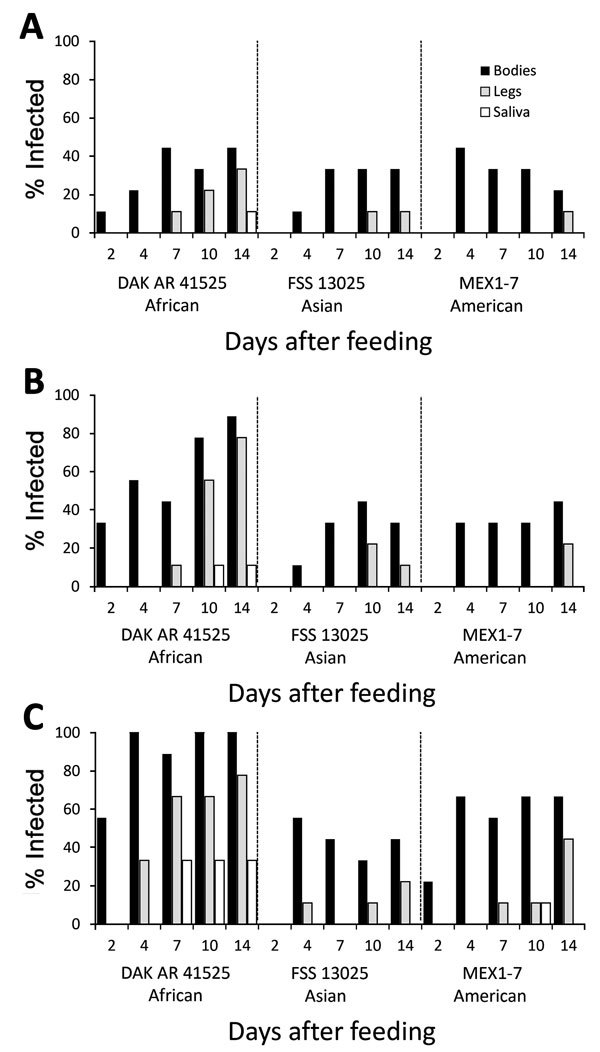
To test whether Zika virus has adapted for more efficient transmission by Aedes aegypti mosquitoes, leading to recent urban outbreaks, we fed mosquitoes from Brazil, the Dominican Republic, and the United States artificial blood meals containing 1 of 3 Zika virus strains (Senegal, Cambodia, Mexico) and monitored infection, dissemination, and virus in saliva. Contrary to our hypothesis, Cambodia and Mexica strains were less infectious than the Senegal strain. Only mosquitoes from the Dominican Republic transmitted the Cambodia and Mexica strains. However, blood meals from viremic mice were more infectious than artificial blood meals of comparable doses; the Cambodia strain was not transmitted by mosquitoes from Brazil after artificial blood meals, whereas 61% transmission occurred after a murine blood meal (saliva titers up to 4 log infectious units/collection). Although regional origins of vector populations and virus strain influence transmission efficiency, Ae. aegypti mosquitoes appear to be competent vectors of Zika virus in several regions of the Americas.
为了测试寨卡病毒是否已适应埃及伊蚊更高效的传播从而导致近期城市疫情爆发,我们用含有3种寨卡病毒毒株(塞内加尔、柬埔寨、墨西哥)之一的人工血餐喂养来自巴西、多米尼加共和国和美国的蚊子,并监测感染、病毒传播以及唾液中的病毒情况。与我们的假设相反,柬埔寨毒株和墨西哥毒株的传染性低于塞内加尔毒株。只有来自多米尼加共和国的蚊子传播了柬埔寨毒株和墨西哥毒株。然而,来自病毒血症小鼠的血餐比同等剂量的人工血餐传染性更强;用人工血餐喂养后,巴西的蚊子没有传播柬埔寨毒株,而用鼠血餐喂养后传播率达61%(唾液滴度高达4 log 感染单位/采集量)。尽管病媒种群的区域来源和病毒毒株会影响传播效率,但埃及伊蚊似乎是美洲几个地区寨卡病毒的有效病媒。