Tang Zheng-Hai, Cao Wen-Xiang, Wang Zhao-Yu, Lu Jia-Hong, Liu Bo, Chen Xiuping, Lu Jin-Jian
State Key Laboratory of Quality Research in Chinese Medicine, Institute of Chinese Medical Sciences, University of Macau, Macao, China.
The Second Affiliated Hospital of Guangzhou University of Chinese Medicine, Guangdong Provincial Academy of Chinese Medical Sciences, Guangzhou, China.
Redox Biol. 2017 Aug;12:367-376. doi: 10.1016/j.redox.2017.03.009. Epub 2017 Mar 9.
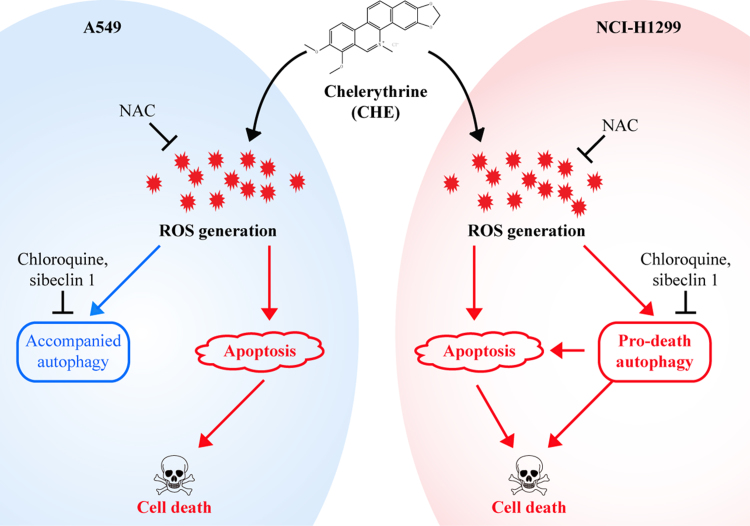
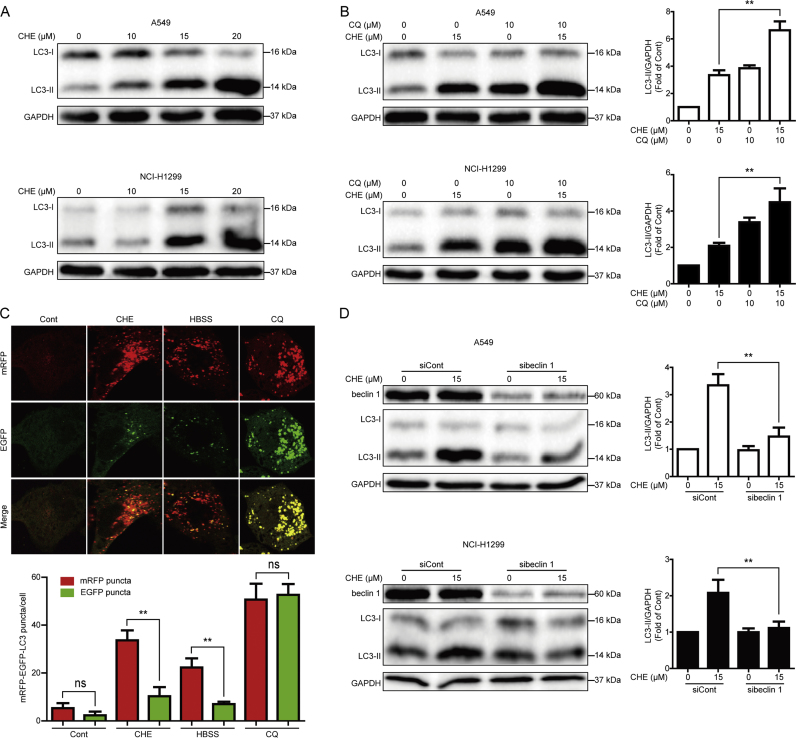
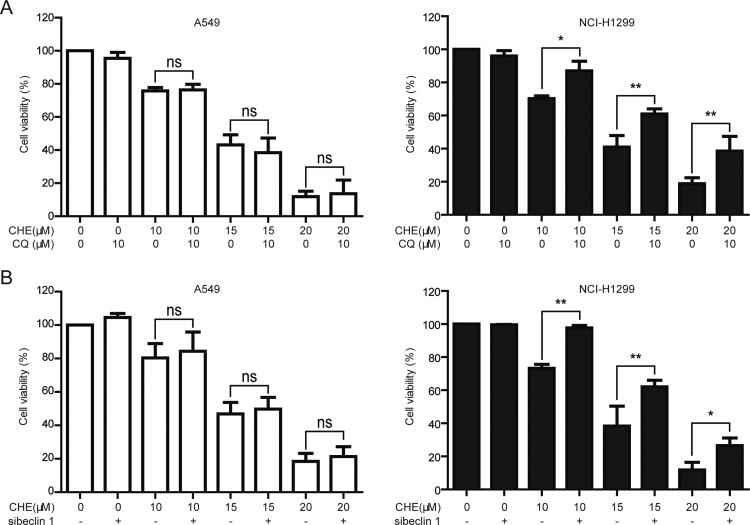
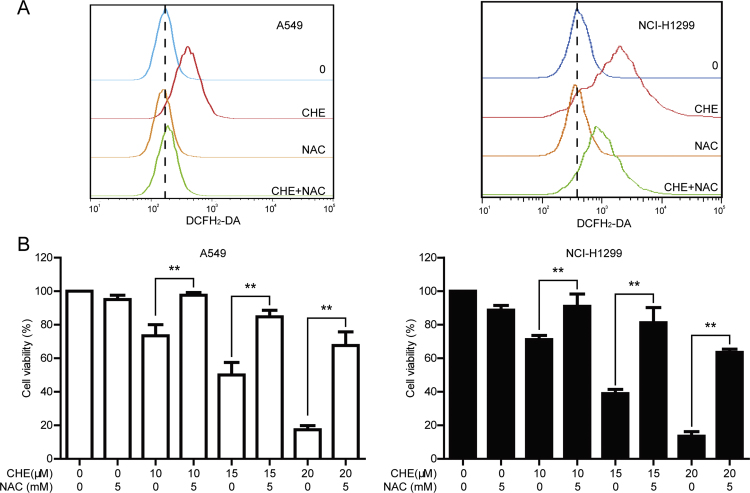
Chelerythrine (CHE), a natural benzo[c]phenanthridine alkaloid, shows anti-cancer effect through a number of mechanisms. Herein, the effect and mechanism of the CHE-induced autophagy, a type II programmed cell death, in non-small cell lung cancer (NSCLC) cells were studied for the first time. CHE induced cell viability decrease, colony formation inhibition, and apoptosis in a concentration-dependent manner in NSCLC A549 and NCI-H1299 cells. In addition, CHE triggered the expression of phosphatidylethanolamine-modified microtubule-associated protein light-chain 3 (LC3-II). The CHE-induced expression of LC3-II was further increased in the combination treatment with chloroquine (CQ), an autophagy inhibitor, and large amounts of red-puncta were observed in the CHE-treated A549 cells with stable expression of mRFP-EGFP-LC3, indicating that CHE induces autophagy flux. Silence of beclin 1 reversed the CHE-induced expression of LC3-II. Inhibition of autophagy remarkably reversed the CHE-induced cell viability decrease and apoptosis in NCI-H1299 cells but not in A549 cells. Furthermore, CHE triggered reactive oxygen species (ROS) generation in both cell lines. A decreased level of ROS through pretreatment with N-acetyl-L-cysteine reversed the CHE-induced cell viability decrease, apoptosis, and autophagy. Taken together, CHE induced distinctive autophagy in A549 (accompanied autophagy) and NCI-H1299 (pro-death autophagy) cells and a decreased level of ROS reversed the effect of CHE in NSCLC cells in terms of cell viability, apoptosis, and autophagy.
白屈菜红碱(CHE)是一种天然的苯并[c]菲啶生物碱,通过多种机制发挥抗癌作用。本文首次研究了CHE诱导的自噬(一种II型程序性细胞死亡)在非小细胞肺癌(NSCLC)细胞中的作用及机制。CHE以浓度依赖的方式降低NSCLC A549和NCI-H1299细胞的活力、抑制集落形成并诱导凋亡。此外,CHE触发了磷脂酰乙醇胺修饰的微管相关蛋白轻链3(LC3-II)的表达。在与自噬抑制剂氯喹(CQ)联合处理时,CHE诱导的LC3-II表达进一步增加,并且在稳定表达mRFP-EGFP-LC3的CHE处理的A549细胞中观察到大量红色斑点,表明CHE诱导自噬通量。沉默beclin 1可逆转CHE诱导的LC3-II表达。抑制自噬显著逆转了CHE诱导的NCI-H1299细胞活力降低和凋亡,但对A549细胞无效。此外,CHE在两种细胞系中均触发了活性氧(ROS)的产生。通过用N-乙酰-L-半胱氨酸预处理降低ROS水平可逆转CHE诱导的细胞活力降低、凋亡和自噬。综上所述,CHE在A549(伴随自噬)和NCI-H1299(促死亡自噬)细胞中诱导了独特的自噬,并且降低ROS水平在细胞活力、凋亡和自噬方面逆转了CHE对NSCLC细胞的作用。