Kai Kang, Han-Bing Jiang, Bing-Lin Cheng, Shu-Jun Zhang
Department of Integrated Traditional Chinese and Western Medicine Oncology, The First Affiliated Hospital of Harbin Medical University, Harbin, Heilongjiang, 150000, PR China.
Department of Radiation Oncology, Tangdu Hospital, The Second Affiliated Hospital of Air Force Military Medical University, Xi'an, 710038, China.
Heliyon. 2023 Jun 28;9(7):e17393. doi: 10.1016/j.heliyon.2023.e17393. eCollection 2023 Jul.
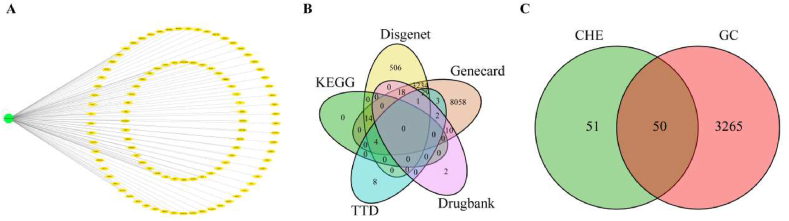
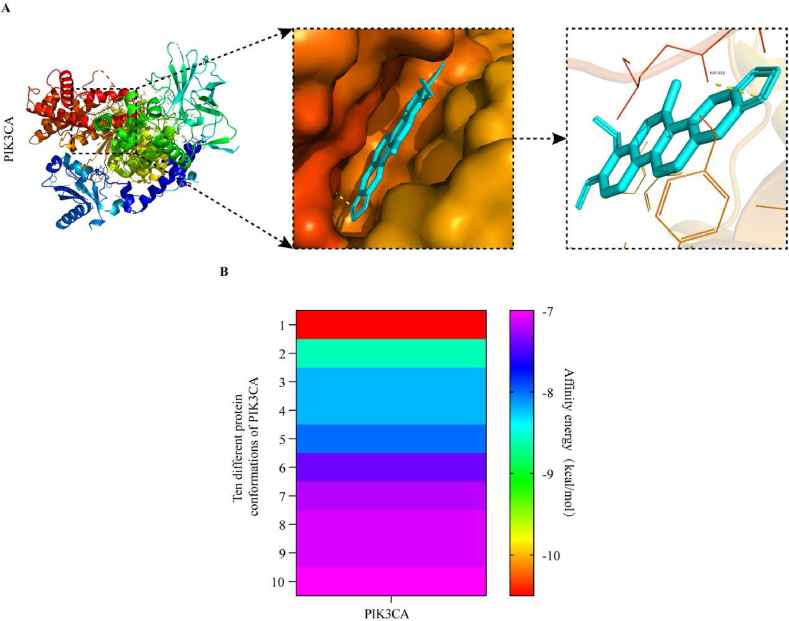
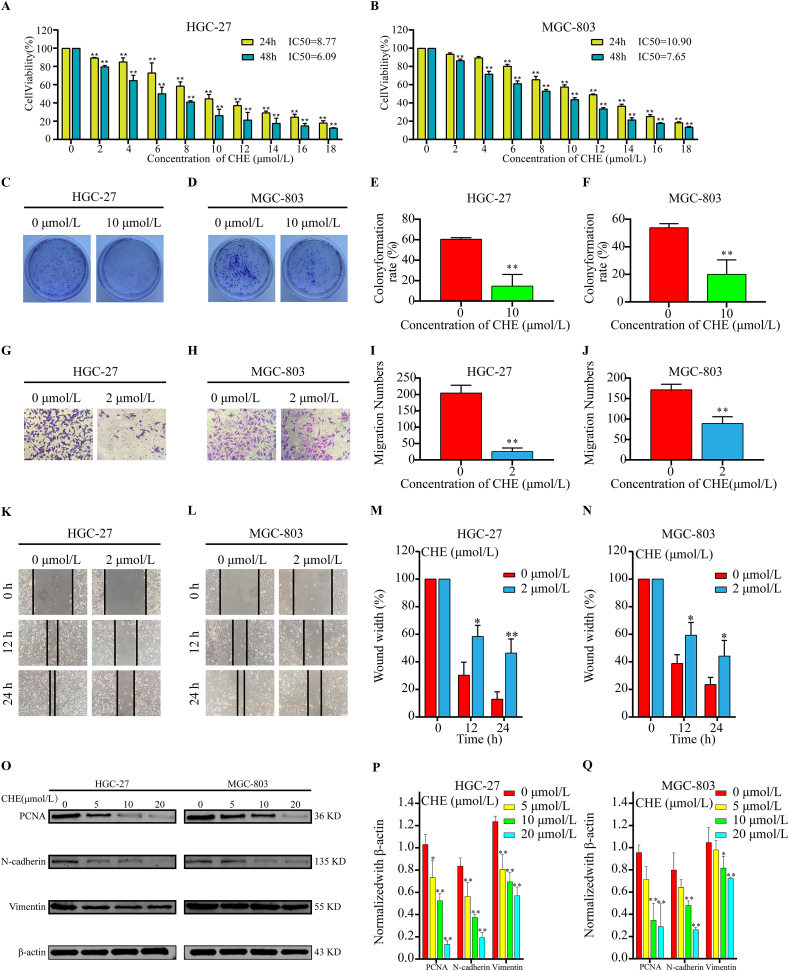
Gastric cancer (GC) is a deadly malignant tumor with a high fatality rate and limited curative options. A growing body of research suggests that network pharmacology can replace traditional methods for determining the precise mechanism of action of medicinal substances in conditions such as cancer. The goal of this study was to clarify the biological mechanism of chelerythrine (CHE) and develop a prediction target for CHE against GC using network pharmacology. First, the genes related to GC were identified from the databases Genecards, Disgenet, Online Mendelian Inheritance in Man, Therapeutic Target Database, and Drugbank, and the targets of CHE were obtained from the SwissTargetPrediction database. Fifty linked targets were identified as -GC targets of CHE. Functional enrichment and pathway analyses revealed important biological mechanisms mediated by these targets. The core target PIK3CA of CHE -GC was obtained using the protein-protein interaction network, CytoHubba plug-in, and Human Protein Atlas. Molecular docking studies revealed that CHE has a strong affinity for PIK3CA (-10.5 kcal/mol). In addition, we used MTT, colony formation, wound-healing, Transwell®, and flow cytometry experiments to confirm that CHE inhibited the proliferation and migration of GC cells and induced cell cycle arrest and apoptosis. Finally, western blotting results showed that CHE downregulated the expression of the PIK3CA protein and inhibited the activation of the PI3K/AKT signaling pathway. Therefore, we concluded that CHE inhibited GC cell proliferation and migration and induced cell cycle arrest and apoptosis by targeting the PIK3CA protein to inhibit the PI3K/AKT pathway activity.
胃癌(GC)是一种致命的恶性肿瘤,死亡率高且治疗选择有限。越来越多的研究表明,网络药理学可以取代传统方法来确定药物物质在癌症等病症中的精确作用机制。本研究的目的是阐明白屈菜红碱(CHE)的生物学机制,并利用网络药理学开发CHE抗GC的预测靶点。首先,从Genecards、Disgenet、人类孟德尔遗传在线、治疗靶点数据库和药物银行等数据库中鉴定出与GC相关的基因,并从SwissTargetPrediction数据库中获取CHE的靶点。确定了50个相关靶点作为CHE的GC靶点。功能富集和通路分析揭示了这些靶点介导的重要生物学机制。使用蛋白质-蛋白质相互作用网络、CytoHubba插件和人类蛋白质图谱获得了CHE-GC的核心靶点PIK3CA。分子对接研究表明,CHE与PIK3CA具有很强的亲和力(-10.5 kcal/mol)。此外,我们使用MTT、集落形成、伤口愈合、Transwell®和流式细胞术实验证实,CHE抑制GC细胞的增殖和迁移,并诱导细胞周期停滞和凋亡。最后,蛋白质印迹结果表明,CHE下调PIK3CA蛋白的表达并抑制PI3K/AKT信号通路的激活。因此,我们得出结论,CHE通过靶向PIK3CA蛋白抑制PI3K/AKT通路活性,从而抑制GC细胞的增殖和迁移,并诱导细胞周期停滞和凋亡。