Department of Biochemistry and Molecular Biology I, Universidad Complutense de Madrid, 28040, Madrid, Spain.
Faculty of Science and Engineering, Microbial Physiology-Gron Inst Biomolecular Sciences & Biotechnology, Nijenborgh 7, 9747 AG, Groningen, The Netherlands.
Microb Cell Fact. 2017 Mar 14;16(1):42. doi: 10.1186/s12934-017-0657-1.
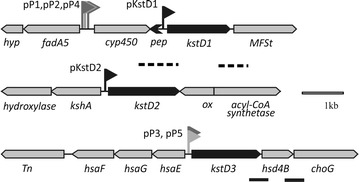
The Rhodococcus ruber strain Chol-4 genome contains at least three putative 3-ketosteroid Δ-dehydrogenase ORFs (kstD1, kstD2 and kstD3) that code for flavoenzymes involved in the steroid ring degradation. The aim of this work is the functional characterization of these enzymes prior to the developing of different biotechnological applications.
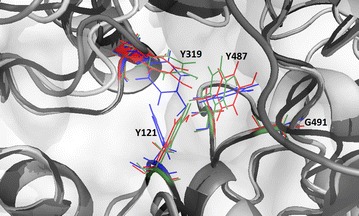
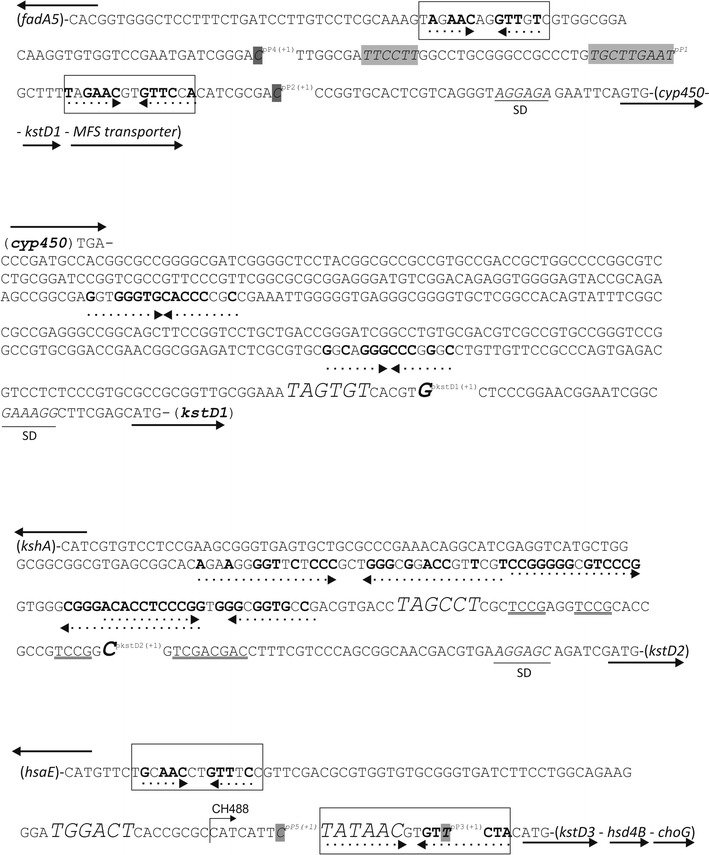
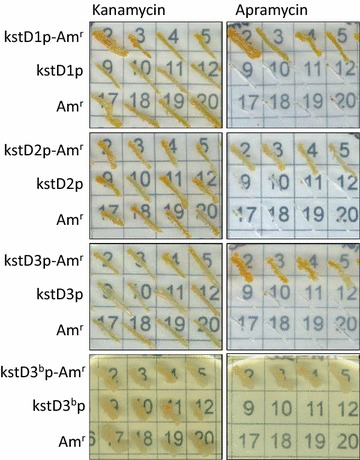
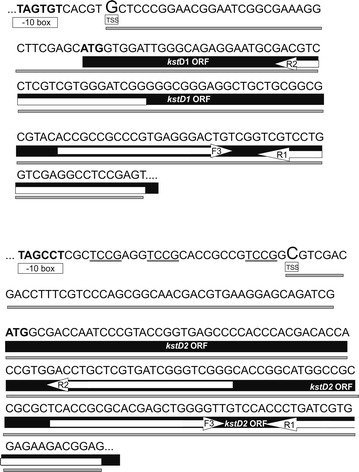
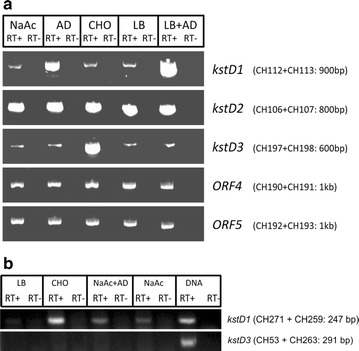
The three R. ruber KstD enzymes have different substrate profiles. KstD1 shows preference for 9OHAD and testosterone, followed by progesterone, deoxy corticosterone AD and, finally, 4-BNC, corticosterone and 19OHAD. KstD2 shows maximum preference for progesterone followed by 5α-Tes, DOC, AD testosterone, 4-BNC and lastly 19OHAD, corticosterone and 9OHAD. KstD3 preference is for saturated steroid substrates (5α-Tes) followed by progesterone and DOC. A preliminary attempt to model the catalytic pocket of the KstD proteins revealed some structural differences probably related to their catalytic differences. The expression of kstD genes has been studied by RT-PCR and RT-qPCR. All the kstD genes are transcribed under all the conditions assayed, although an additional induction in cholesterol and AD could be observed for kstD1 and in cholesterol for kstD3. Co-transcription of some correlative genes could be stated. The transcription initiation signals have been searched, both in silico and in vivo. Putative promoters in the intergenic regions upstream the kstD1, kstD2 and kstD3 genes were identified and probed in an apramycin-promoter-test vector, leading to the functional evidence of those R. ruber kstD promoters.
At least three putative 3-ketosteroid Δ-dehydrogenase ORFs (kstD1, kstD2 and kstD3) have been identified and functionally confirmed in R. ruber strain Chol-4. KstD1 and KstD2 display a wide range of substrate preferences regarding to well-known intermediaries of the cholesterol degradation pathway (9OHAD and AD) and other steroid compounds. KstD3 shows a narrower substrate range with a preference for saturated substrates. KstDs differences in their catalytic properties was somehow related to structural differences revealed by a preliminary structural modelling. Transcription of R. ruber kstD genes is driven from specific promoters. The three genes are constitutively transcribed, although an additional induction is observed in kstD1 and kstD3. These enzymes have a wide versatility and allow a fine tuning-up of the KstD cellular activity.
红平红球菌菌株 Chol-4 的基因组至少包含三个假定的 3-酮甾体 Δ-脱氢酶 ORF(kstD1、kstD2 和 kstD3),它们编码参与甾体环降解的黄素酶。本工作的目的是在开发不同的生物技术应用之前对这些酶进行功能表征。
三种红平红球菌 KstD 酶具有不同的底物谱。KstD1 对 9OHAD 和睾酮表现出偏好,其次是孕酮、脱氧皮质酮 AD,最后是 4-BNC、皮质酮和 19OHAD。KstD2 对孕酮的最大偏好,其次是 5α-Tes、DOC、AD 睾酮、4-BNC 和最后 19OHAD、皮质酮和 9OHAD。KstD3 优先选择饱和甾体底物(5α-Tes),其次是孕酮和 DOC。初步尝试对 KstD 蛋白的催化口袋进行建模揭示了一些可能与其催化差异相关的结构差异。通过 RT-PCR 和 RT-qPCR 研究了 kstD 基因的表达。所有 kstD 基因在所有检测到的条件下都转录,尽管在胆固醇和 AD 中可以观察到 kstD1 的额外诱导,在胆固醇中可以观察到 kstD3 的诱导。可以说明一些相关基因的共转录。在体外和体内都搜索了转录起始信号。在 kstD1、kstD2 和 kstD3 基因上游的基因间区识别并探测了推定的启动子,并在氨苄青霉素启动子测试载体中进行了功能验证,从而为红平红球菌 kstD 启动子的功能提供了证据。
在红平红球菌菌株 Chol-4 中至少鉴定和功能证实了三个假定的 3-酮甾体 Δ-脱氢酶 ORF(kstD1、kstD2 和 kstD3)。KstD1 和 KstD2 对胆固醇降解途径的知名中间体(9OHAD 和 AD)和其他甾体化合物表现出广泛的底物偏好。KstD3 的底物范围较窄,对饱和底物有偏好。KstD 在催化特性上的差异与初步结构建模揭示的结构差异有关。红平红球菌 kstD 基因的转录由特定的启动子驱动。这三个基因是组成性转录的,尽管在 kstD1 和 kstD3 中观察到额外的诱导。这些酶具有广泛的多功能性,可以精细调节 KstD 细胞活性。