Liu Kuancan, Xie Fuan, Gao Anding, Zhang Rui, Zhang Long, Xiao Zhangwu, Hu Qiong, Huang Weifeng, Huang Qiaojia, Lin Baoshun, Zhu Jian, Wang Haikun, Que Jianwen, Lan Xiaopeng
Institute for Laboratory Medicine, Fuzhou General Hospital, PLA, Fuzhou, 350025, Fujian, People's Republic of China.
Department of Medicine, Columbia University Medical Center, New York, 10032, NY, USA.
Mol Cancer. 2017 Mar 14;16(1):62. doi: 10.1186/s12943-017-0632-9.
High levels of SOX2 protein are correlated with increased dissemination of breast cancer. However, the underlying molecular mechanisms are not fully understood.
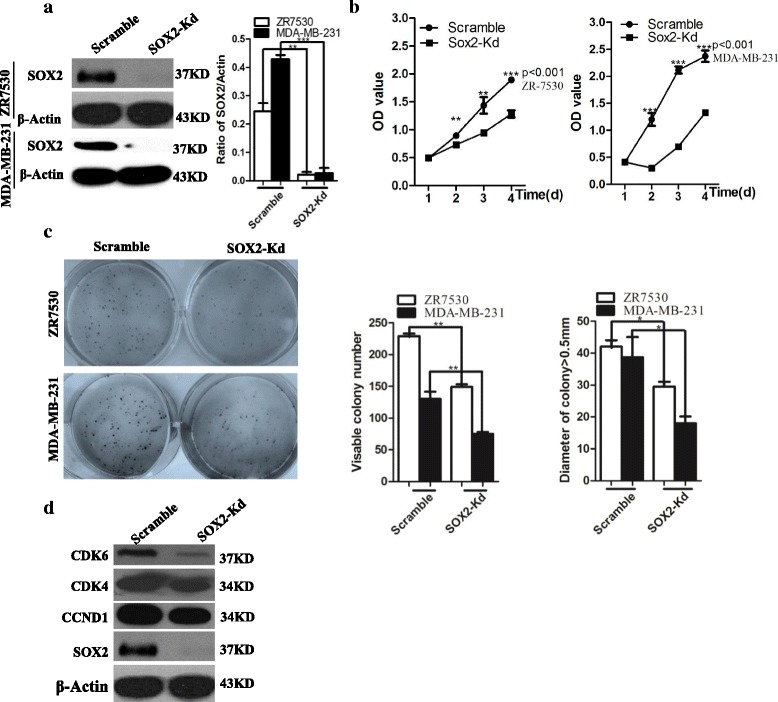
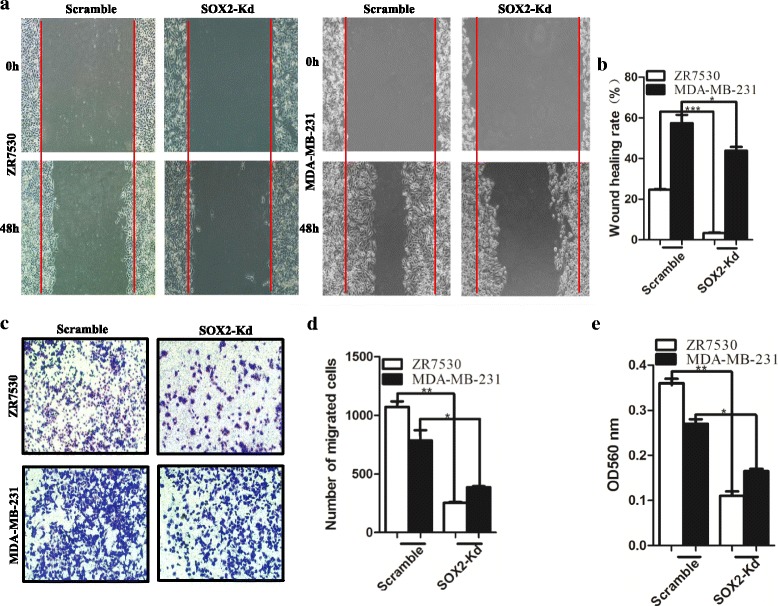
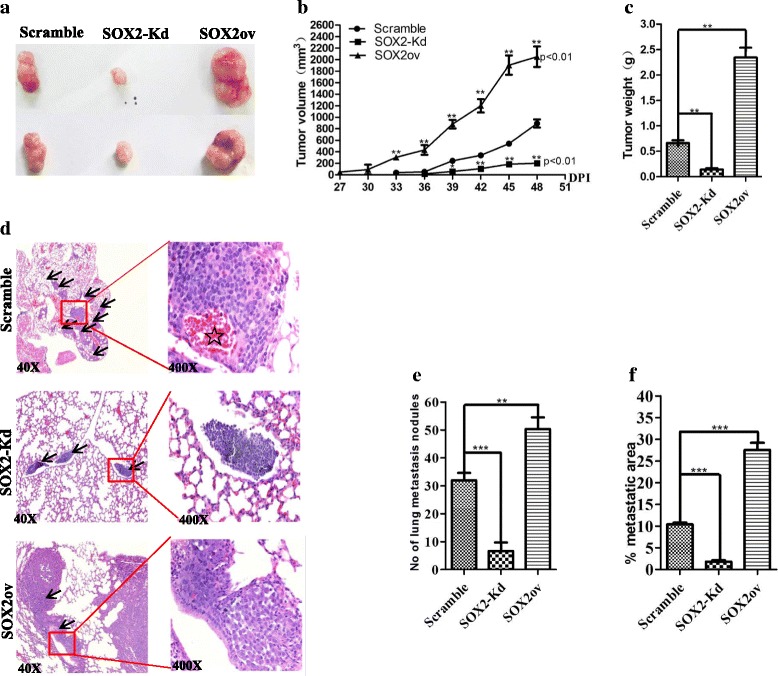
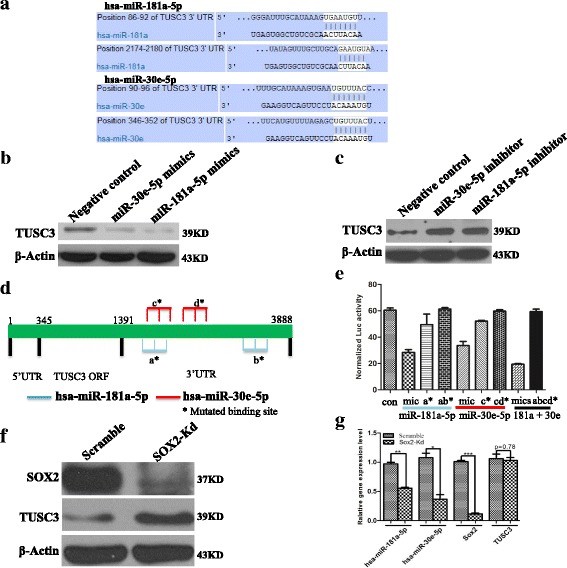
In this study we investigate the role of SOX2 in breast cancer metastasis using multiple in vitro and in vivo assays including cell culture, shRNA-mediated knockdown, wound healing, colony formation, transwell chamber, xenograft and tail vein injection. Moreover, western blot, immunostaining, microarray and real-time PCR were used to determine the change of protein and miRNA levels. Luciferase assays were also used to evaluate activity which TUSC3 is a target of miR-181a-5p and miR-30e-5p, and the clinical survival relevance was analyzed by Kaplan-Meier analysis.
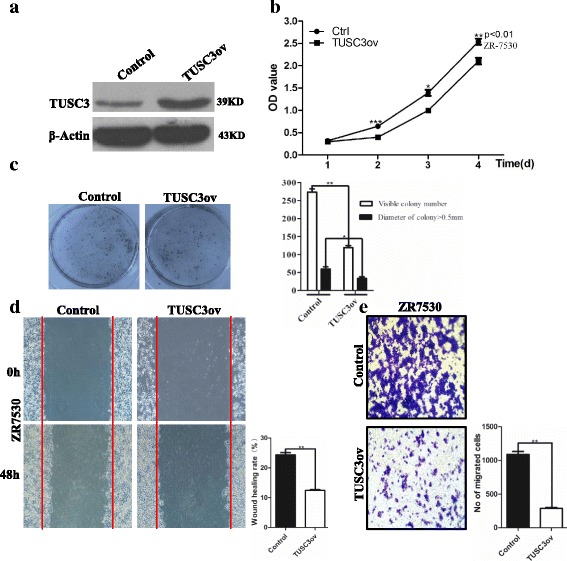
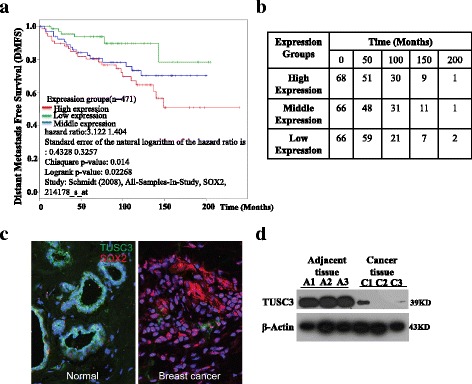
We identified a novel pathway involving SOX2 regulation of microRNAs to control the proliferation and migration of breast cancer cells. shRNA-mediated knockdown of SOX2 inhibits breast cancer cell expansion and migration. More importantly, we found that these changes are accompanied by significant reduction in the levels of two microRNAs, miR-181a-5p and miR-30e-5p. Overexpression of these two microRNAs leads to reduced protein levels of Tumor Suppressor Candidate 3 (TUSC3) in breast cancer cells; mutations of the potential binding sites in the 3'-UTR of TUSC3 abrogate the inhibitory effects of the microRNAs. We further found that upregulation of TUSC3 expression leads to reduced proliferation and migration of breast cancer cells. In human breast cancer samples the levels of TUSC3 protein are inversely correlated with those of SOX2 protein.
Taken together, our work reveals a novel SOX2-mediated regulatory axis that plays critical roles in the proliferation, migration and invasiveness of breast cancer cells. Targeting this axis may provide beneficial effect in the treatment of breast cancer.
SOX2蛋白水平升高与乳腺癌扩散增加相关。然而,其潜在的分子机制尚未完全明确。
在本研究中,我们使用多种体外和体内试验,包括细胞培养、shRNA介导的敲低、伤口愈合、集落形成、Transwell小室、异种移植和尾静脉注射,来研究SOX2在乳腺癌转移中的作用。此外,采用蛋白质印迹法、免疫染色、基因芯片和实时定量PCR来确定蛋白质和微小RNA水平的变化。还使用荧光素酶报告基因检测来评估TUSC3是miR-181a-5p和miR-30e-5p的靶标的活性,并通过Kaplan-Meier分析来分析临床生存相关性。
我们鉴定出一条涉及SOX2对微小RNA的调控以控制乳腺癌细胞增殖和迁移的新途径。shRNA介导的SOX2敲低抑制乳腺癌细胞的扩增和迁移。更重要的是,我们发现这些变化伴随着两种微小RNA,即miR-181a-5p和miR-30e-5p水平的显著降低。这两种微小RNA的过表达导致乳腺癌细胞中肿瘤抑制候选基因3(TUSC3)的蛋白质水平降低;TUSC3 3'-UTR中潜在结合位点的突变消除了微小RNA的抑制作用。我们进一步发现TUSC3表达上调导致乳腺癌细胞的增殖和迁移减少。在人乳腺癌样本中,TUSC3蛋白水平与SOX2蛋白水平呈负相关。
综上所述,我们的研究揭示了一条新的SOX2介导的调控轴,其在乳腺癌细胞的增殖、迁移和侵袭中起关键作用。靶向该轴可能对乳腺癌治疗产生有益效果。