Schmid Sofie, Tsantilas Pavlos, Knappich Christoph, Kallmayer Michael, König Thomas, Breitkreuz Thorben, Zimmermann Alexander, Kuehnl Andreas, Eckstein Hans-Henning
Department of Vascular and Endovascular Surgery, Klinikum rechts der Isar Technical University of Munich, Germany.
AQUA-Institut für angewandte Qualitätsförderung und Forschung im Gesundheitswesen GmbH, Göttingen, Germany.
J Am Heart Assoc. 2017 Mar 13;6(3):e004764. doi: 10.1161/JAHA.116.004764.
Guideline recommendations on carotid endarterectomy are based predominantly on randomized, controlled trials, in which women or elderly patients are often under-represented. This study analyzed the association of age and sex with the risk of in-hospital stroke or death following carotid endarterectomy under routine conditions in Germany.
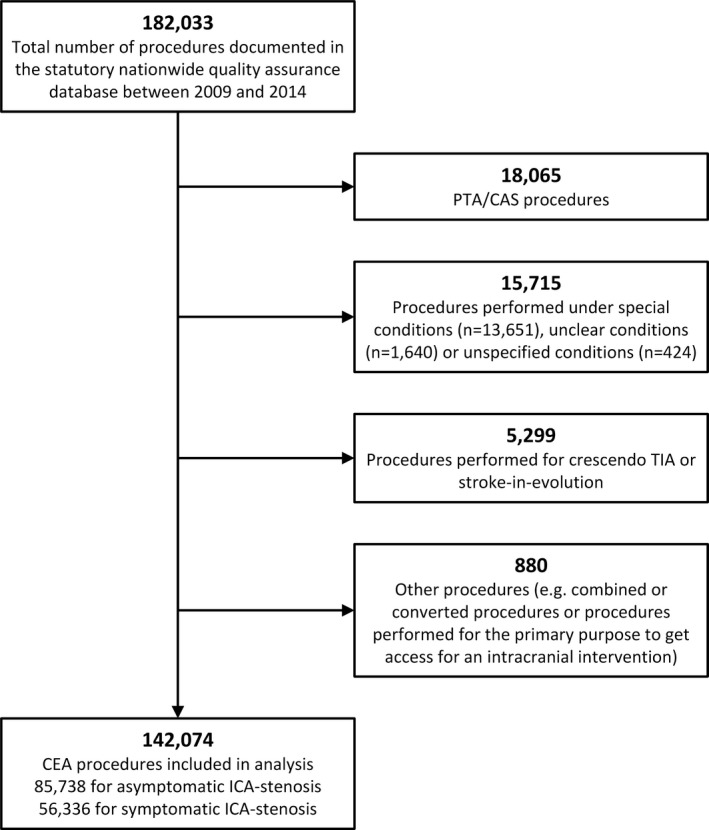
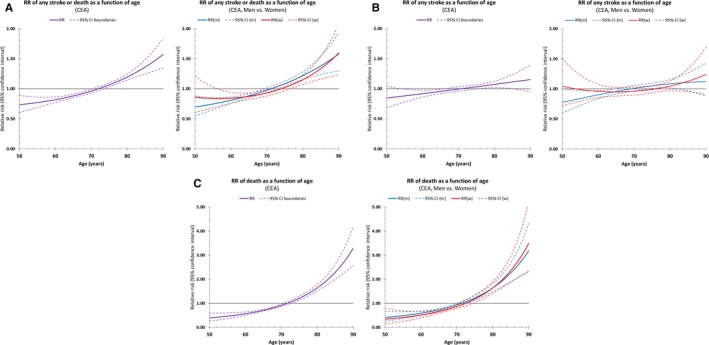
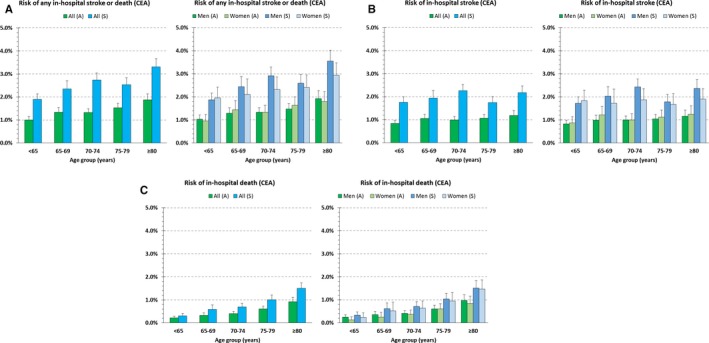
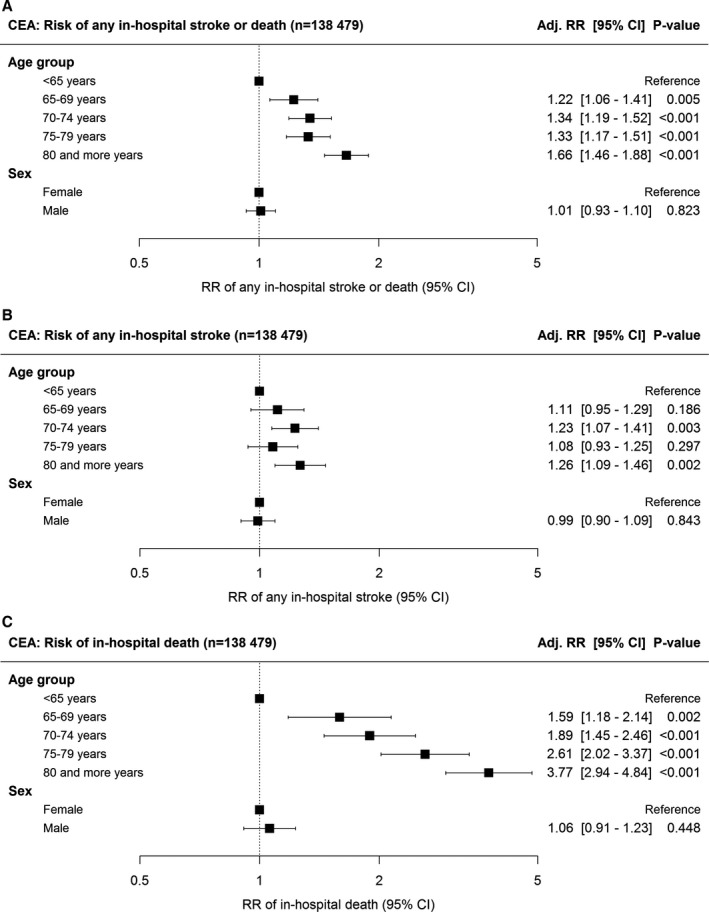
Secondary data analysis using the Statutory German Quality Assurance Database on all carotid endarterectomy procedures (n=142 074) performed between 2009 and 2014. Primary outcome was any stroke or death until discharge; secondary outcomes were any in-hospital stroke (alone), and death (alone). Descriptive statistics and multilevel multivariable regression analyses were applied. Patients were predominately male (68%), with mean age 71 years. Carotid stenosis was symptomatic in 40%. Primary outcome occurred in 1.8% of women and 1.9% of men. Multivariable regression analysis revealed that more-advanced age was associated with a higher primary outcome rate (relative risk [RR] per 10-year increase: 1.19; 95% CI, 1.14-1.24). Risk of death (alone) was associated with age (RR, 1.68; 95% CI, 1.54-1.84). Age was associated with the risk of stroke (alone; RR, 1.05; 95% CI, 1.00-1.11). Sex was not associated with primary outcome rate (1.01; 95% CI, 0.93-1.10), nor did it significantly modify the age effect.
This study shows that increasing age, but not sex, is associated with a higher risk of in-hospital stroke or death following carotid endarterectomy under everyday conditions in Germany. Whereas the risk of death (alone) is significantly associated with age, the association between age and the risk of stroke (alone) can be considered of minor importance.
关于颈动脉内膜切除术的指南建议主要基于随机对照试验,而在这些试验中,女性或老年患者的代表性往往不足。本研究分析了在德国常规条件下,年龄和性别与颈动脉内膜切除术后住院期间发生中风或死亡风险之间的关联。
利用德国法定质量保证数据库对2009年至2014年间进行的所有颈动脉内膜切除术(n = 142074例)进行二次数据分析。主要结局是出院前发生的任何中风或死亡;次要结局是任何住院期间单独发生的中风以及单独发生的死亡。采用描述性统计和多水平多变量回归分析。患者以男性为主(68%),平均年龄71岁。40%的患者有症状性颈动脉狭窄。主要结局在1.8%的女性和1.9%的男性中发生。多变量回归分析显示,年龄越大,主要结局发生率越高(每增加10岁的相对风险[RR]:1.19;95%CI,1.14 - 1.24)。单独死亡风险与年龄相关(RR,1.68;95%CI,1.54 - 1.84)。年龄与单独中风风险相关(RR,1.05;95%CI,1.00 - 1.11)。性别与主要结局发生率无关(1.01;95%CI,0.93 - 1.10),也未显著改变年龄效应。
本研究表明,在德国日常条件下,颈动脉内膜切除术后住院期间发生中风或死亡的风险增加与年龄有关,而非性别有关。单独死亡风险与年龄显著相关,而年龄与单独中风风险之间的关联可认为不太重要。