Torres Sheila, Clayton Jonathan B, Danzeisen Jessica L, Ward Tonya, Huang Hu, Knights Dan, Johnson Timothy J
Department of Veterinary Clinical Sciences, University of Minnesota , Saint Paul, MN , USA.
Department of Veterinary and Biomedical Sciences, University of Minnesota , Saint Paul, MN , USA.
PeerJ. 2017 Mar 9;5:e3075. doi: 10.7717/peerj.3075. eCollection 2017.
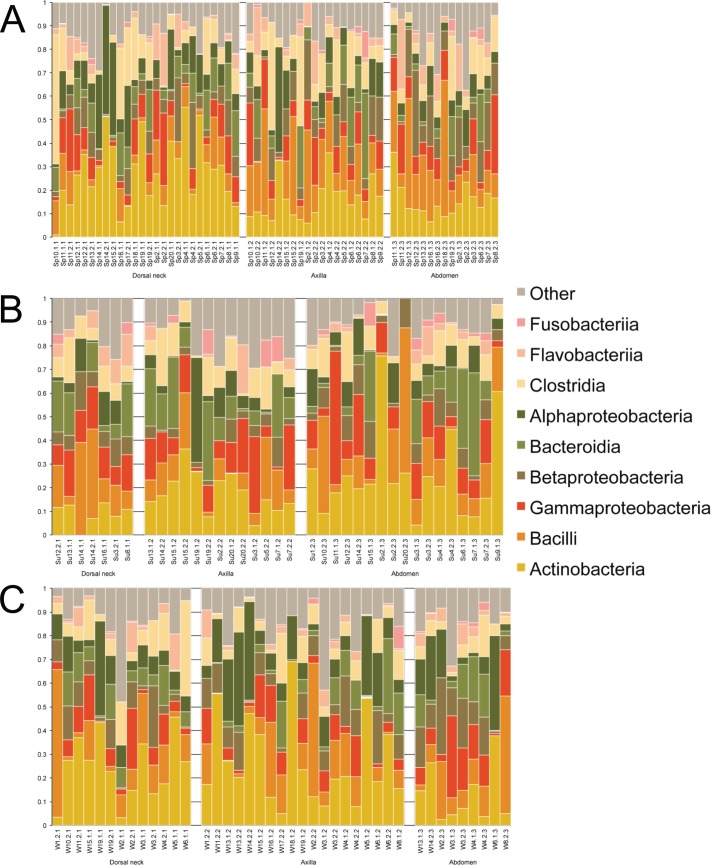
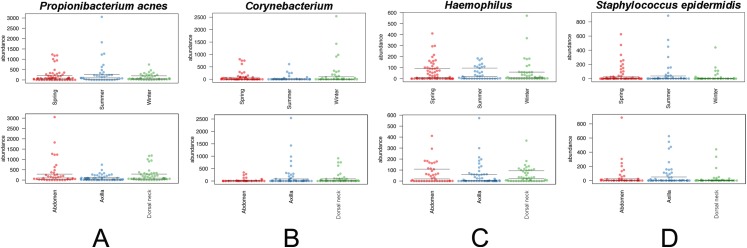
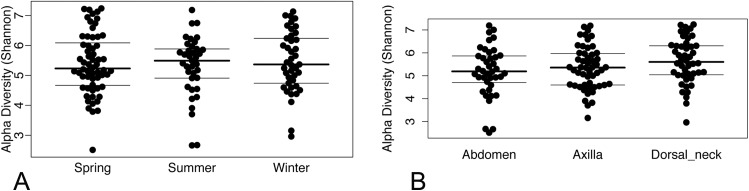
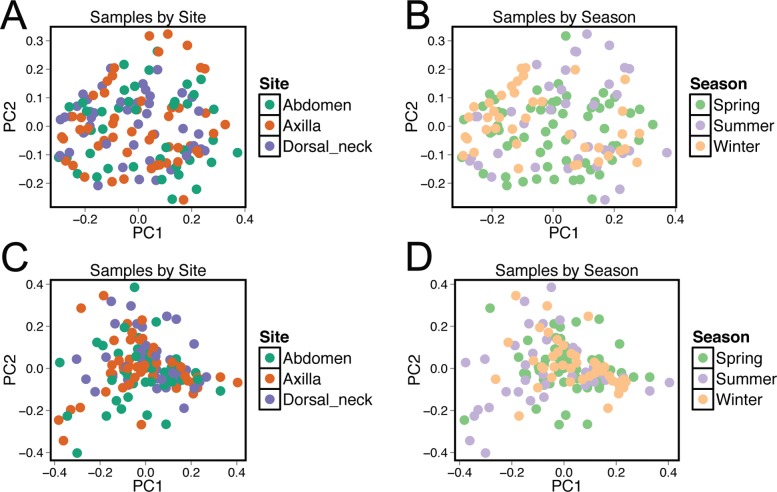
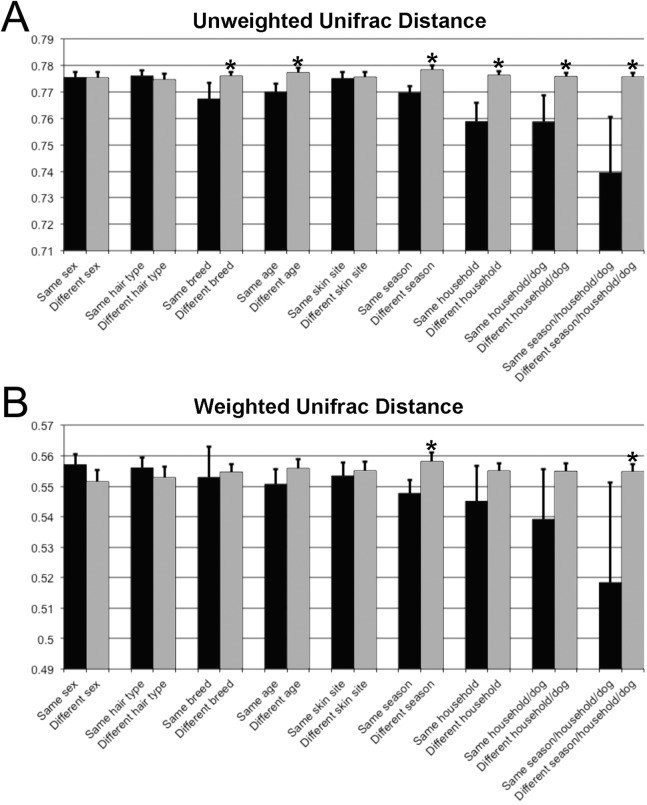
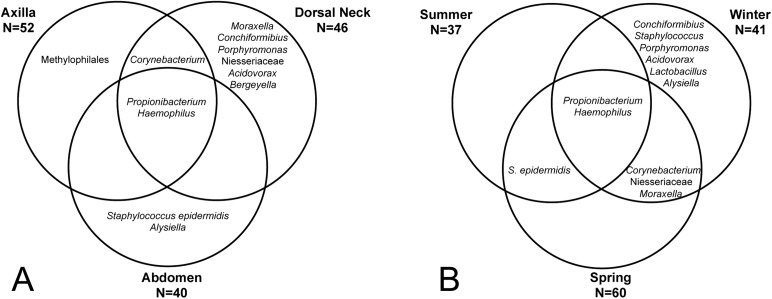
It has previously been shown that domestic dogs and their household owners share bacterial populations, and that sharing of bacteria between humans is facilitated through the presence of dogs in the household. However, less is known regarding the bacterial communities of dogs, how these communities vary by location and over time, and how cohabitation of dogs themselves influences their bacterial community. Furthermore, the effects of factors such as breed, hair coat length, sex, shedding, and age on the canine skin microbiome is unknown. This study sampled the skin bacterial communities of 40 dogs belonging to 20 households longitudinally across three seasons (spring, summer, and winter). Significant differences in bacterial community structure between samples were identified when stratified by season, but not by dog sex, age, breed, hair type, or skin site. Cohabitating dogs were more likely to share bacteria of the skin than non-cohabitating dogs. Similar to human bacterial microbiomes, dogs' microbiomes were more similar to their own microbiomes over time than to microbiomes of other individuals. Dogs sampled during the same season were also more similar to each other than to dogs from different seasons, irrespective of household. However, there were very few core operational taxonomic units (OTUs) identified across all dogs sampled. Taxonomic classification revealed and sp. as key members of the dog skin bacterial community, along with sp. and . This study shows that the skin bacterial community structure of dogs is highly individualized, but can be shared among dogs through cohabitation.
此前已有研究表明,家犬及其家庭成员拥有共同的细菌种群,且家庭中犬只的存在促进了人类之间细菌的共享。然而,关于犬只的细菌群落、这些群落如何随地点和时间变化,以及犬只之间的同居如何影响它们的细菌群落,我们所知甚少。此外,品种、毛发长度、性别、脱毛情况和年龄等因素对犬类皮肤微生物群的影响尚不清楚。本研究对来自20个家庭的40只犬只在三个季节(春季、夏季和冬季)进行了纵向皮肤细菌群落采样。当按季节分层时,样本之间的细菌群落结构存在显著差异,但按犬只性别、年龄、品种、毛发类型或皮肤部位分层时则没有。同居的犬类比不同居的犬类更有可能共享皮肤细菌。与人类细菌微生物群类似,随着时间的推移,犬只的微生物群与其自身的微生物群比与其他个体的微生物群更相似。无论来自哪个家庭,同一季节采样的犬只彼此之间也比来自不同季节的犬只更相似。然而,在所有采样犬只中鉴定出的核心操作分类单元(OTU)非常少。分类学分析表明, 和 属,以及 属和 属是犬类皮肤细菌群落的关键成员。本研究表明,犬只的皮肤细菌群落结构高度个体化,但可以通过同居在犬只之间共享。