Patel Vrajeshri, Craig Jamie, Schumacher Michelle, Burns Martin K, Florescu Ionut, Vinjamuri Ramana
Sensorimotor Control Laboratory, Department of Biomedical Engineering, Chemistry, and Biological Sciences, Stevens Institute of Technology , Hoboken, NJ , USA.
Front Bioeng Biotechnol. 2017 Feb 27;5:9. doi: 10.3389/fbioe.2017.00009. eCollection 2017.
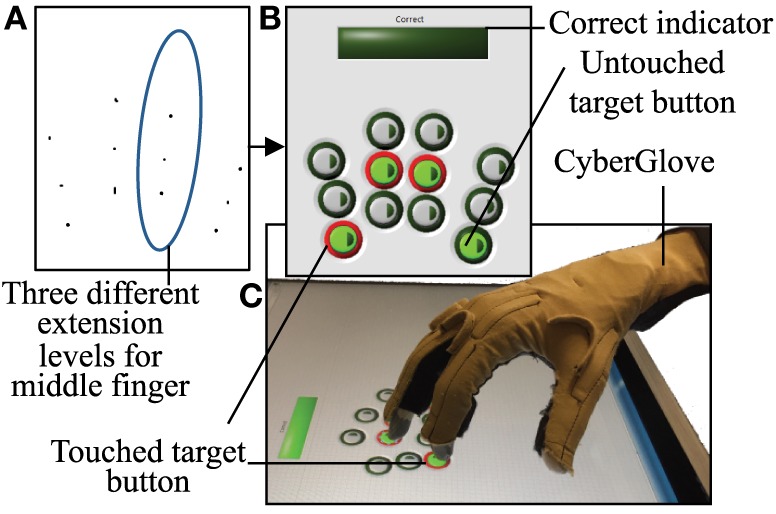
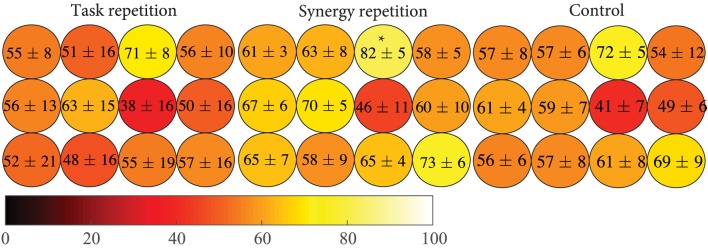
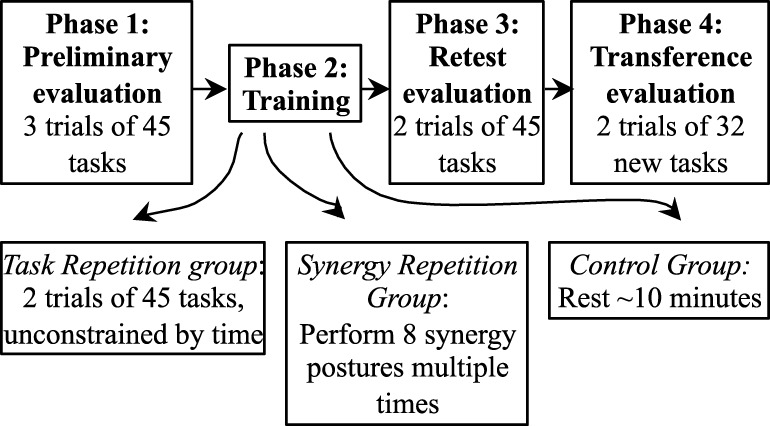
Traditionally, repetitive practice of a task is used to learn a new skill, exhibiting as immediately improved performance. Research suggests, however, that a more experience-based rather than exposure-based training protocol may allow for better transference of the skill to related tasks. In synergy-based motor control theory, fundamental motor skills, such as hand grasping, are represented with a synergy subspace that captures essential motor patterns. In this study, we propose that motor-skill learning through synergy-based mechanisms may provide advantages over traditional task repetition learning. A new task was designed to highlight the range of motion and dexterity of the human hand. Two separate training strategies were tested in healthy subjects: task repetition training and synergy training versus a control. All three groups showed improvements when retested on the same task. When tested on a similar, but different set of tasks, only the synergy group showed improvements in accuracy (9.27% increase) compared to the repetition (3.24% decline) and control (3.22% decline) groups. A kinematic analysis revealed that although joint angular peak velocities decreased, timing benefits stemmed from the initial feed-forward portion of the task (reaction time). Accuracy improvements may have derived from general improved coordination among the four involved fingers. These preliminary results warrant further investigation of synergy-based motor training in healthy individuals, as well as in individuals undergoing hand-based rehabilitative therapy.
传统上,通过重复练习一项任务来学习新技能,表现为立即提高的绩效。然而,研究表明,一种基于经验而非基于暴露的训练方案可能会使技能更好地转移到相关任务中。在基于协同作用的运动控制理论中,诸如抓握等基本运动技能由一个捕获基本运动模式的协同子空间来表示。在本研究中,我们提出通过基于协同作用的机制进行运动技能学习可能比传统的任务重复学习具有优势。设计了一项新任务以突出人类手部的运动范围和灵活性。在健康受试者中测试了两种不同的训练策略:任务重复训练和协同训练与对照组。当对相同任务进行重新测试时,所有三组都表现出了进步。当在一组相似但不同的任务上进行测试时,与重复训练组(下降3.24%)和对照组(下降3.22%)相比,只有协同训练组的准确性有所提高(提高9.27%)。运动学分析表明,尽管关节角峰值速度降低,但时间优势源于任务的初始前馈部分(反应时间)。准确性的提高可能源于所涉及的四个手指之间总体协调性的改善。这些初步结果值得对健康个体以及正在接受手部康复治疗的个体中基于协同作用的运动训练进行进一步研究。