Jolly David, Dunn Leon, Kenny John
Epworth Radiation Oncology Research Centre, Epworth HealthCare, Melbourne, VIC, Australia.
J Appl Clin Med Phys. 2017 Jan;18(1):59-65. doi: 10.1002/acm2.12009. Epub 2016 Nov 30.
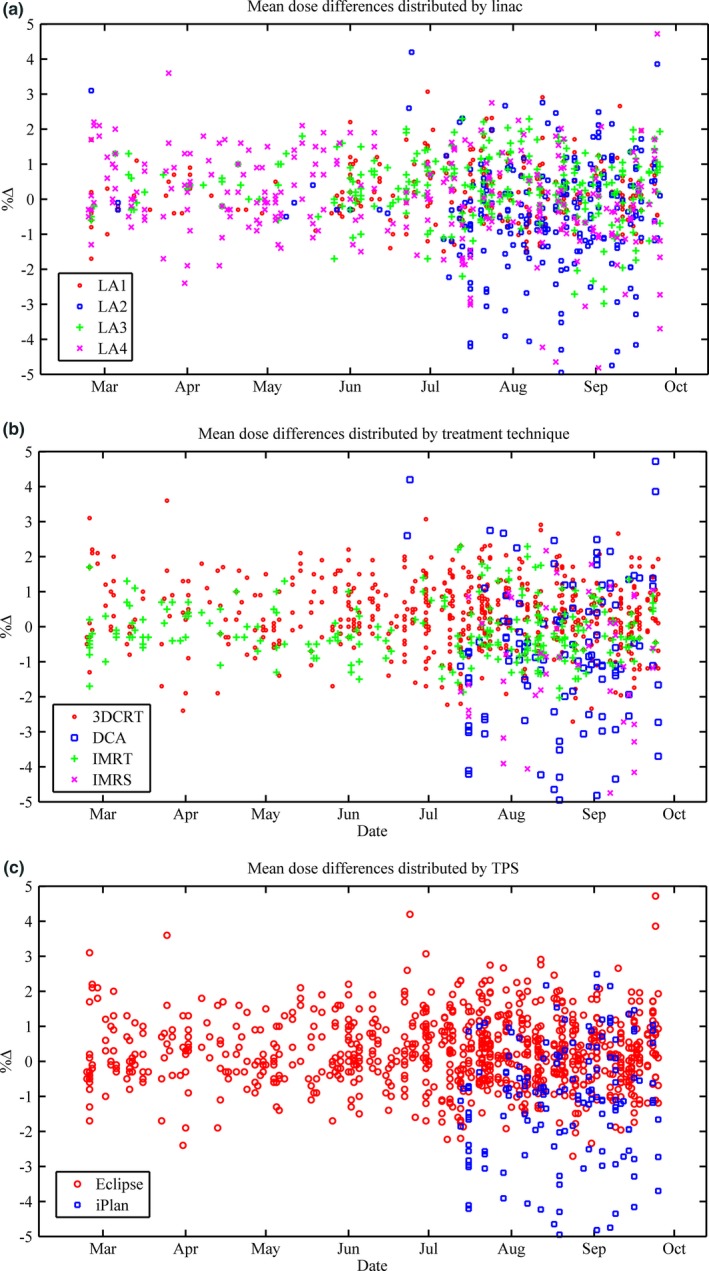
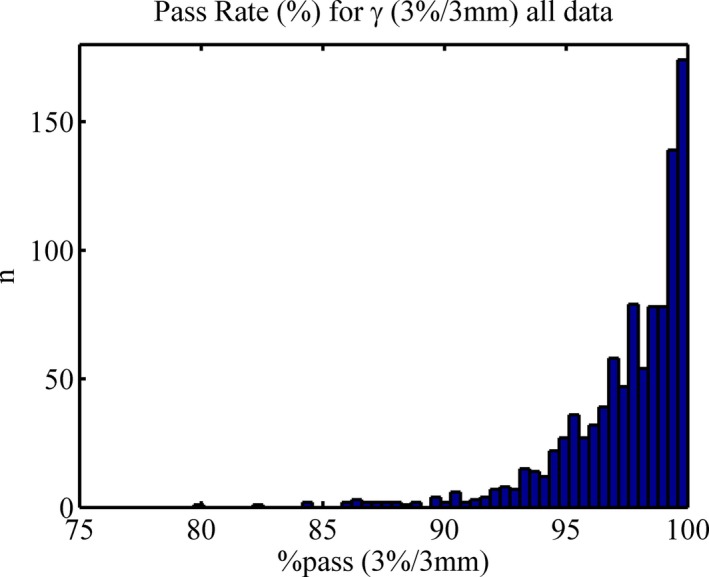
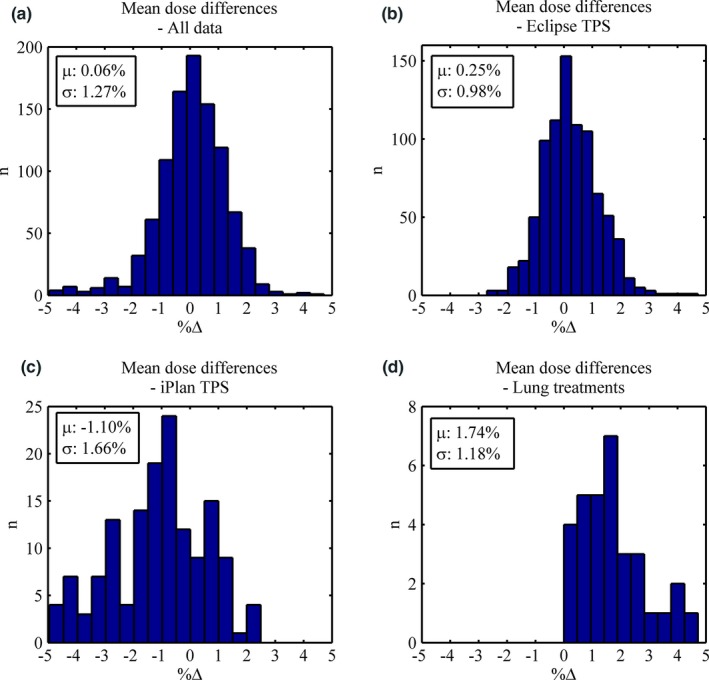
In radiation therapy, calculation of dose within the patient contains inherent uncertainties, inaccuracies, limitations, and the potential for random error. Thus, point dose-independent verification of such calculations is a well-established process, with published data to support the setting of both action levels and tolerances. Mobius3D takes this process one step further with a full independent calculation of patient dose and comparisons of clinical parameters such as mean target dose and voxel-by-voxel gamma analysis. There is currently no published data to directly inform tolerance levels for such parameters, and therefore this work presents a database of 1000 Mobius3D results to fill this gap. The data are tested for normality using a normal probability plot and found to fit this distribution for three sub groups of data; Eclipse, iPlan and the treatment site Lung. The mean (μ) and standard deviation (σ) of these sub groups is used to set action levels and tolerances at μ ± 2σ and μ ± 3σ, respectively. A global (3%, 3 mm) gamma tolerance is set at 88.5%. The mean target dose tolerance for Eclipse data is the narrowest at ± 3%, whilst iPlan and Lung have a range of -5.0 to 2.2% and -1.8 to 5.0%, respectively. With these limits in place, future results failing the action level or tolerance will fall within the worst 5% and 1% of historical results and an informed decision can be made regarding remedial action prior to treatment.
在放射治疗中,患者体内剂量的计算存在固有的不确定性、不准确性、局限性以及随机误差的可能性。因此,对这类计算进行与点剂量无关的验证是一个成熟的过程,有已发表的数据支持行动水平和公差的设定。Mobius3D将这一过程更进一步,对患者剂量进行完全独立的计算,并对平均靶区剂量和逐体素伽马分析等临床参数进行比较。目前尚无已发表的数据直接告知此类参数的公差水平,因此这项工作提供了一个包含1000个Mobius3D结果的数据库来填补这一空白。使用正态概率图对数据进行正态性检验,发现三组数据(Eclipse、iPlan和治疗部位肺)均符合该分布。这些子组的均值(μ)和标准差(σ)分别用于设定行动水平和公差,分别为μ±2σ和μ±3σ。全局(3%,3毫米)伽马公差设定为88.5%。Eclipse数据的平均靶区剂量公差最窄,为±3%,而iPlan和肺的范围分别为-5.0%至2.2%和-1.8%至5.0%。有了这些限制,未来未达到行动水平或公差的结果将落在历史结果最差的5%和1%范围内,从而可以在治疗前就补救措施做出明智的决定。