Wu Jun-Zheng, Liu Qin, Geng Xiao-Shan, Li Kai-Mian, Luo Li-Juan, Liu Jin-Ping
Hainan Key Laboratory for Sustainable Utilization of Tropical Bioresources, College of Agriculture, Hainan University, Haikou, Hainan Province, 570228, China.
The Institute of Tropical Bioscience and Biotechnology, Chinese Academy of Tropical Agricultural Sciences, Haikou, Hainan Province, 571101, China.
BMC Biotechnol. 2017 Mar 14;17(1):29. doi: 10.1186/s12896-017-0349-2.
Cassava (Manihot esculenta Crantz) is a major crop extensively cultivated in the tropics as both an important source of calories and a promising source for biofuel production. Although stable gene expression have been used for transgenic breeding and gene function study, a quick, easy and large-scale transformation platform has been in urgent need for gene functional characterization, especially after the cassava full genome was sequenced.
Fully expanded leaves from in vitro plantlets of Manihot esculenta were used to optimize the concentrations of cellulase R-10 and macerozyme R-10 for obtaining protoplasts with the highest yield and viability. Then, the optimum conditions (PEG4000 concentration and transfection time) were determined for cassava protoplast transient gene expression. In addition, the reliability of the established protocol was confirmed for subcellular protein localization.
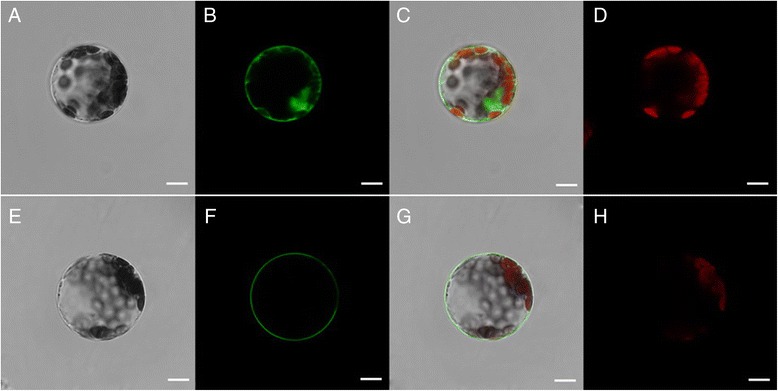
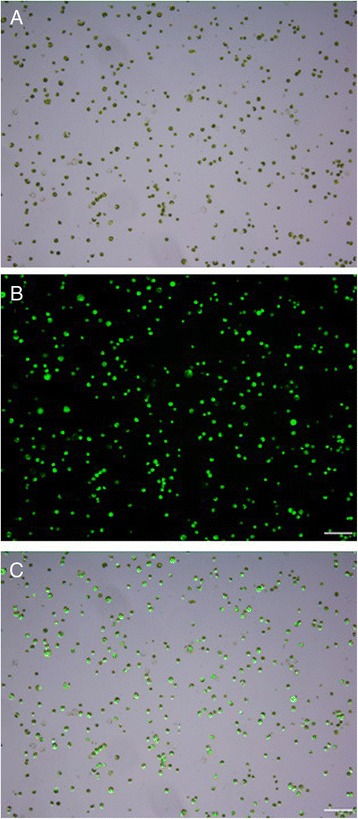
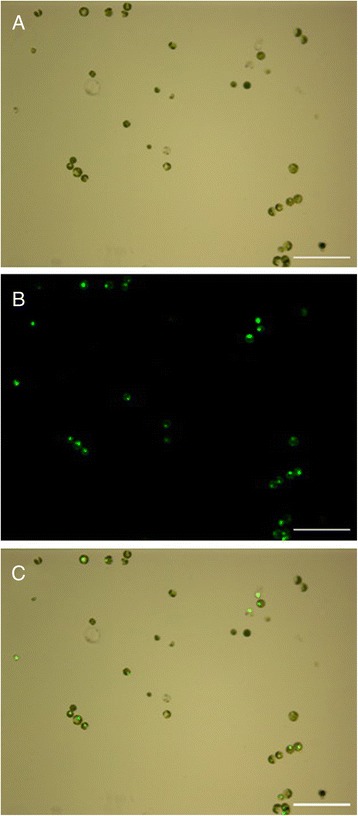
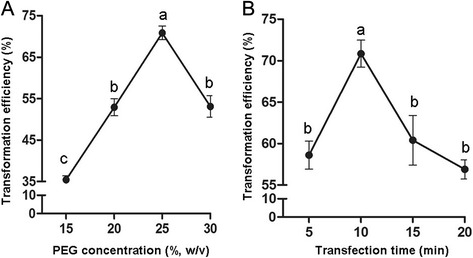
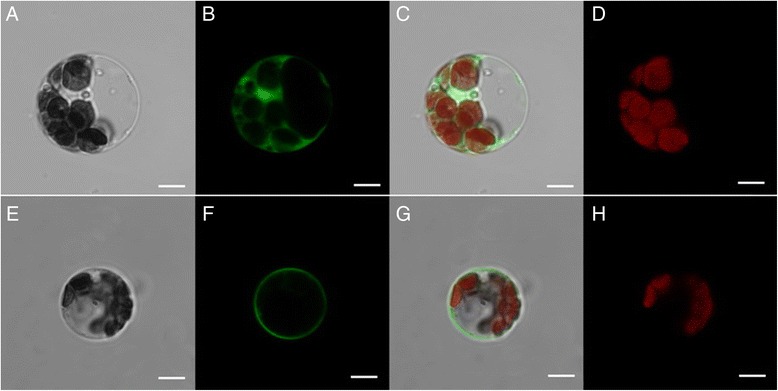
In this work we optimized the main influencing factors and developed an efficient mesophyll protoplast isolation and PEG-mediated transient gene expression in cassava. The suitable enzyme digestion system was established with the combination of 1.6% cellulase R-10 and 0.8% macerozyme R-10 for 16 h of digestion in the dark at 25 °C, resulting in the high yield (4.4 × 10 protoplasts/g FW) and vitality (92.6%) of mesophyll protoplasts. The maximum transfection efficiency (70.8%) was obtained with the incubation of the protoplasts/vector DNA mixture with 25% PEG4000 for 10 min. We validated the applicability of the system for studying the subcellular localization of MeSTP7 (an H/monosaccharide cotransporter) with our transient expression protocol and a heterologous Arabidopsis transient gene expression system.
We optimized the main influencing factors and developed an efficient mesophyll protoplast isolation and transient gene expression in cassava, which will facilitate large-scale characterization of genes and pathways in cassava.
木薯(Manihot esculenta Crantz)是一种主要作物,在热带地区广泛种植,既是重要的热量来源,也是生物燃料生产的潜在来源。尽管稳定的基因表达已用于转基因育种和基因功能研究,但迫切需要一个快速、简便且大规模的转化平台来进行基因功能鉴定,尤其是在木薯全基因组测序之后。
使用木薯离体苗完全展开的叶片来优化纤维素酶R-10和离析酶R-10的浓度,以获得产量和活力最高的原生质体。然后,确定木薯原生质体瞬时基因表达的最佳条件(PEG4000浓度和转染时间)。此外,还证实了所建立方案用于亚细胞蛋白定位的可靠性。
在这项工作中,我们优化了主要影响因素,开发了一种高效的木薯叶肉原生质体分离和PEG介导的瞬时基因表达方法。建立了合适的酶解系统,将1.6%纤维素酶R-10和0.8%离析酶R-10组合,在25℃黑暗中消化16小时,从而获得了高产(4.4×10个原生质体/g鲜重)和高活力(92.6%)的叶肉原生质体。原生质体/载体DNA混合物与25% PEG4000孵育10分钟时,获得了最高转染效率(70.8%)。我们通过瞬时表达方案和异源拟南芥瞬时基因表达系统验证了该系统用于研究MeSTP7(一种H/单糖共转运蛋白)亚细胞定位的适用性。
我们优化了主要影响因素,开发了一种高效的木薯叶肉原生质体分离和瞬时基因表达方法,这将有助于对木薯中的基因和途径进行大规模鉴定。