Pfeffer Suzanne R
Department of Biochemistry, Stanford University School of Medicine, Stanford, CA 94305-5307
Mol Biol Cell. 2017 Mar 15;28(6):712-715. doi: 10.1091/mbc.E16-10-0737.
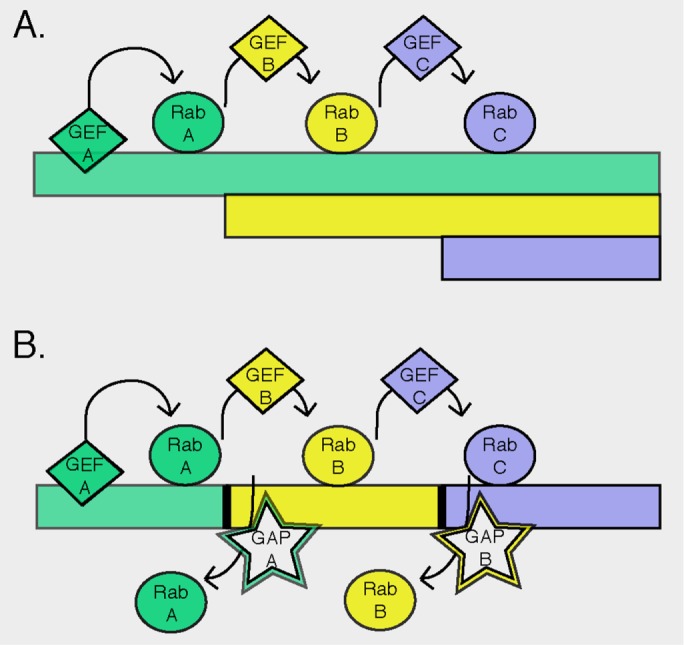
Several of the most important discoveries in the field of membrane traffic have come from studies of Rab GTPases by Marino Zerial and Peter Novick and their colleagues. Zerial was the first to discover that Rab GTPases represent identity markers for different membrane-bound compartments, and each Rab organizes a collection of specific effectors into function-specifying membrane microdomains to carry out receptor trafficking. Novick discovered that the order (and thus polarity) of Rab GTPases along the secretory and endocytic pathways are established by their specific, cognate guanine nucleotide exchange factors (GEFs) and GTPase-activating proteins (GAPs), which partner with one Rab to regulate the subsequent- and prior-acting Rabs. Such so-called Rab cascades have evolved to establish domains that contain unique Rab proteins and their cognate effectors, which drive all steps of membrane trafficking. These findings deserve much broader recognition by the biomedical research community and are highlighted here, along with open questions that require serious attention for full understanding of the molecular basis of Rab GTPase-regulated membrane trafficking in eukaryotic cells.
膜泡运输领域的一些最重要发现来自于马里诺·泽里尔、彼得·诺维克及其同事对Rab GTP酶的研究。泽里尔是第一个发现Rab GTP酶代表不同膜结合区室的身份标记的人,并且每个Rab将一组特定的效应蛋白组织成功能特定的膜微区,以进行受体运输。诺维克发现,Rab GTP酶沿分泌和内吞途径的顺序(从而极性)是由它们特定的、同源的鸟嘌呤核苷酸交换因子(GEF)和GTP酶激活蛋白(GAP)建立的,这些因子与一种Rab协同作用,调节后续和先前作用的Rab。这种所谓的Rab级联已经进化形成了包含独特Rab蛋白及其同源效应蛋白的结构域,这些结构域驱动膜泡运输的所有步骤。这些发现值得生物医学研究界更广泛的认可,本文将重点介绍这些发现,以及一些开放性问题,要全面理解真核细胞中Rab GTP酶调节的膜泡运输的分子基础,这些问题需要认真关注。