Hodson L, Bhatia L, Scorletti E, Smith D E, Jackson N C, Shojaee-Moradie F, Umpleby M, Calder P C, Byrne C D
Oxford Centre for Diabetes, Endocrinology and Metabolism (OCDEM), Radcliffe Department of Medicine, University of Oxford, Oxford, UK.
Human Development and Health Academic Unit, Southampton, UK.
Eur J Clin Nutr. 2017 Aug;71(8):973-979. doi: 10.1038/ejcn.2017.9. Epub 2017 Mar 15.
BACKGROUND/OBJECTIVE: Treatment of subjects with non-alcoholic fatty liver disease (NAFLD) with omega-3 polyunsaturated fatty acids (FAs) suggests high levels of docosahexaenoic acid (DHA) tissue enrichment decrease liver fat content. We assessed whether changes in erythrocyte DHA enrichment (as a surrogate marker of changes in tissue enrichment) were associated with alterations in hepatic de novo lipogenesis (DNL), postprandial FA partitioning and hepatic and peripheral insulin sensitivity in a sub-study of the WELCOME trial (Wessex Evaluation of fatty Liver and Cardiovascular markers in NAFLD (non-alcoholic fatty liver disease) with OMacor thErapy).
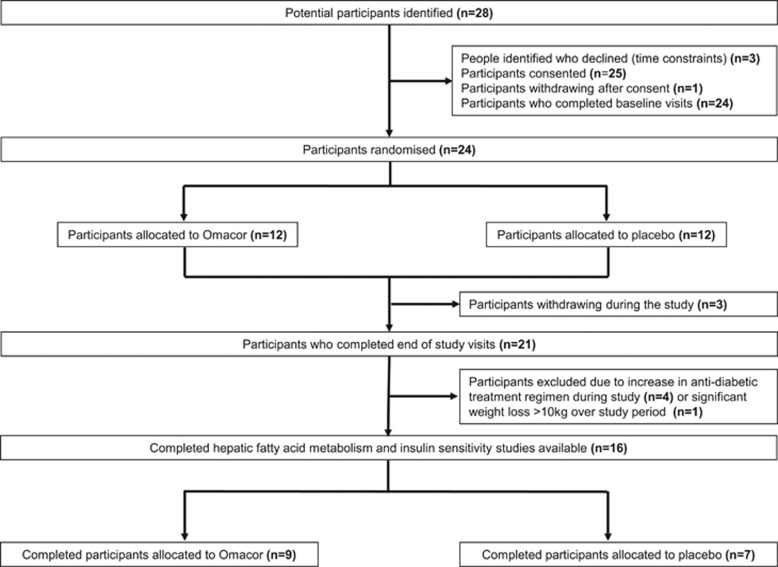
SUBJECTS/METHODS: Sixteen participants were randomised to 4 g/day EPA+DHA (n=8) or placebo (n=8) for 15-18 months and underwent pre- and post-intervention measurements. Fasting and postprandial hepatic FA metabolism was assessed using metabolic substrates labelled with stable-isotope tracers (HO and [UC]palmitate). Insulin sensitivity was measured by a stepped hyperinsulinaemic-euglycaemic clamp using deuterated glucose. Participants were stratified according to change in DHA erythrocyte enrichment (< or ⩾2% post intervention).
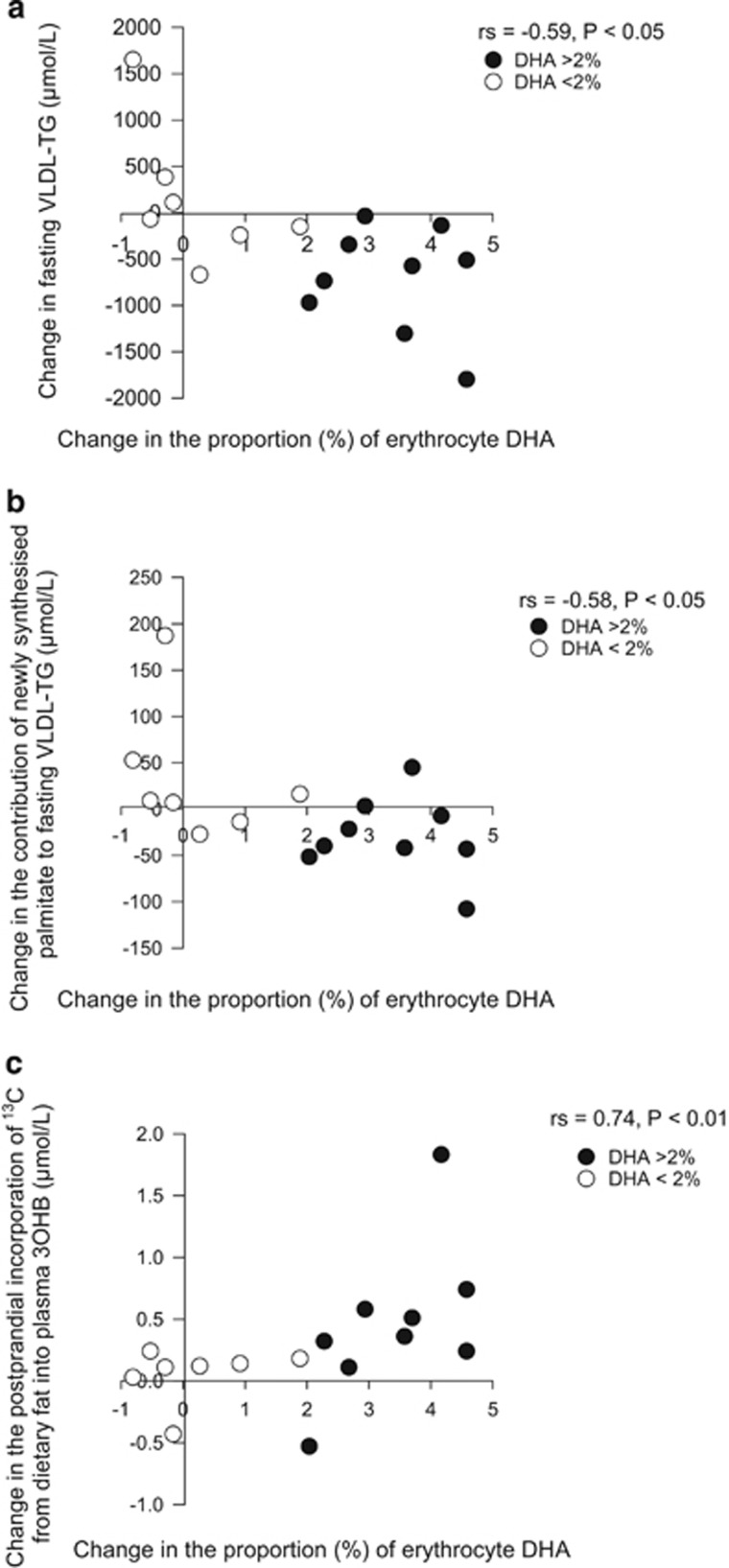
Nine participants were stratified to DHA⩾2% (eight randomised to EPA+DHA and one to placebo) and seven to the DHA<2% group (all placebo). Compared with individuals with erythrocyte <2% change in DHA abundance, those with ⩾2% enrichment had significant improvements in hepatic insulin sensitivity, reduced fasting and postprandial plasma triglyceride concentrations, decreased fasting hepatic DNL, as well as greater appearance of C from dietary fat into plasma 3-hydroxybutyrate (all P<0.05).
The findings from our pilot study indicate that individuals who achieved a change in erythrocyte DHA enrichment ⩾2% show favourable changes in hepatic FA metabolism and insulin sensitivity, which may contribute to decreasing hepatic fat content.
背景/目的:用ω-3多不饱和脂肪酸(FAs)治疗非酒精性脂肪性肝病(NAFLD)患者表明,高水平的二十二碳六烯酸(DHA)组织富集可降低肝脏脂肪含量。在WELCOME试验(非酒精性脂肪性肝病(NAFLD)中使用OMacor疗法对脂肪肝和心血管标志物的韦塞克斯评估)的一项子研究中,我们评估了红细胞DHA富集的变化(作为组织富集变化的替代标志物)是否与肝脏从头脂肪生成(DNL)、餐后脂肪酸分配以及肝脏和外周胰岛素敏感性的改变相关。
受试者/方法:16名参与者被随机分为每天服用4克二十碳五烯酸+二十二碳六烯酸(n = 8)或安慰剂(n = 8),为期15 - 18个月,并在干预前后进行测量。使用稳定同位素示踪剂标记的代谢底物(HO和[UC]棕榈酸)评估空腹和餐后肝脏脂肪酸代谢。通过使用氘代葡萄糖的逐步高胰岛素-正常血糖钳夹法测量胰岛素敏感性。参与者根据红细胞DHA富集的变化(干预后<或⩾2%)进行分层。
9名参与者被分层到DHA⩾2%组(8名随机分配到二十碳五烯酸+二十二碳六烯酸组,1名分配到安慰剂组),7名被分到DHA<2%组(均为安慰剂组)。与红细胞DHA丰度变化<2%的个体相比,富集⩾2%的个体肝脏胰岛素敏感性显著改善,空腹和餐后血浆甘油三酯浓度降低,空腹肝脏DNL减少,以及膳食脂肪中的C更多地出现在血浆3-羟基丁酸中(所有P<0.05)。
我们的初步研究结果表明,红细胞DHA富集变化⩾2%的个体在肝脏脂肪酸代谢和胰岛素敏感性方面表现出有利变化,这可能有助于降低肝脏脂肪含量。