Department of Chemistry, Massachusetts Institute of Technology , Cambridge, Massachusetts 02139, United States.
Acc Chem Res. 2017 Apr 18;50(4):960-967. doi: 10.1021/acs.accounts.6b00653. Epub 2017 Mar 15.
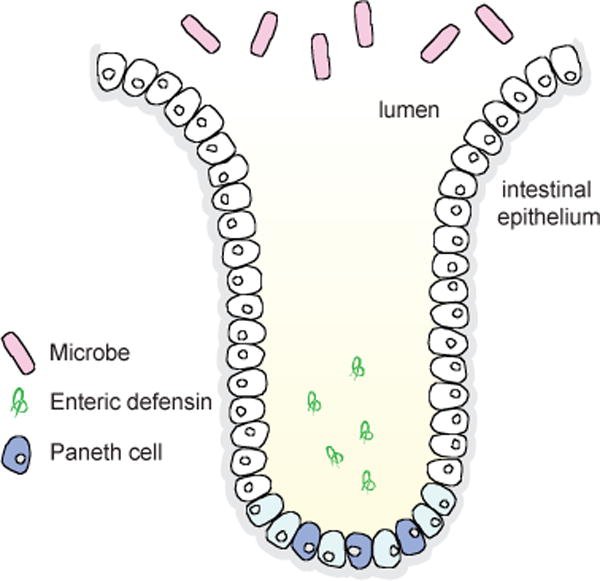
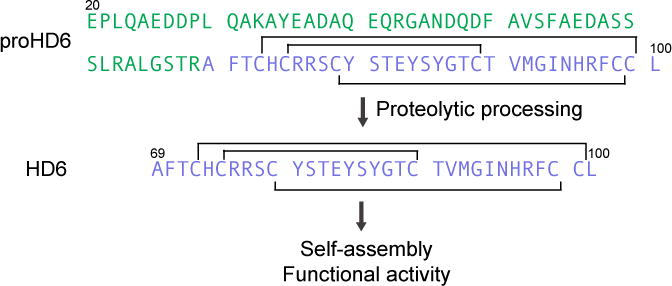
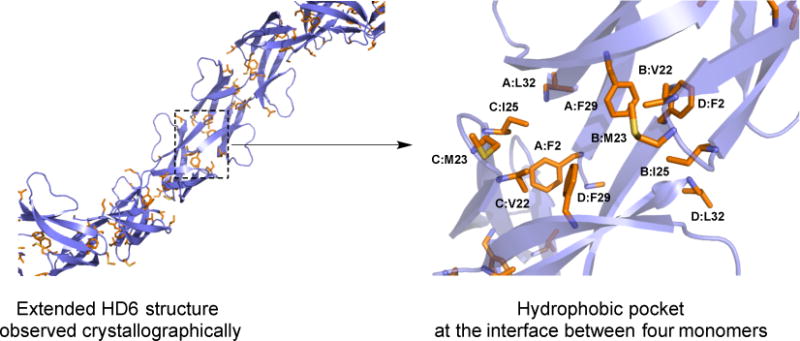
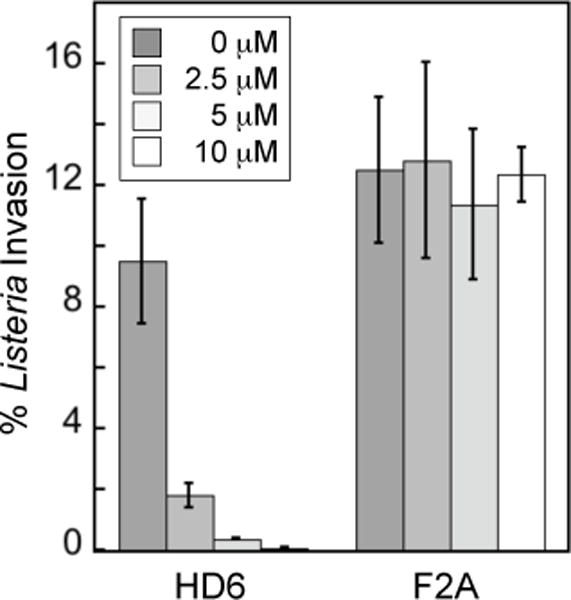
Human α-defensin 6 (HD6) is a 32-residue cysteine-rich peptide that contributes to innate immunity by protecting the host at mucosal sites. This peptide is produced in small intestinal Paneth cells, stored as an 81-residue precursor peptide named proHD6 in granules, and released into the lumen. One unusual feature of HD6 is that it lacks the broad-spectrum antimicrobial activity observed for other human α-defensins, including the Paneth cell peptide human α-defensin 5 (HD5). HD6 exhibits unprecedented self-assembly properties, which confer an unusual host-defense function. HD6 monomers self-assemble into higher-order oligomers termed "nanonets", which entrap microbes and prevent invasive gastrointestinal pathogens such as Salmonella enterica serovar Typhimurium and Listeria monocytogenes from entering host cells. One possible advantage of this host-defense mechanism is that HD6 helps to keep microbes in the lumen such that they can be excreted or attacked by other components of the immune system, such as recruited neutrophils. In this Account, we report our current understanding of HD6 and focus on work published since 2012 when Bevins and co-workers described the discovery of HD6 nanonets in the literature. First, we present studies that address the biosynthesis, storage, and maturation of HD6, which demonstrate that nature uses a propeptide strategy to spatially and temporally control the formation of HD6 nanonets in the small intestine. The propeptide is stored in Paneth cell granules, and proteolysis occurs during or following release into the lumen, which affords the 32-residue mature peptide that self-assembles. We subsequently highlight structure-function studies that provide a foundation for understanding the molecular basis for why HD6 exhibits unusual self-assembly properties compared with other characterized defensins. The disposition of hydrophobic residues in the HD6 primary structure differs from that of other human α-defensins and is an important structural determinant for oligomerization. Lastly, we consider functional studies that illuminate how HD6 contributes to mucosal immunity. We recently discovered that in addition to blocking bacterial invasion into host epithelial cells by Gram-negative and Gram-positive gastrointestinal pathogens, HD6 suppresses virulence traits displayed by the opportunistic human fungal pathogen Candida albicans. In particular, we found that C. albicans biofilm formation, which causes complications in the treatment of candidiasis, is inhibited by HD6. This observation suggests that HD6 may contribute to intestinal homeostasis by helping to keep C. albicans in its commensal state. We intend for this Account to inspire further biochemical, biophysical, and biological investigations that will advance our understanding of HD6 in mucosal immunity and the host-microbe interaction.

人α-防御素 6(HD6)是一种由 32 个氨基酸残基组成的富含半胱氨酸的肽,通过在黏膜部位保护宿主而有助于先天免疫。这种肽由小肠潘氏细胞产生,作为一种 81 个氨基酸残基的前体肽,以颗粒形式储存,称为 proHD6,并释放到腔中。HD6 的一个不寻常特征是,它缺乏其他人类α-防御素(包括潘氏细胞肽人α-防御素 5(HD5))所观察到的广谱抗菌活性。HD6 表现出前所未有的自组装特性,赋予其独特的宿主防御功能。HD6 单体自组装成更高阶的低聚物,称为“纳米网”,可捕获微生物,并阻止侵袭性胃肠道病原体如鼠伤寒沙门氏菌和李斯特菌进入宿主细胞。这种宿主防御机制的一个可能优势是,HD6 有助于将微生物留在腔中,以便它们可以被免疫系统的其他成分(如招募的中性粒细胞)排出或攻击。在本报告中,我们报告了我们目前对 HD6 的理解,并重点介绍了自 2012 年贝文斯及其同事在文献中描述 HD6 纳米网的发现以来发表的工作。首先,我们介绍了研究 HD6 的生物合成、储存和成熟的研究,这些研究表明,自然界使用前肽策略来在空间和时间上控制小肠中 HD6 纳米网的形成。前肽储存在潘氏细胞颗粒中,并且在释放到腔中时或之后发生蛋白水解,从而提供自组装的 32 个氨基酸残基的成熟肽。随后,我们强调了结构功能研究,为理解为什么与其他表征的防御素相比,HD6 表现出异常的自组装特性提供了基础。HD6 一级结构中疏水性残基的排列方式与其他人类α-防御素不同,是寡聚化的重要结构决定因素。最后,我们考虑了阐明 HD6 如何有助于黏膜免疫的功能研究。我们最近发现,除了阻止革兰氏阴性和革兰氏阳性胃肠道病原体入侵宿主上皮细胞外,HD6 还抑制机会性人类真菌病原体白色念珠菌的毒力特性。具体而言,我们发现 HD6 抑制白色念珠菌生物膜的形成,这会导致念珠菌病治疗复杂化。这一观察结果表明,HD6 通过帮助白色念珠菌保持共生状态,可能有助于肠道内稳态。我们希望本报告能够激发进一步的生化、生物物理和生物学研究,从而增进我们对 HD6 在黏膜免疫和宿主-微生物相互作用中的理解。