Cheon Yun-Hong, Kim Hyun-Ok, Suh Young Sun, Kim Min Gyo, Yoo Wan-Hee, Kim Rock Bum, Yang Hyun-Su, Lee Sang-Il, Park Ki-Soo
Internal Medicine and Institute of Health Science, Gyeongsang National University School of Medicine, Jinju, Republic of Korea.
Department of Rheumatology, Internal Medicine, Chonbuk National University School of Medicine, Chonju, Republic of Korea.
PLoS One. 2017 Mar 15;12(3):e0173036. doi: 10.1371/journal.pone.0173036. eCollection 2017.
To identify the prevalence of and risk factors for knee pain and radiographic knee osteoarthritis (RKOA) and to investigate the relationship between decreased lower extremity muscle mass (DLEM) and knee pain severity.
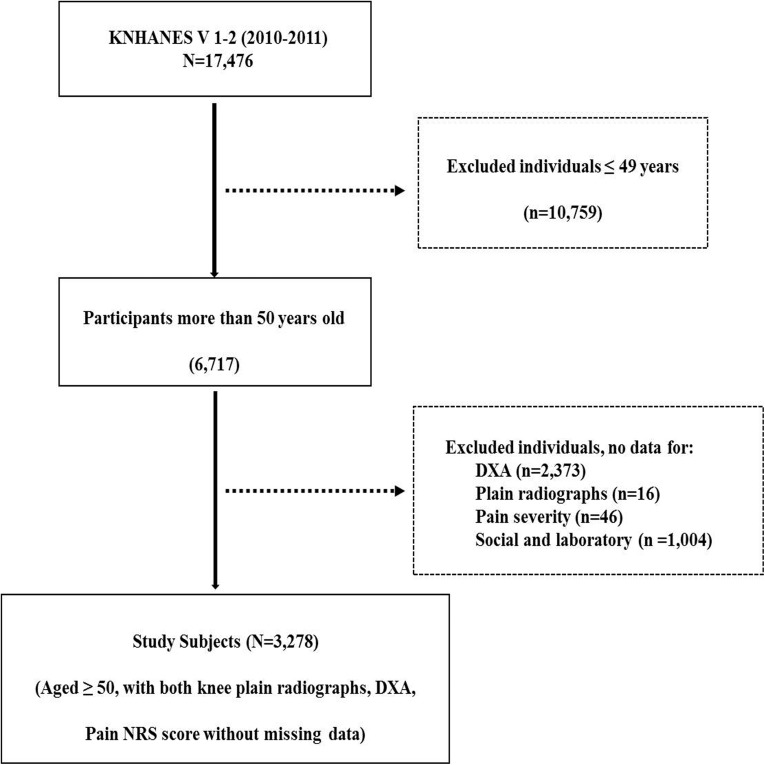
Using data from the Korea National Health and Nutrition Examination Survey, 3,278 participants who were ≥50 years old and who underwent dual x-ray absorptiometry, plain knee radiographs and completed a knee pain questionnaire were enrolled. Lower extremity muscle mass (LEM) was defined as the sum of the fat-free soft tissue mass of the legs, and lower extremity muscle mass index (LMI) was calculated as LEM/body weight (%). DLEM was defined as an LMI more than two standard deviations below the mean of a gender-matched young reference group. Categorical variables were presented as numbers (weighted %).
The prevalence of knee pain and RKOA were 22% (n = 721) and 34.7% (n = 1,234), respectively. Multivariate logistic regression analysis showed being female (OR 2.15, 95% CI 1.67-2.79), older (OR 1.03, 95% CI 1.01-1.04), less educated (OR 1.72, 95% CI 1.09-2.71), stiffness (OR 16.15, 95% CI 12.04-21.66), bed rest (OR 2.49, 95% CI 1.81-3.43), RKOA (OR 2.20, 95% CI 1.78-2.74) and DLEM (OR 1.54, 95% CI 1.09-2.17) were associated with knee pain. Participants with simultaneous RKOA and DLEM complained of more severe pain (pain score 7.18 ± 2.48) than those with knee pain without RKOA or DLEM (5.02 ± 2.44), those with only RKOA (6.29 ± 2.50), or those with only DLEM (6.78 ± 2.18) (P<0.001). These results remained after multivariate analyses of variance (MANOVAs).
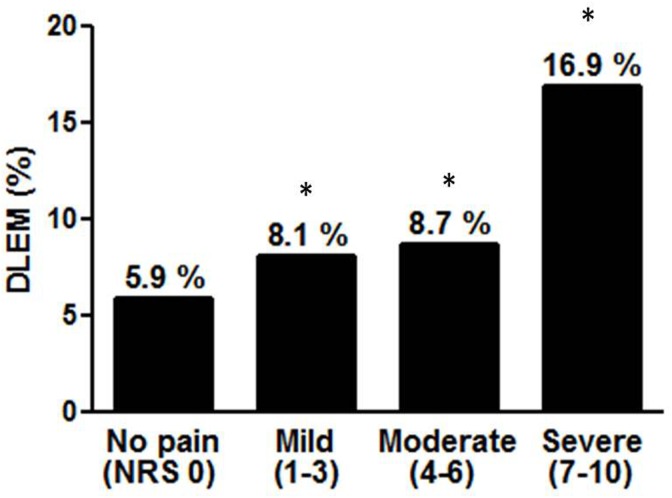
The prevalence of knee pain and RKOA were 22% and 34.7%, respectively, in the general Korean population. DLEM was an independent risk factor for knee pain and it was associated with increased pain severity, regardless of RKOA.
确定膝关节疼痛和膝关节影像学骨关节炎(RKOA)的患病率及危险因素,并研究下肢肌肉量减少(DLEM)与膝关节疼痛严重程度之间的关系。
利用韩国国家健康与营养检查调查的数据,纳入3278名年龄≥50岁、接受双能X线吸收法检查、膝关节X线平片检查并完成膝关节疼痛问卷的参与者。下肢肌肉量(LEM)定义为双腿无脂肪软组织质量之和,下肢肌肉量指数(LMI)计算为LEM/体重(%)。DLEM定义为LMI低于性别匹配的年轻参照组均值两个标准差以上。分类变量以数字(加权%)表示。
膝关节疼痛和RKOA的患病率分别为22%(n = 721)和34.7%(n = 1234)。多因素逻辑回归分析显示,女性(比值比[OR] 2.15,95%置信区间[CI] 1.67 - 2.79)、年龄较大(OR 1.03,95% CI 1.01 - 1.04)、受教育程度较低(OR 1.72,95% CI 1.09 - 2.71)、关节僵硬(OR 16.15,95% CI 12.04 - 21.66)、卧床休息(OR 2.49,95% CI 1.81 - 3.43)、RKOA(OR 2.20,95% CI 1.78 - 2.74)和DLEM(OR 1.54,95% CI 1.09 - 2.17)与膝关节疼痛相关。同时患有RKOA和DLEM的参与者抱怨的疼痛比无RKOA或DLEM的膝关节疼痛患者(疼痛评分5.02±2.44)、仅患有RKOA的患者(6.29±2.50)或仅患有DLEM的患者(6.78±2.18)更严重(疼痛评分7.18±2.48)(P<0.001)。这些结果在多因素方差分析(MANOVA)后仍然成立。
在韩国普通人群中,膝关节疼痛和RKOA的患病率分别为22%和34.7%。DLEM是膝关节疼痛的独立危险因素,且与疼痛严重程度增加相关,无论是否存在RKOA。