Ashok Abhishekh H, Mizuno Yuya, Volkow Nora D, Howes Oliver D
Psychiatric Imaging Group, Medical Research Council London Institute of Medical Sciences Centre, London, England2Psychiatric Imaging Group, Institute of Clinical Sciences, Faculty of Medicine, Imperial College London, London, England3Department of Psychosis Studies, Institute of Psychiatry, Psychology & Neuroscience, King's College London, London, England.
Department of Psychosis Studies, Institute of Psychiatry, Psychology & Neuroscience, King's College London, London, England4Department of Neuropsychiatry, Keio University School of Medicine, Tokyo, Japan.
JAMA Psychiatry. 2017 May 1;74(5):511-519. doi: 10.1001/jamapsychiatry.2017.0135.
Stimulant use disorder is common, affecting between 0.3% and 1.1% of the population, and costs more than $85 billion per year globally. There are no licensed treatments to date. Several lines of evidence implicate the dopamine system in the pathogenesis of substance use disorder. Therefore, understanding the nature of dopamine dysfunction seen in stimulant users has the potential to aid the development of new therapeutics.
To comprehensively review the in vivo imaging evidence for dopaminergic alterations in stimulant (cocaine, amphetamine, or methamphetamine) abuse or dependence.
The entire PubMed, EMBASE, and PsycINFO databases were searched for studies from inception date to May 14, 2016.
Case-control studies were identified that compared dopaminergic measures between stimulant users and healthy controls using positron emission tomography or single-photon emission computed tomography to measure striatal dopamine synthesis or release or to assess dopamine transporter availability or dopamine receptor availability.
Demographic, clinical, and imaging measures were extracted from each study, and meta-analyses and sensitivity analyses were conducted for stimulants combined, as well as for cocaine and for amphetamine and methamphetamine separately if there were sufficient studies.
Differences were measured in dopamine release (assessed using change in the D2/D3 receptor availability after administration of amphetamine or methylphenidate), dopamine transporter availability, and dopamine receptor availability in cocaine users, amphetamine and methamphetamine users, and healthy controls.
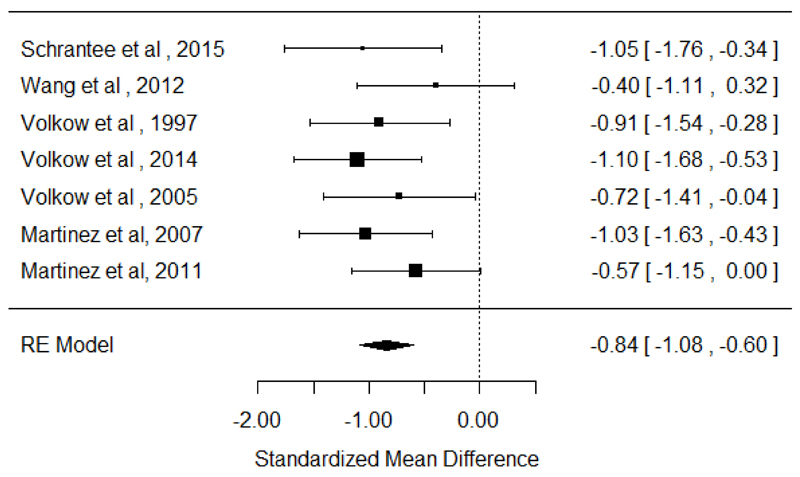
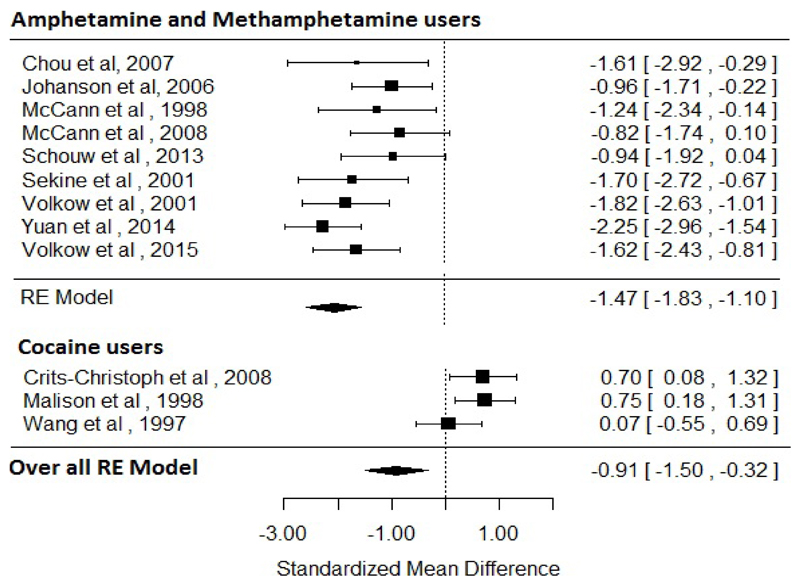
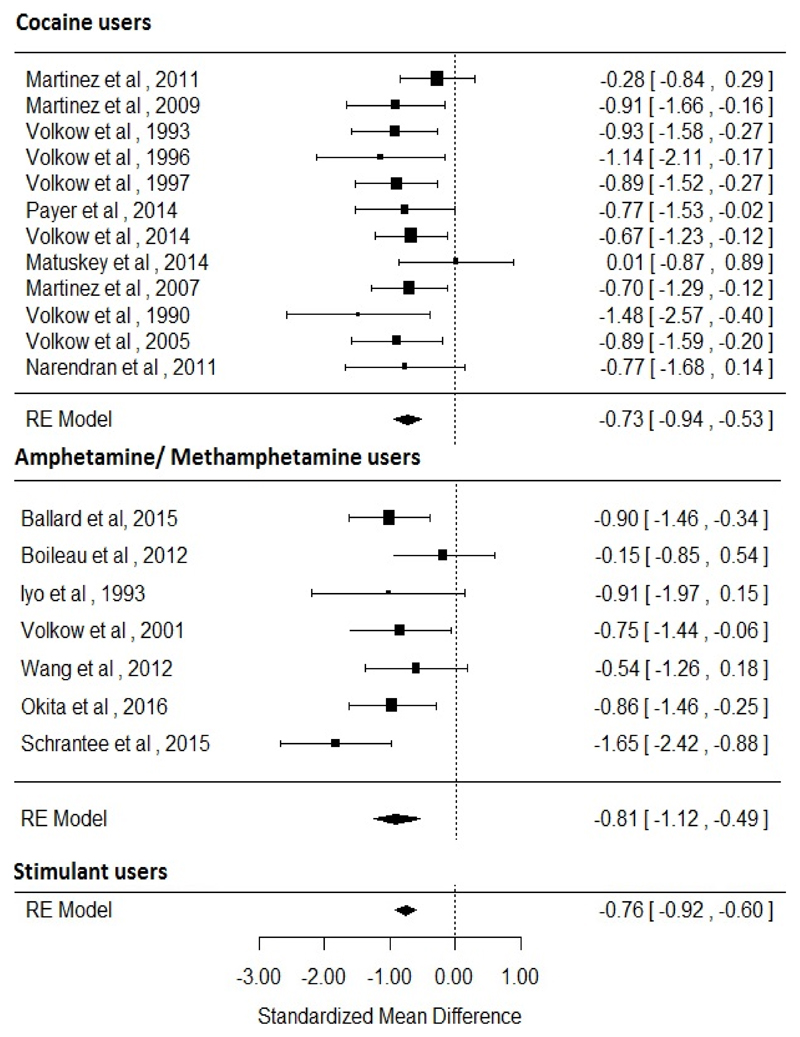
A total of 31 studies that compared dopaminergic measures between 519 stimulant users and 512 healthy controls were included in the final analysis. In most of the studies, the duration of abstinence varied from 5 days to 3 weeks. There was a significant decrease in striatal dopamine release in stimulant users compared with healthy controls: the effect size was -0.84 (95% CI, -1.08 to -0.60; P < .001) for stimulants combined and -0.87 (95% CI, -1.15 to -0.60; P < .001) for cocaine. In addition, there was a significant decrease in dopamine transporter availability: the effect size was -0.91 (95% CI, -1.50 to -0.32; P < .01) for stimulants combined and -1.47 (95% CI, -1.83 to -1.10; P < .001) for amphetamine and methamphetamine. There was also a significant decrease in D2/D3 receptor availability: the effect size was -0.76 (95% CI, -0.92 to -0.60; P < .001) for stimulants combined, -0.73 (95% CI, -0.94 to -0.53; P < .001) for cocaine, and -0.81 (95% CI, -1.12 to -0.49; P < .001) for amphetamine and methamphetamine. Consistent alterations were not found in vesicular monoamine transporter, dopamine synthesis, or D1 receptor studies.
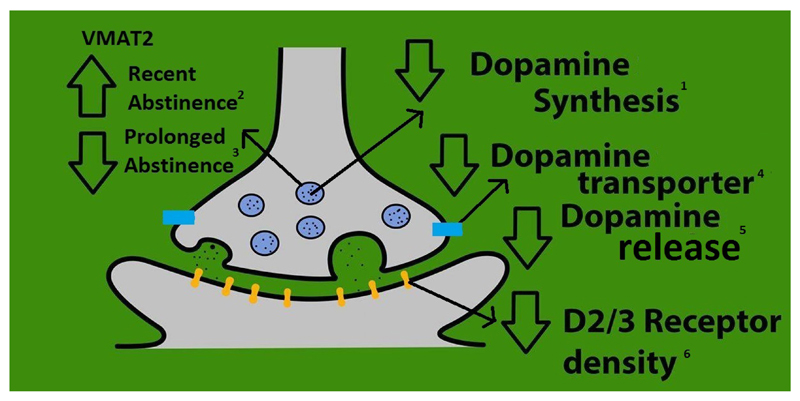
Data suggest that both presynaptic and postsynaptic aspects of the dopamine system in the striatum are down-regulated in stimulant users. The commonality and differences between these findings and the discrepancies with the preclinical literature and models of drug addiction are discussed, as well as their implications for future drug development.
兴奋剂使用障碍很常见,影响着0.3%至1.1%的人口,全球每年花费超过850亿美元。迄今为止尚无许可的治疗方法。有几条证据表明多巴胺系统与物质使用障碍的发病机制有关。因此,了解兴奋剂使用者中多巴胺功能障碍的本质有可能有助于开发新的治疗方法。
全面综述兴奋剂(可卡因、苯丙胺或甲基苯丙胺)滥用或依赖中多巴胺能改变的体内成像证据。
检索了整个PubMed、EMBASE和PsycINFO数据库,查找从起始日期到2016年5月14日的研究。
确定了病例对照研究,这些研究使用正电子发射断层扫描或单光子发射计算机断层扫描比较兴奋剂使用者和健康对照之间的多巴胺能测量指标,以测量纹状体多巴胺合成或释放,或评估多巴胺转运体可用性或多巴胺受体可用性。
从每项研究中提取人口统计学、临床和成像测量指标,对合并使用的兴奋剂进行荟萃分析和敏感性分析,如果有足够的研究,也分别对可卡因、苯丙胺和甲基苯丙胺进行分析。
测量可卡因使用者、苯丙胺和甲基苯丙胺使用者以及健康对照之间在多巴胺释放(使用苯丙胺或哌醋甲酯给药后D2/D3受体可用性的变化进行评估)、多巴胺转运体可用性和多巴胺受体可用性方面的差异。
最终分析纳入了31项比较519名兴奋剂使用者和512名健康对照之间多巴胺能测量指标的研究。在大多数研究中,禁欲时间从5天到3周不等。与健康对照相比,兴奋剂使用者纹状体多巴胺释放显著减少:合并使用兴奋剂时效应大小为-0.84(95%CI,-1.08至-0.60;P<0.001),可卡因使用者为-0.87(95%CI,-1.15至-0.60;P<0.001)。此外,多巴胺转运体可用性显著降低:合并使用兴奋剂时效应大小为-0.91(95%CI,-1.50至-0.32;P<0.01),苯丙胺和甲基苯丙胺使用者为-1.47(95%CI,-1.83至-1.10;P<0.001)。D2/D3受体可用性也显著降低:合并使用兴奋剂时效应大小为-0.76(95%CI,-0.92至-0.60;P<0.001),可卡因使用者为-0.73(95%CI,-0.94至-0.53;P<0.001),苯丙胺和甲基苯丙胺使用者为-0.81(95%CI,-1.12至-0.49;P<0.001)。在囊泡单胺转运体、多巴胺合成或D1受体研究中未发现一致的改变。
数据表明,兴奋剂使用者纹状体中多巴胺系统的突触前和突触后方面均下调。讨论了这些发现之间的共性和差异以及与临床前文献和药物成瘾模型的差异,以及它们对未来药物开发的影响。