Eshaghi Alireza, Duvvuri Venkata R, Isabel Sandra, Banh Philip, Li Aimin, Peci Adriana, Patel Samir N, Gubbay Jonathan B
Department of Clinical Laboratory and Microbiology Sciences, Public Health Ontario, Toronto ON, Canada.
Department of Paediatrics, The Hospital for Sick Children, University of Toronto, Toronto ON, Canada.
Front Microbiol. 2017 Mar 1;8:257. doi: 10.3389/fmicb.2017.00257. eCollection 2017.
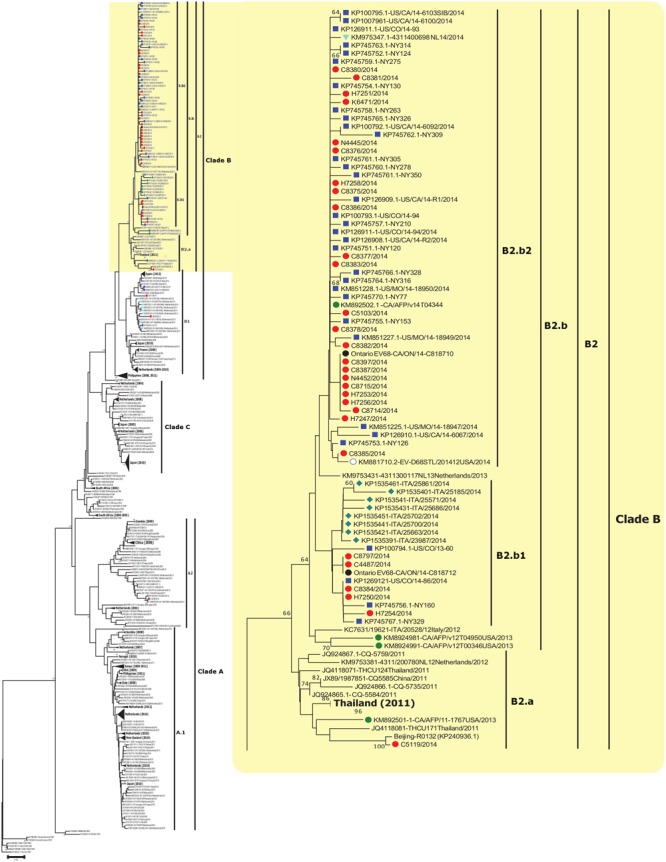
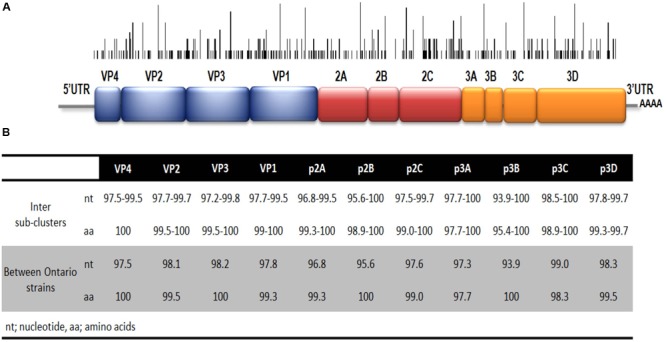
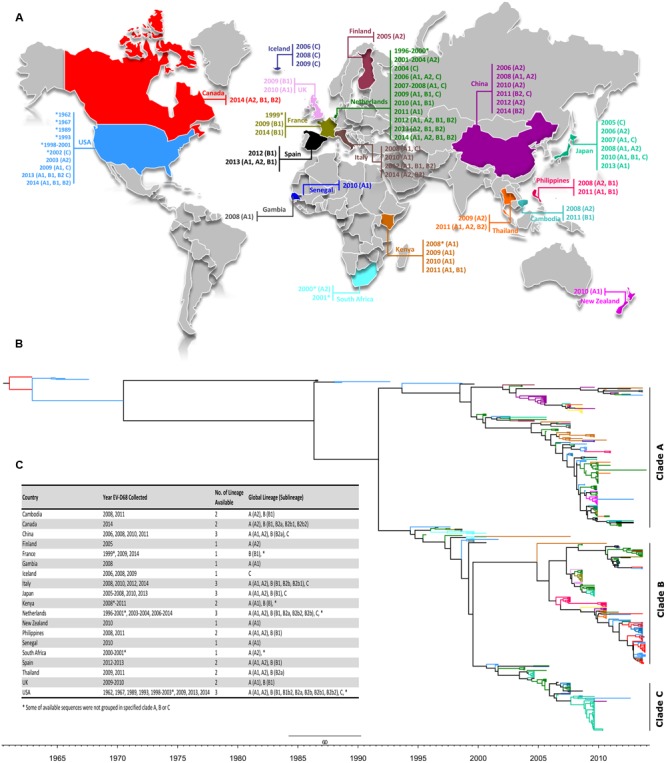
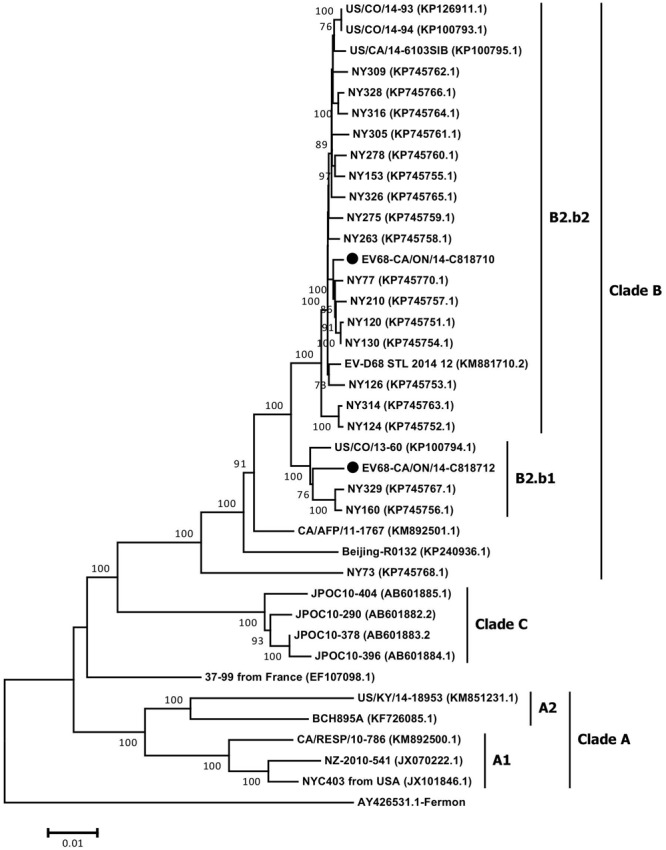
Despite its first appearance in 1962, human enterovirus D68 (EV-D68) has been recognized as an emerging respiratory pathogen in the last decade when it caused outbreaks and clusters in several countries including Japan, the Philippines, and the Netherlands. The most recent and largest outbreak of EV-D68 associated with severe respiratory illness took place in North America between August 2014 and January 2015. Between September 1 and October 31 2014, EV-D68 infection was laboratory confirmed among 153/907 (16.9%) persons tested for the virus in Ontario, Canada, using real time RT-PCR and subsequent genotyping by sequencing of partial VP1 gene. In order to understand the evolutionary history of the 2014 North American EV-D68 outbreak, we conducted phylogenetic and phylodynamic analyses using available partial VP1 genes ( = 469) and NCBI available whole genome sequences (WGS) ( = 38). The global EV-D68 phylogenetic tree ( = 469) reconfirms the divergence of three distinct clades A, B, and C from the prototype EV-D68 Fermon strain as previously documented. Two sub-clades (B1 and B2) were identified, with most 2014 EV-D68 outbreak strains belonging to sub-cluster B2b2 (one of the two emerging clusters within sub-clade B2), with two signature substitutions T650A and M700V in BC and DE loops of VP1 gene, respectively. The close homology between WGS of strains from Ontario ( = 2) and USA ( = 21) in the recent EV-D68 outbreak suggests genetic relatedness and also a common source for the outbreak. The time of most recent common ancestor of EV-D68 and the 2014 EV-D68 outbreak strain suggest that the viruses possibly emerged during 1960-1961 and 2012-2013, respectively. We observed lower mean evolutionary rates of global EV-D68 using WGS data than estimated with partial VP1 gene sequences. Based on WGS data, the estimated mean rate of evolution of the EV-D68 B2b cluster was 9.75 × 10 substitutions/site/year (95% BCI 4.11 × 10 to 16 × 10).
尽管人类肠道病毒D68(EV-D68)于1962年首次出现,但在过去十年中它才被认定为一种新出现的呼吸道病原体,当时它在包括日本、菲律宾和荷兰在内的几个国家引发了疫情和聚集性病例。与严重呼吸道疾病相关的EV-D68最近一次也是规模最大的疫情爆发发生在2014年8月至2015年1月的北美地区。在2014年9月1日至10月31日期间,在加拿大安大略省接受病毒检测的907人中,有153人(16.9%)经实验室确诊感染了EV-D68,检测方法为实时逆转录聚合酶链反应(RT-PCR),随后通过对部分VP1基因进行测序进行基因分型。为了了解2014年北美EV-D68疫情的进化史,我们使用现有的部分VP1基因(n = 469)和美国国立生物技术信息中心(NCBI)现有的全基因组序列(WGS)(n = 38)进行了系统发育和系统动力学分析。全球EV-D68系统发育树(n = 469)再次证实了先前记录的三个不同进化枝A、B和C与原型EV-D68 Fermon株的分化。鉴定出了两个亚进化枝(B1和B2),2014年大多数EV-D68疫情菌株属于亚群B2b2(亚进化枝B2内两个新出现的亚群之一),在VP1基因的BC环和DE环中分别有两个特征性替换T650A和M700V。近期EV-D68疫情中安大略省(n = 2)和美国(n = 21)菌株的全基因组序列之间的密切同源性表明它们在遗传上相关,也表明疫情有共同来源。EV-D68与2014年EV-D68疫情菌株的最近共同祖先时间表明,这些病毒可能分别在1960 - 1961年和2012 - 2013年出现。我们观察到,使用全基因组序列数据得出的全球EV-D68平均进化速率低于使用部分VP1基因序列估计的速率。基于全基因组序列数据,EV-D68 B2b亚群的估计平均进化速率为每年9.75×10⁻⁴个替换/位点(95%贝叶斯可信区间为4.11×10⁻⁴至16×10⁻⁴)。