Kaida Atsushi, Iritani Nobuhiro, Yamamoto Seiji P, Kanbayashi Daiki, Hirai Yuki, Togawa Masao, Amo Kiyoko, Kohdera Urara, Nishigaki Toshinori, Shiomi Masashi, Asai Sadasaburo, Kageyama Tsutomu, Kubo Hideyuki
Division of Microbiology, Osaka Institute of Public Health, Osaka, Japan.
Osaka City General Hospital, Osaka, Japan.
PLoS One. 2017 Sep 13;12(9):e0184335. doi: 10.1371/journal.pone.0184335. eCollection 2017.
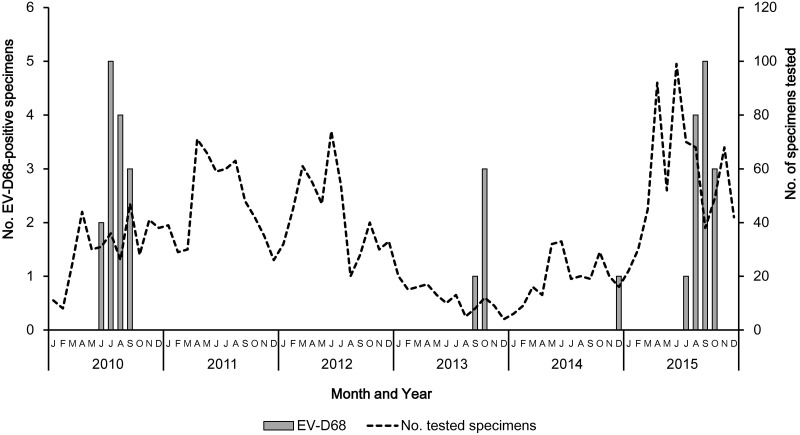
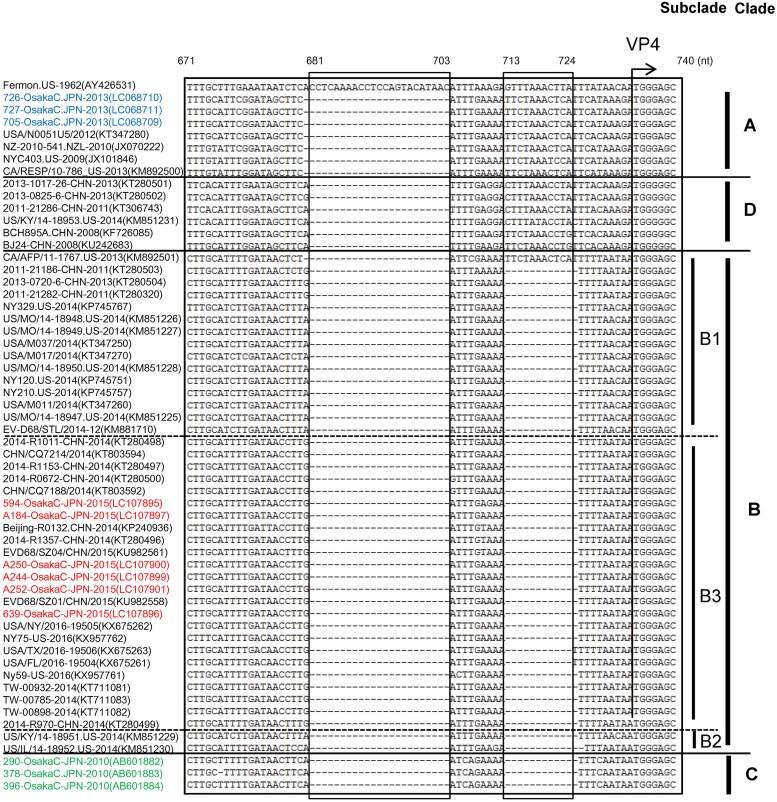
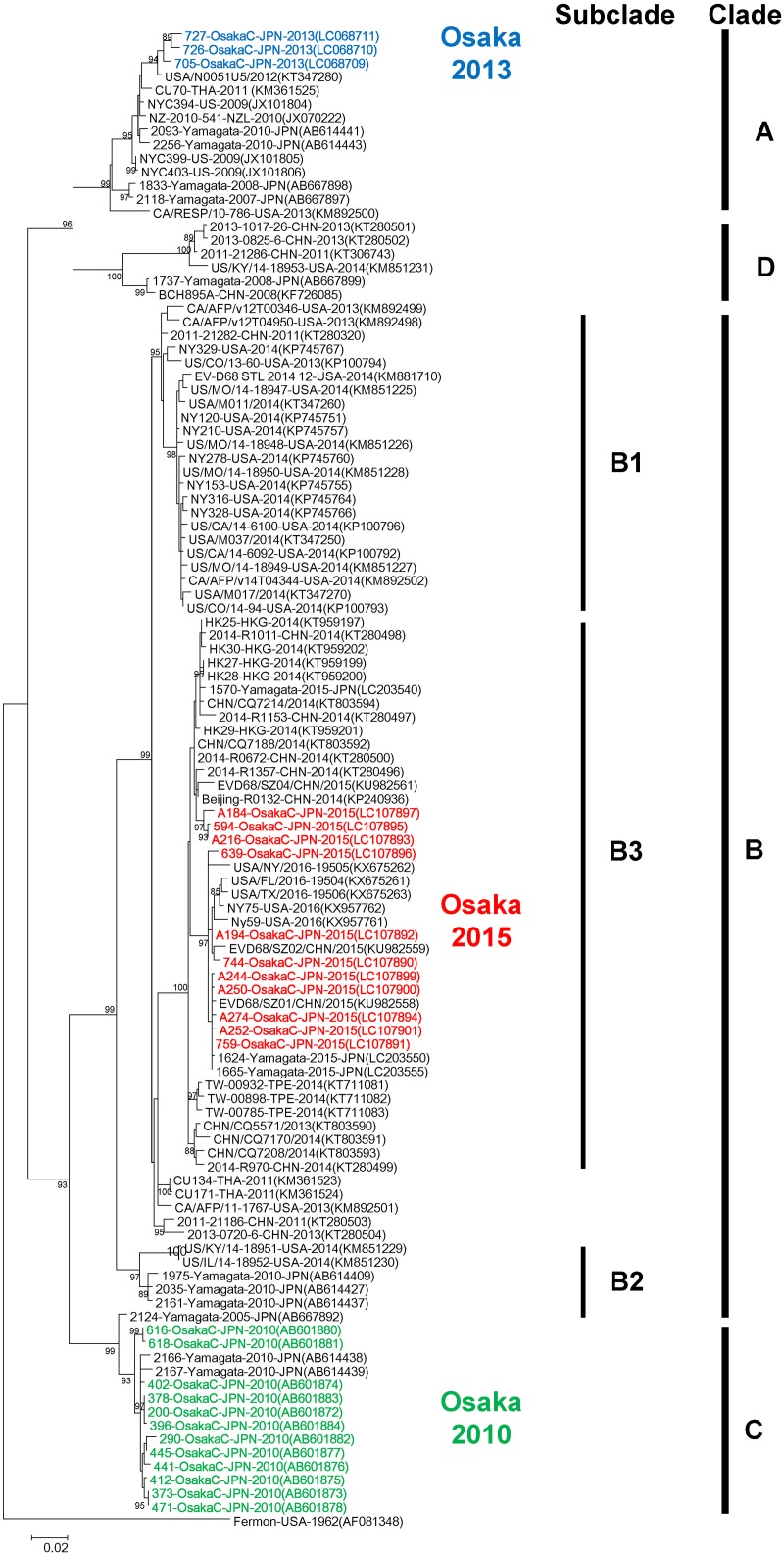
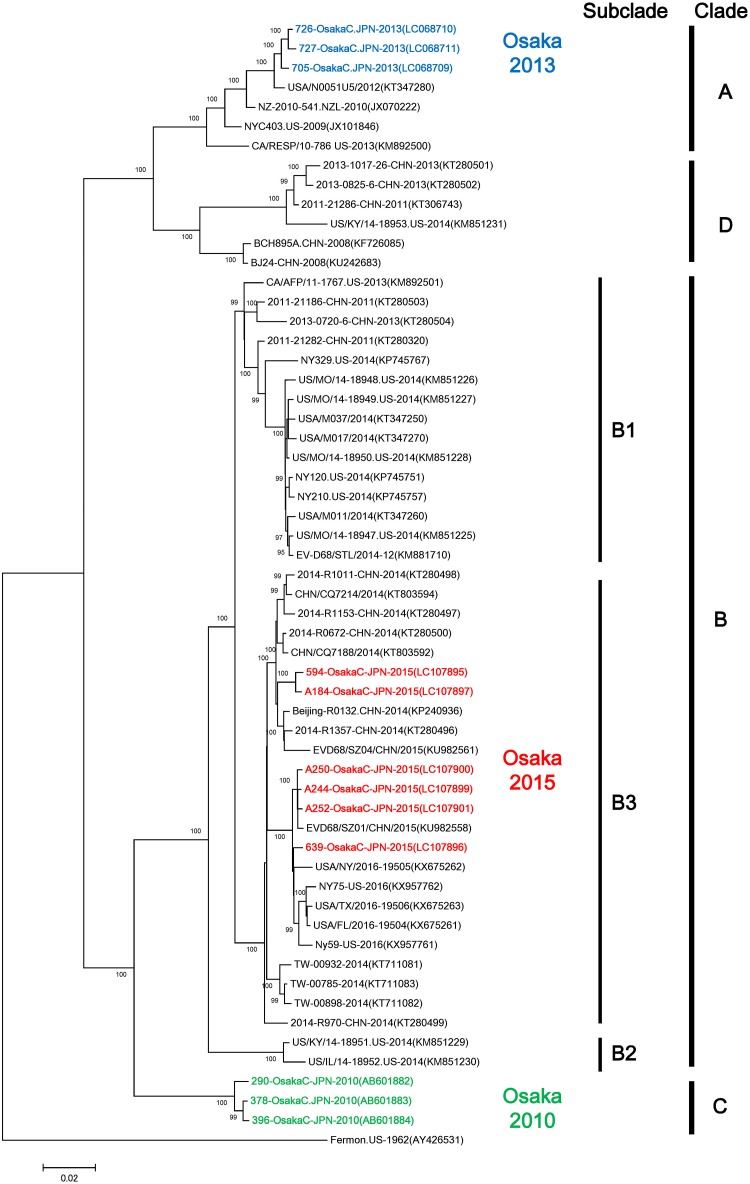
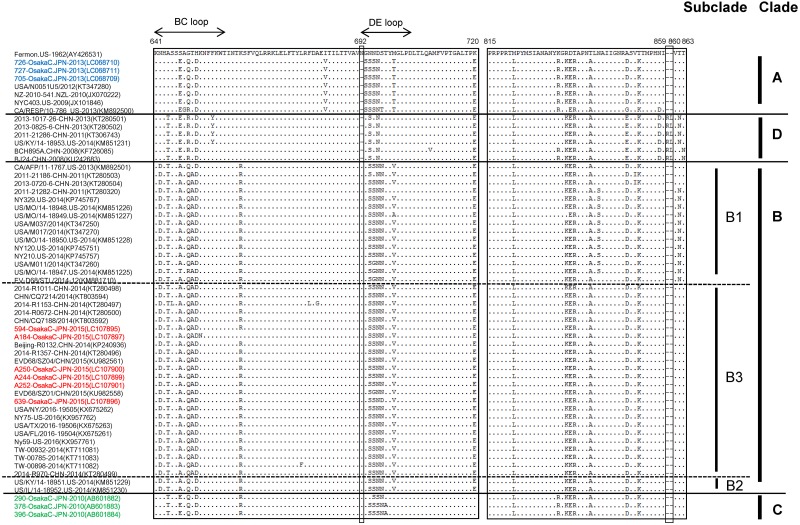
The first upsurge of enterovirus D68 (EV-D68), a causative agent of acute respiratory infections (ARIs), in Japan was reported in Osaka City in 2010. In this study, which began in 2010, we surveyed EV-D68 in children with ARIs and analyzed sequences of EV-D68 strains detected. Real-time PCR of 19 respiratory viruses or subtypes of viruses, including enterovirus, was performed on 2,215 specimens from ARI patients (<10 years of age) collected between November 2010 and December 2015 in Osaka City, Japan. EV-D68 was identified in 18 enterovirus-positive specimens (n = 4 in 2013, n = 1 in 2014, and n = 13 in 2015) by analysis of viral protein 1 (VP1) or VP4 sequences, followed by a BLAST search for similar sequences. All EV-D68 strains were detected between June and October (summer to autumn), except for one strain detected in 2014. A phylogenetic analysis of available VP1 sequences revealed that the Osaka strains detected in 2010, 2013, and 2015 belonged to distinct clusters (Clades C, A, and B [Subclade B3], respectively). Comparison of the 5' untranslated regions of these viruses showed that Osaka strains in Clades A, B (Subclade B3), and C commonly had deletions at nucleotide positions 681-703 corresponding to the prototype Fermon strain. Clades B and C had deletions from nucleotide positions 713-724. Since the EV-D68 epidemic in 2010, EV-D68 re-emerged in Osaka City, Japan, in 2013 and 2015. Results of this study indicate that distinct clades of EV-D68 contributed to re-emergences of this virus in 2010, 2013, and 2015 in this limited region.
肠道病毒D68(EV-D68)是急性呼吸道感染(ARI)的病原体,2010年在日本大阪市首次出现疫情。在这项始于2010年的研究中,我们对患ARI的儿童进行了EV-D68调查,并分析了检测到的EV-D68毒株的序列。对2010年11月至2015年12月期间在日本大阪市收集的2215份ARI患者(<10岁)的标本进行了19种呼吸道病毒或病毒亚型(包括肠道病毒)的实时PCR检测。通过分析病毒蛋白1(VP1)或VP4序列,然后进行BLAST搜索相似序列,在18份肠道病毒阳性标本中鉴定出EV-D68(2013年4份,2014年1份,2015年13份)。除2014年检测到的1株外,所有EV-D68毒株均在6月至10月(夏季至秋季)期间检测到。对可用VP1序列的系统发育分析表明,2010年、2013年和2015年在大阪检测到的毒株分别属于不同的簇(C、A和B [B3亚簇])。对这些病毒的5'非翻译区进行比较发现,A、B(B3亚簇)和C簇中的大阪毒株在对应于原型Fermon毒株的核苷酸位置681-703处通常有缺失。B和C簇在核苷酸位置713-724处有缺失。自2010年EV-D68疫情以来,该病毒于2013年和2015年在日本大阪市再次出现。本研究结果表明,不同的EV-D68簇导致了该病毒在2010年、2013年和2015年在这一有限区域的再次出现。