Uji Akihito, Abdelfattah Nizar Saleh, Boyer David S, Balasubramanian Siva, Lei Jianqin, Sadda SriniVas R
Doheny Image Reading Center, Doheny Eye Institute, Los Angeles, California, USA ; Department of Ophthalmology, David Geffen School of Medicine at the University of California-Los Angeles, Los Angeles, California, USA.
Retina Vitreous Associates Medical Group, Beverly Hills, California, USA.
Transl Vis Sci Technol. 2017 Mar 1;6(2):1. doi: 10.1167/tvst.6.2.1. eCollection 2017 Mar.
To investigate the level of inaccuracy of retinal thickness measurements in tilted and axially stretched optical coherence tomography (OCT) images.
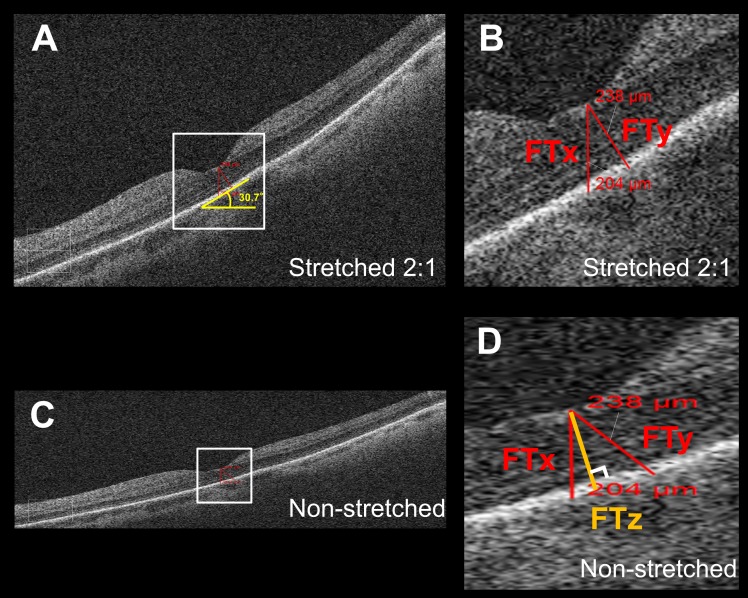
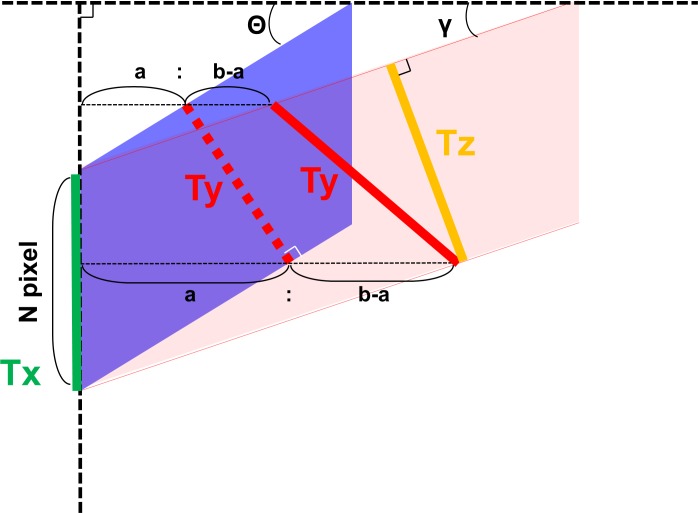
A consecutive series of 50 eyes of 50 patients with age-related macular degeneration were included in this study, and Cirrus HD-OCT images through the foveal center were used for the analysis. The foveal thickness was measured in three ways: (1) parallel to the orientation of the A-scan (Tx), (2) perpendicular to the retinal pigment epithelium (RPE) surface in the instrument-displayed aspect ratio image (Ty), and (3) thickness measured perpendicular to the RPE surface in a native aspect ratio image (Tz). Mathematical modeling was performed to estimate the measurement error.
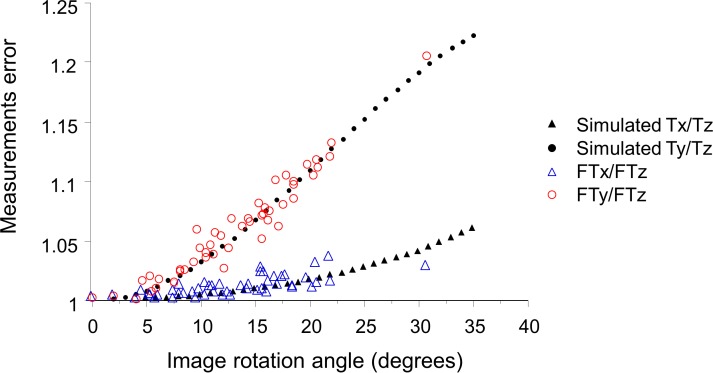
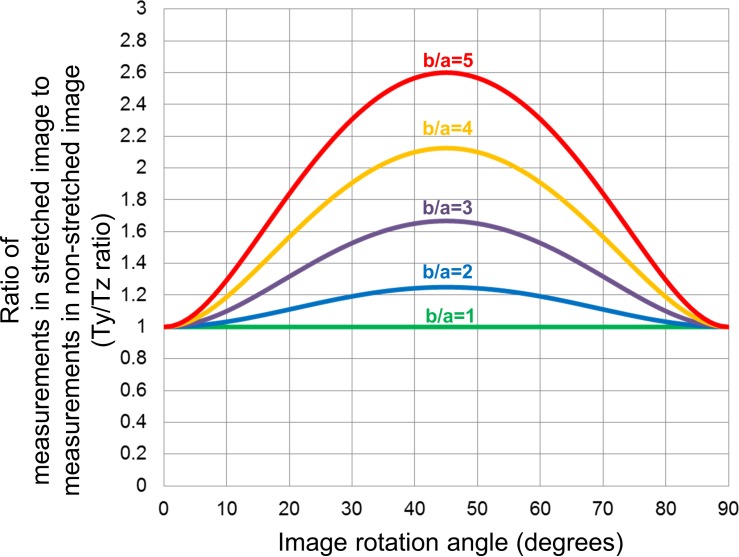
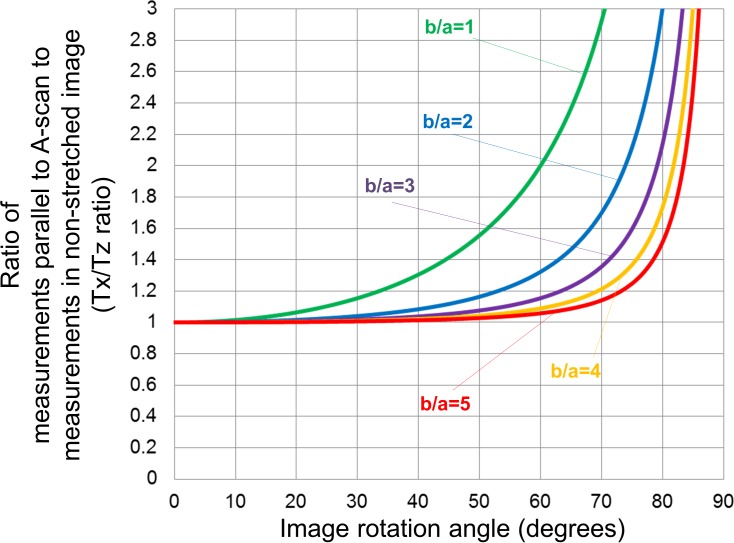
The measurement error was larger in tilted images with a greater angle of tilt. In the simulation, with axial stretching by a factor of 2, Ty/Tz ratio was > 1.05 at a tilt angle between 13° to 18° and 72° to 77°, > 1.10 at a tilt angle between 19° to 31° and 59° to 71°, and > 1.20 at an angle ranging from 32° to 58°. Of note with even more axial stretching, the Ty/Tz ratio is even larger. Tx/Tz ratio was smaller than the Ty/Tz ratio at angles ranging from 0° to 54°. The actual patient data showed good agreement with the simulation.
The Ty/Tz ratio was greater than 1.05 (5% error) at angles ranging from 13° to 18° and 72° to 77°, greater than 1.10 (10% error) angles ranging from 19° to 31° and 59° to 71°, and greater than 1.20 (20% error) angles ranging from 32° to 58° in the images axially stretched by a factor of 2 (b/a = 2), which is typical of most OCT instrument displays.
Retinal thickness measurements obtained perpendicular to the RPE surface were overestimated when using tilted and axially stretched OCT images.
If accurate measurements are to be obtained, images with a native aspect ratio similar to microscopy must be used.
研究倾斜和轴向拉伸的光学相干断层扫描(OCT)图像中视网膜厚度测量的不准确程度。
本研究纳入了50例年龄相关性黄斑变性患者的连续50只眼,使用通过黄斑中心的Cirrus HD-OCT图像进行分析。通过三种方式测量黄斑厚度:(1)平行于A扫描方向(Tx);(2)在仪器显示的长宽比图像中垂直于视网膜色素上皮(RPE)表面(Ty);(3)在原始长宽比图像中垂直于RPE表面测量的厚度(Tz)。进行数学建模以估计测量误差。
倾斜角度越大的倾斜图像中测量误差越大。在模拟中,轴向拉伸2倍时,在13°至18°和72°至77°的倾斜角度下,Ty/Tz比值>1.05;在19°至31°和59°至71°的倾斜角度下,>1.10;在32°至58°的角度范围内,>1.20。值得注意的是,轴向拉伸越大,Ty/Tz比值越大。在0°至54°的角度范围内,Tx/Tz比值小于Ty/Tz比值。实际患者数据与模拟结果吻合良好。
在轴向拉伸2倍(b/a = 2)的图像中,这是大多数OCT仪器显示的典型情况,在13°至18°和72°至77°的角度范围内,Ty/Tz比值大于1.05(误差5%);在19°至31°和59°至71°的角度范围内,大于1.10(误差10%);在32°至58°的角度范围内,大于1.20(误差20%)。
使用倾斜和轴向拉伸的OCT图像时,垂直于RPE表面获得的视网膜厚度测量值被高估。
若要获得准确测量值,则必须使用与显微镜相似的原始长宽比图像。