Song Yanjing, Wang Yao, Tong Chuan, Xi Hongqing, Zhao Xudong, Wang Yi, Chen Lin
Department of General Surgery, Chinese PLA General Hospital, Beijing 100853, China.
Department of Immunology, Institute of Basic Medicine, School of Life Sciences, Chinese PLA General Hospital, Beijing 100853, China.
Br J Cancer. 2017 Apr 11;116(8):973-989. doi: 10.1038/bjc.2017.54. Epub 2017 Mar 16.
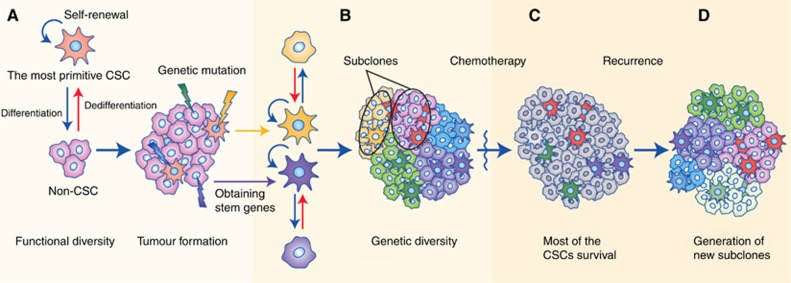
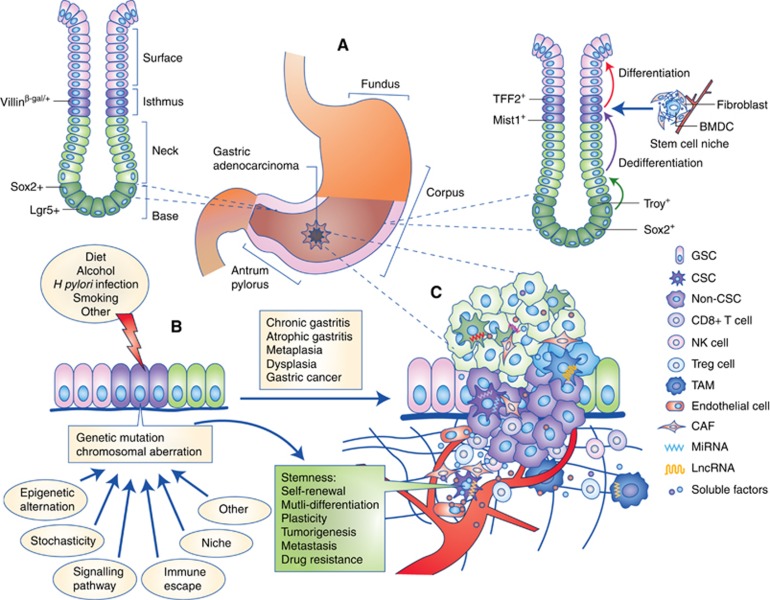
Gastric cancer (GC) is a life-threatening disease worldwide. Despite remarkable advances in treatments for GC, it is still fatal to many patients due to cancer progression, recurrence and metastasis. Regarding the development of novel therapeutic techniques, many studies have focused on the biological mechanisms that initiate tumours and cause treatment resistance. Tumours have traditionally been considered to result from somatic mutations, either via clonal evolution or through a stochastic model. However, emerging evidence has characterised tumours using a hierarchical organisational structure, with cancer stem cells (CSCs) at the apex. Both stochastic and hierarchical models are reasonable systems that have been hypothesised to describe tumour heterogeneity. Although each model alone inadequately explains tumour diversity, the two models can be integrated to provide a more comprehensive explanation. In this review, we discuss existing evidence supporting a unified model of gastric CSCs, including the regulatory mechanisms of this unified model in addition to the current status of stemness-related targeted therapy in GC patients.
胃癌(GC)是一种在全球范围内危及生命的疾病。尽管胃癌治疗取得了显著进展,但由于癌症进展、复发和转移,许多患者仍然面临死亡。关于新型治疗技术的发展,许多研究集中在引发肿瘤和导致治疗耐药性的生物学机制上。传统上,肿瘤被认为是由体细胞突变导致的,要么通过克隆进化,要么通过随机模型。然而,新出现的证据表明,肿瘤具有分层组织结构,癌症干细胞(CSCs)处于顶端。随机模型和分层模型都是被假设用来描述肿瘤异质性的合理系统。虽然每个模型单独都不足以解释肿瘤的多样性,但这两个模型可以整合起来提供更全面的解释。在这篇综述中,我们讨论了支持胃癌干细胞统一模型的现有证据,包括该统一模型的调控机制以及胃癌患者中与干性相关的靶向治疗的现状。