Lajnef Tarek, O'Reilly Christian, Combrisson Etienne, Chaibi Sahbi, Eichenlaub Jean-Baptiste, Ruby Perrine M, Aguera Pierre-Emmanuel, Samet Mounir, Kachouri Abdennaceur, Frenette Sonia, Carrier Julie, Jerbi Karim
Psychology Department, University of MontrealMontreal, QC, Canada; Center for Advanced Research in Sleep Medicine, Hôpital du Sacré-Cœur de MontréalMontreal, QC, Canada.
Blue Brain Project, École Polytechnique Fédérale de Lausanne Geneve, Switzerland.
Front Neuroinform. 2017 Mar 2;11:15. doi: 10.3389/fninf.2017.00015. eCollection 2017.
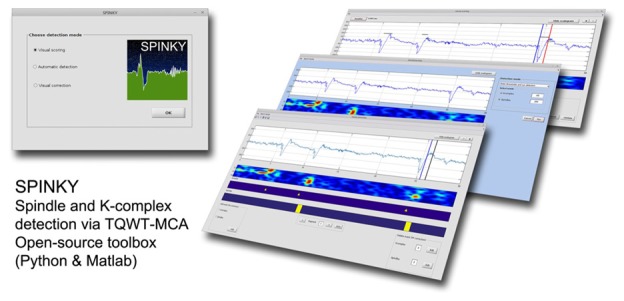
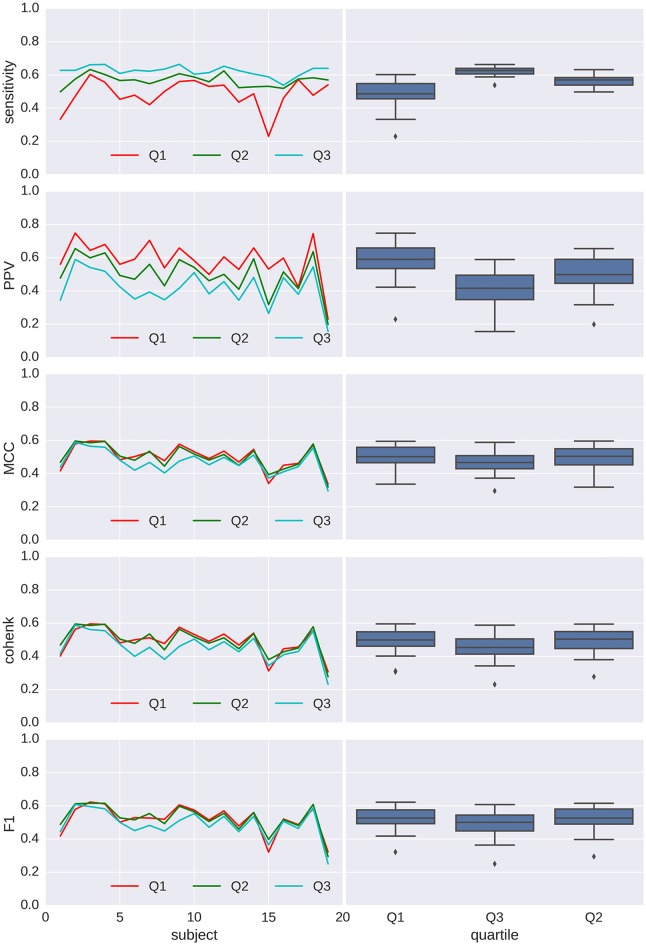
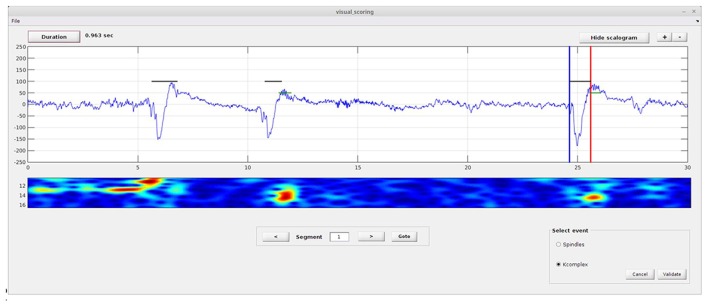
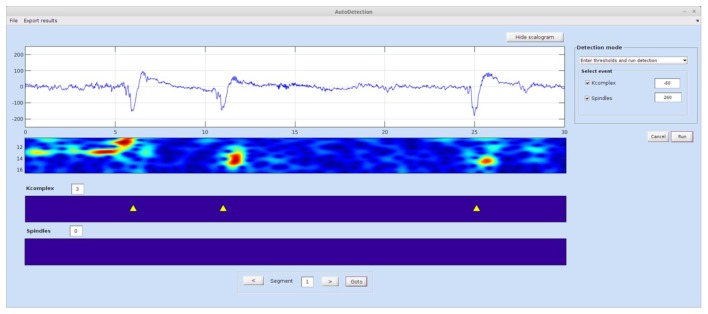
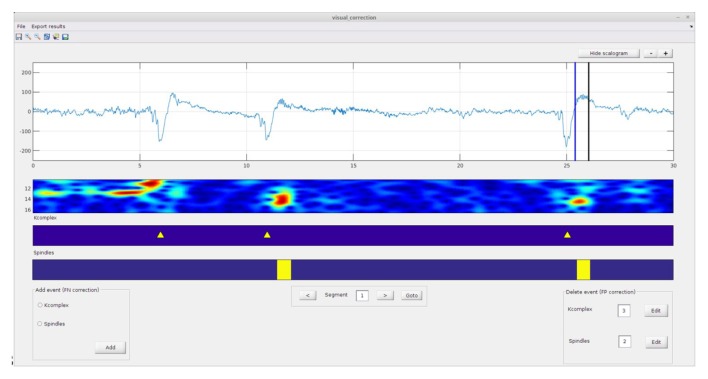
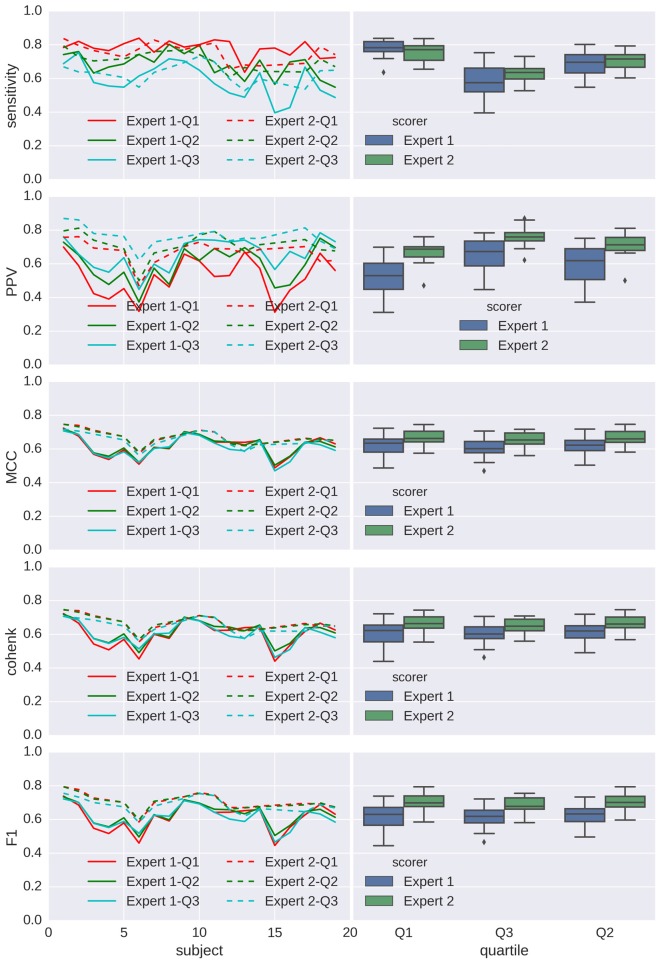
Sleep spindles and K-complexes are among the most prominent micro-events observed in electroencephalographic (EEG) recordings during sleep. These EEG microstructures are thought to be hallmarks of sleep-related cognitive processes. Although tedious and time-consuming, their identification and quantification is important for sleep studies in both healthy subjects and patients with sleep disorders. Therefore, procedures for automatic detection of spindles and K-complexes could provide valuable assistance to researchers and clinicians in the field. Recently, we proposed a framework for joint spindle and K-complex detection (Lajnef et al., 2015a) based on a Tunable Q-factor Wavelet Transform (TQWT; Selesnick, 2011a) and morphological component analysis (MCA). Using a wide range of performance metrics, the present article provides critical validation and benchmarking of the proposed approach by applying it to open-access EEG data from the Montreal Archive of Sleep Studies (MASS; O'Reilly et al., 2014). Importantly, the obtained scores were compared to alternative methods that were previously tested on the same database. With respect to spindle detection, our method achieved higher performance than most of the alternative methods. This was corroborated with statistic tests that took into account both sensitivity and precision (i.e., Matthew's coefficient of correlation (MCC), F1, Cohen κ). Our proposed method has been made available to the community via an open-source tool named Spinky (for spindle and K-complex detection). Thanks to a GUI implementation and access to Matlab and Python resources, Spinky is expected to contribute to an open-science approach that will enhance replicability and reliable comparisons of classifier performances for the detection of sleep EEG microstructure in both healthy and patient populations.
睡眠纺锤波和K复合波是睡眠期间脑电图(EEG)记录中观察到的最显著的微观事件。这些脑电图微观结构被认为是与睡眠相关的认知过程的标志。尽管识别和量化它们既繁琐又耗时,但对于健康受试者和睡眠障碍患者的睡眠研究来说都很重要。因此,自动检测纺锤波和K复合波的程序可以为该领域的研究人员和临床医生提供有价值的帮助。最近,我们基于可调Q因子小波变换(TQWT;Selesnick,2011a)和形态成分分析(MCA)提出了一种联合纺锤波和K复合波检测框架(Lajnef等人,2015a)。本文使用了广泛的性能指标,通过将其应用于蒙特利尔睡眠研究档案库(MASS;O'Reilly等人,2014)的开放获取脑电图数据,对所提出的方法进行了关键验证和基准测试。重要的是,将获得的分数与之前在同一数据库上测试的替代方法进行了比较。在纺锤波检测方面,我们的方法比大多数替代方法具有更高的性能。这通过考虑敏感性和精度的统计测试得到了证实(即马修斯相关系数(MCC)、F1、科恩κ)。我们提出的方法已通过一个名为Spinky(用于纺锤波和K复合波检测)的开源工具提供给社区。由于其图形用户界面(GUI)实现以及对Matlab和Python资源的访问,Spinky有望为一种开放科学方法做出贡献,这种方法将提高健康人群和患者人群中睡眠脑电图微观结构检测的分类器性能的可重复性和可靠比较。